
基于人工智能对前瞻性产科队列中的胎儿生长受限进行分析,可量化围产期发病和死亡的复合风险,并识别出先前未被认识到的高风险临床情况。
AI-based analysis of fetal growth restriction in a prospective obstetric cohort quantifies compound risks for perinatal morbidity and mortality and identifies previously unrecognized high risk clinical scenarios.
作者信息
Zimmerman Raquel M, Hernandez Edgar J, Yandell Mark, Tristani-Firouzi Martin, Silver Robert M, Grobman William, Haas David, Saade George, Steller Jonathan, Blue Nathan R
机构信息
University of Utah Health.
Brown University.
出版信息
Res Sq. 2024 Dec 16:rs.3.rs-5126218. doi: 10.21203/rs.3.rs-5126218/v1.
BACKGROUND
Fetal growth restriction (FGR) is a leading risk factor for stillbirth, yet the diagnosis of FGR confers considerable prognostic uncertainty, as most infants with FGR do not experience any morbidity. Our objective was to use data from a large, deeply phenotyped observational obstetric cohort to develop a probabilistic graphical model (PGM), a type of "explainable artificial intelligence (AI)", as a potential framework to better understand how interrelated variables contribute to perinatal morbidity risk in FGR.
METHODS
Using data from 9,558 pregnancies delivered at ≥ 20 weeks with available outcome data, we derived and validated a PGM using randomly selected sub-cohorts of 80% (n = 7645) and 20% (n = 1,912), respectively, to discriminate cases of FGR resulting in composite perinatal morbidity from those that did not. We also sought to identify context-specific risk relationships among inter-related variables in FGR. Performance was assessed as area under the receiver-operating characteristics curve (AUC).
RESULTS
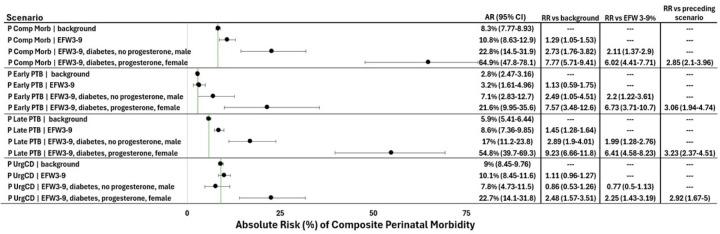
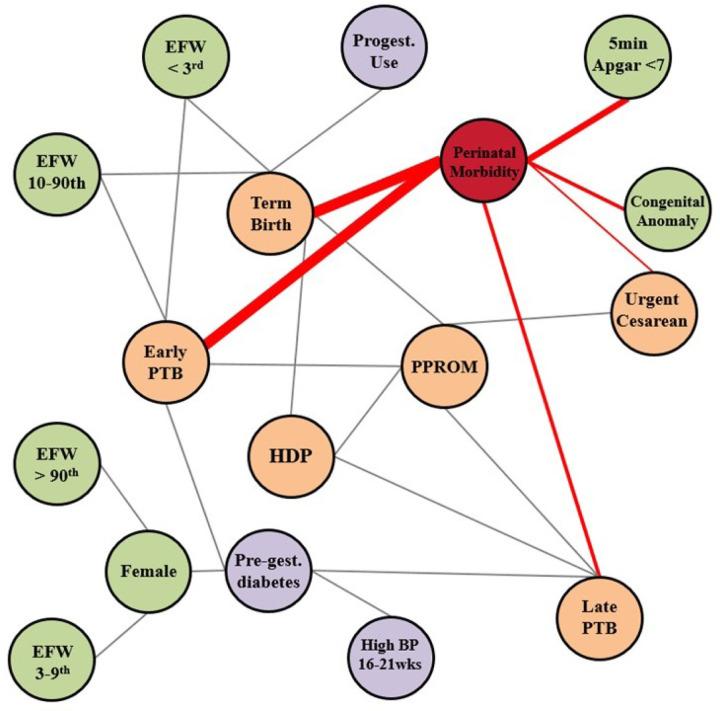
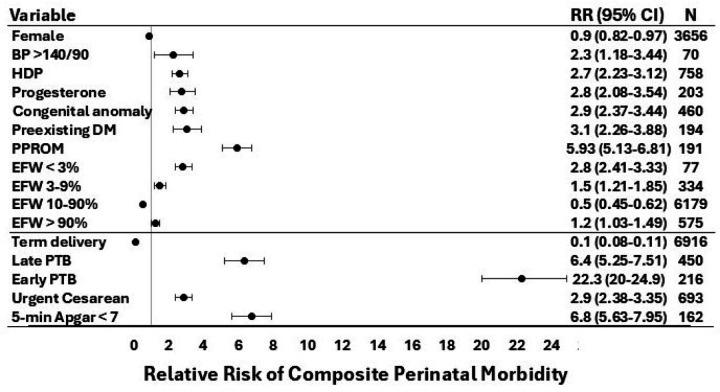
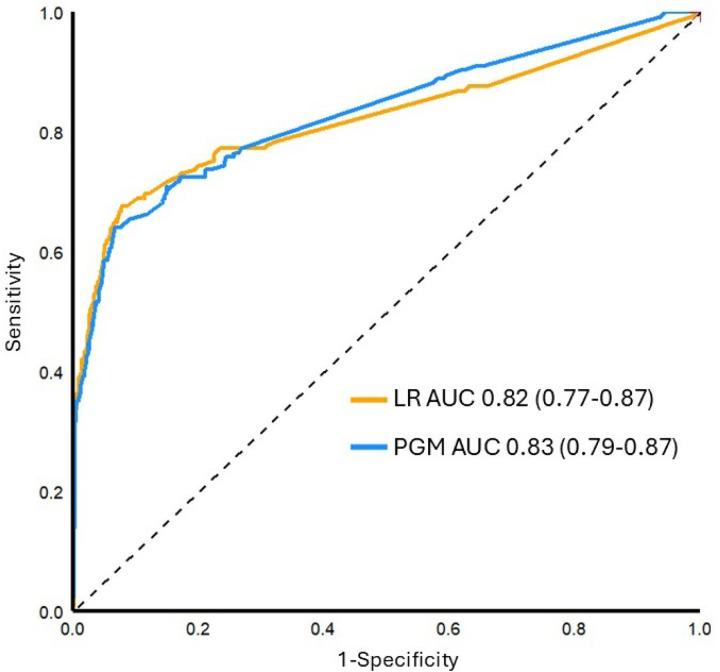
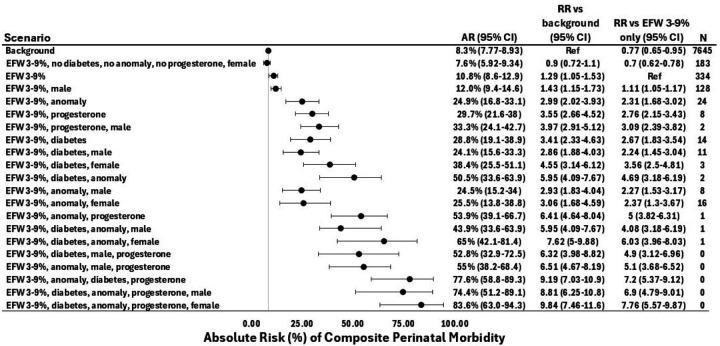
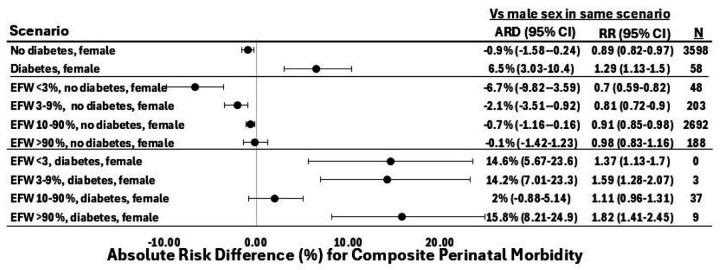
Feature selection identified the 16 most informative variables, which yielded a PGM with good overall performance in the validation cohort (AUC 0.83, 95% CI 0.79-0.87), including among "N of 1" unique scenarios (AUC 0.81, 0.72-0.90). Using the PGM, we identified FGR scenarios with a risk of perinatal morbidity no different from that of the cohort background (e.g. female fetus, estimated fetal weight (EFW) 3-9th percentile, no preexisting diabetes, no progesterone use; RR 0.9, 95% CI 0.7-1.1) alongside others that conferred a nearly 10-fold higher risk (female fetus, EFW 3-9th percentile, maternal preexisting diabetes, progesterone use; RR 9.8, 7.5-11.6). This led to the recognition of a PGM-identified latent interaction of fetal sex with preexisting diabetes, wherein the typical protective effect of female fetal sex was reversed in the presence of maternal diabetes.
CONCLUSIONS
PGMs are able to capture and quantify context-specific risk relationships in FGR and identify latent variable interactions that are associated with large differences in risk. FGR scenarios that are separated by nearly 10-fold perinatal morbidity risk would be managed similarly under current FGR clinical guidelines, highlighting the need for more precise approaches to risk estimation in FGR.
背景
胎儿生长受限(FGR)是死产的主要危险因素,然而FGR的诊断存在相当大的预后不确定性,因为大多数FGR婴儿并未出现任何发病情况。我们的目标是利用来自一个大型、深度表型观察性产科队列的数据,开发一种概率图形模型(PGM),一种“可解释人工智能(AI)”类型,作为一个潜在框架,以更好地理解相互关联的变量如何影响FGR围产期发病风险。
方法
利用9558例孕20周及以上分娩且有可用结局数据的妊娠数据,我们分别使用80%(n = 7645)和20%(n = 1912)的随机选择子队列推导并验证了一个PGM,以区分导致复合围产期发病的FGR病例和未导致发病的病例。我们还试图确定FGR中相互关联变量之间特定背景下的风险关系。性能评估采用受试者操作特征曲线下面积(AUC)。
结果
特征选择确定了16个信息最丰富的变量,由此产生的PGM在验证队列中具有良好的总体性能(AUC 0.83,95% CI 0.79 - 0.87),包括在“单病例”独特场景中(AUC 0.81,0.72 - 0.90)。使用PGM,我们确定了围产期发病风险与队列背景无异的FGR场景(例如女胎、估计胎儿体重(EFW)处于第3至9百分位、无既往糖尿病史、未使用孕激素;RR 0.9,95% CI 0.7 - 1.1)以及其他风险高出近10倍的场景(女胎、EFW处于第3至9百分位、母亲有既往糖尿病史、使用孕激素;RR 9.8, 7.5 - 11.6)。这使得人们认识到PGM识别出的胎儿性别与既往糖尿病之间的潜在相互作用,即在母亲患有糖尿病的情况下女胎通常的保护作用会逆转。
结论
PGM能够捕捉并量化FGR中特定背景下的风险关系,并识别与风险差异巨大相关的潜在变量相互作用。在当前FGR临床指南下,围产期发病风险相差近10倍的FGR场景会得到相似的处理,这凸显了在FGR中需要更精确的风险评估方法。

 Zotero 插件