
OSI-027作为靶向鼻鼻窦鳞状细胞癌潜在机制中上调的核心蛋白TAF1的潜在候选药物:蛋白质组学和分子对接的见解
OSI-027 as a Potential Drug Candidate Targeting Upregulated Hub Protein TAF1 in Potential Mechanism of Sinonasal Squamous Cell Carcinoma: Insights from Proteomics and Molecular Docking.
作者信息
Panthong Watcharapong, Pientong Chamsai, Nukpook Thawaree, Heawchaiyaphum Chukkris, Aromseree Sirinart, Ekalaksananan Tipaya
机构信息
Department of Microbiology, Faculty of Medicine, Khon Kaen University, Khon Kaen 40002, Thailand.
HPV&EBV and Carcinogenesis (HEC) Research Group, Faculty of Medicine, Khon Kaen University, Khon Kaen 40002, Thailand.
出版信息
Biology (Basel). 2024 Dec 23;13(12):1089. doi: 10.3390/biology13121089.
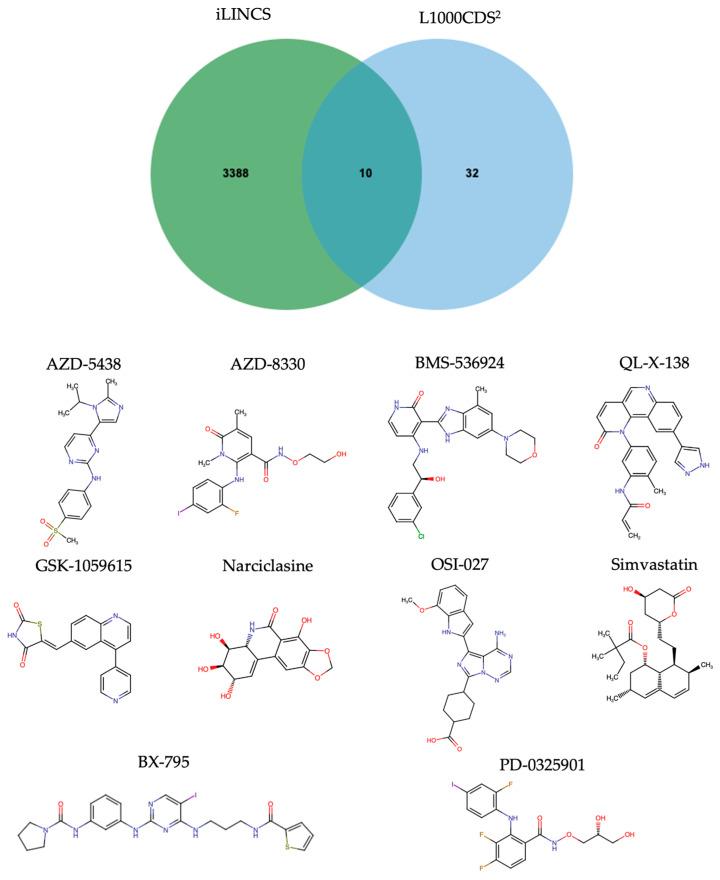
Sinonasal squamous cell carcinoma (SNSCC) is a rare tumor with high mortality and recurrence rates. However, SNSCC carcinogenesis mechanisms and potential therapeutic drugs have not been fully elucidated. This study investigated the key molecular mechanisms and hub proteins involved in SNSCC carcinogenesis using proteomics and bioinformatic analysis. Dysregulated proteins were validated by RT-qPCR in SNSCC and nasal polyp (NP) tissues. Proteomic analysis revealed that differentially expressed proteins were clustered using MCODE scores ≥ 4 into three modules. The specific hub proteins in each module were analyzed in carcinogenesis pathways using STRING, highlighting potential mechanisms of histone modification and spliceosome dysregulation. Spliceosome components SNRNP200 and SF3A3 were significantly downregulated in SNSCC by RT-qPCR. Web-based applications L1000CDS and iLINCS were applied to identify 10 potential repurposable drugs that could reverse the gene expression pattern associated with SNSCC. Docking studies of TAF1, a protein in histone modification, with these 10 small molecule inhibitors indicated OSI-027 to be the most promising due to its strong binding interactions with key residues. These findings suggest that hub proteins involved in the underlying mechanism of SNSCC carcinogenesis may serve as valuable targets for drug development, with OSI-027 emerging as a novel candidate against TAF1 in SNSCC.
鼻窦鳞状细胞癌(SNSCC)是一种死亡率和复发率都很高的罕见肿瘤。然而,SNSCC的致癌机制和潜在治疗药物尚未完全阐明。本研究利用蛋白质组学和生物信息学分析,研究了SNSCC致癌过程中涉及的关键分子机制和核心蛋白。通过RT-qPCR在SNSCC和鼻息肉(NP)组织中验证了失调的蛋白质。蛋白质组学分析显示,使用MCODE评分≥4将差异表达的蛋白质聚类为三个模块。使用STRING在致癌途径中分析每个模块中的特定核心蛋白,突出了组蛋白修饰和剪接体失调的潜在机制。通过RT-qPCR发现剪接体成分SNRNP200和SF3A3在SNSCC中显著下调。应用基于网络的应用程序L1000CDS和iLINCS来识别10种可能可重新利用的药物,这些药物可以逆转与SNSCC相关的基因表达模式。对组蛋白修饰中的一种蛋白质TAF1与这10种小分子抑制剂进行对接研究,结果表明OSI-027由于其与关键残基的强结合相互作用而最具前景。这些发现表明,参与SNSCC致癌潜在机制的核心蛋白可能成为药物开发的有价值靶点,OSI-027作为一种针对SNSCC中TAF1的新型候选药物而出现。


 Zotero 插件