
关于新冠病毒感染作为肺癌危险因素的可能性及作为联系的常见分子途径的模棱两可与深思熟虑
Equivocating and Deliberating on the Probability of COVID-19 Infection Serving as a Risk Factor for Lung Cancer and Common Molecular Pathways Serving as a Link.
作者信息
Amara Abdelbasset, Trabelsi Saoussen, Hai Abdul, Zaidi Syeda Huma H, Siddiqui Farah, Alsaeed Sami
机构信息
Department of Medical Laboratory Technology, Faculty of Applied Medical Sciences, Northern Border University, Arar 91431, Saudi Arabia.
Center for Health Research, Northern Border University, Arar 91431, Saudi Arabia.
出版信息
Pathogens. 2024 Dec 6;13(12):1070. doi: 10.3390/pathogens13121070.
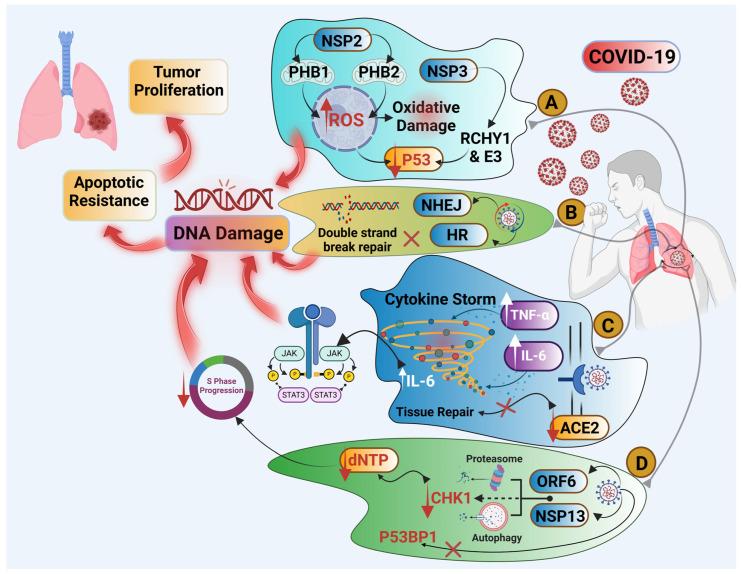
The COVID-19 infection caused by SARS-CoV-2 in late 2019 posed unprecedented global health challenges of massive proportions. The persistent effects of COVID-19 have become a subject of significant concern amongst the medical and scientific community. This article aims to explore the probability of a link between the COVID-19 infection and the risk of lung cancer development. First, this article reports that SARS-CoV-2 induces severe inflammatory response and cellular stress, potentially leading to tumorigenesis through common pathways between SARS-CoV-2 infection and cancer. These pathways include the JAK/STAT3 pathway which is activated after the initiation of cytokine storm following SARS-CoV-2 infection. This pathway is involved in cellular proliferation, differentiation, and immune homeostasis. The JAK/STAT3 pathway is also hyperactivated in lung cancer which serves as a link thereof. It predisposes patients to lung cancer through myriad molecular mechanisms such as DNA damage, genomic instability, and cell cycle dysregulation. Another probable pathway to tumorigenesis is based on the possibility of an oncogenic nature of SARS-CoV-2 through hijacking the p53 protein, leading to cell oxidative stress and interfering with the DNA repair mechanisms. Finally, this article highlights the overexpression of the SLC22A18 gene in lung cancer. This gene can be overexpressed by the ZEB1 transcription factor, which was found to be highly expressed during COVID-19 infection.
2019年末由严重急性呼吸综合征冠状病毒2(SARS-CoV-2)引起的新型冠状病毒肺炎(COVID-19)感染带来了规模巨大、前所未有的全球健康挑战。COVID-19的持续影响已成为医学界和科学界极为关注的话题。本文旨在探讨COVID-19感染与肺癌发生风险之间存在关联的可能性。首先,本文报道SARS-CoV-2会引发严重的炎症反应和细胞应激,可能通过SARS-CoV-2感染与癌症之间的共同途径导致肿瘤发生。这些途径包括JAK/STAT3途径,该途径在SARS-CoV-2感染引发细胞因子风暴后被激活。此途径参与细胞增殖、分化和免疫稳态。JAK/STAT3途径在肺癌中也过度激活,这成为了两者之间的一个联系。它通过DNA损伤、基因组不稳定和细胞周期失调等多种分子机制使患者易患肺癌。另一条可能的肿瘤发生途径基于SARS-CoV-2具有致癌性的可能性,即通过劫持p53蛋白,导致细胞氧化应激并干扰DNA修复机制。最后,本文强调了SLC22A18基因在肺癌中的过度表达。该基因可由ZEB1转录因子过度表达,而ZEB1转录因子在COVID-19感染期间被发现高表达。
 Zotero 插件