
评估单侧乳房切除术后乳腺癌患者的身体意象障碍及其影响因素。
Evaluating Body Image Disturbance and Its Influencing Factors in Breast Cancer Patients Following Unilateral Mastectomy.
作者信息
Xu Weidan, Zhou Liuyin, Zhao Chaofu, Zhou Yi, Chen Shuzheng, Yang Li
机构信息
Department of Operating Room, the Fifth Affiliated Hospital of Wenzhou Medical University, Lishui Central Hospital, Lishui, China.
Department of Breast Surgery, the Fifth Affiliated Hospital of Wenzhou Medical University, Lishui Central Hospital, Lishui, China.
出版信息
Psychiatry Clin Psychopharmacol. 2024 Dec 17;34(4):328-335. doi: 10.5152/pcp.2024.24953.
BACKGROUND
Patients with unilateral breast loss after single mastectomy for breast cancer may have body image disorders such as surgical lymphedema, flap ischemia, and spinal deformity, resulting in negative emotions such as depression, inferiority, and social dysfunction. This study mainly investigated and analyzed the status quo and influencing factors of body image disorder in breast cancer patients after single mastectomy.
METHODS
This study is a cross-sectional study. Breast cancer patients admitted from May 2023 to April 2024 were selected as the research subjects. Data were collected with a general information questionnaire, the Body Image Scale (BIS), the Self-Image Scale, the Self-Acceptance Questionnaire, and the Perceived Social Support Scale. Based on the scores, the research subjects were divided into a body image disturbance group and a non-disturbance group. Univariate and multiple logistic regression analyses were conducted to analyze the influencing factors of body image disturbances in breast cancer patients.
RESULTS
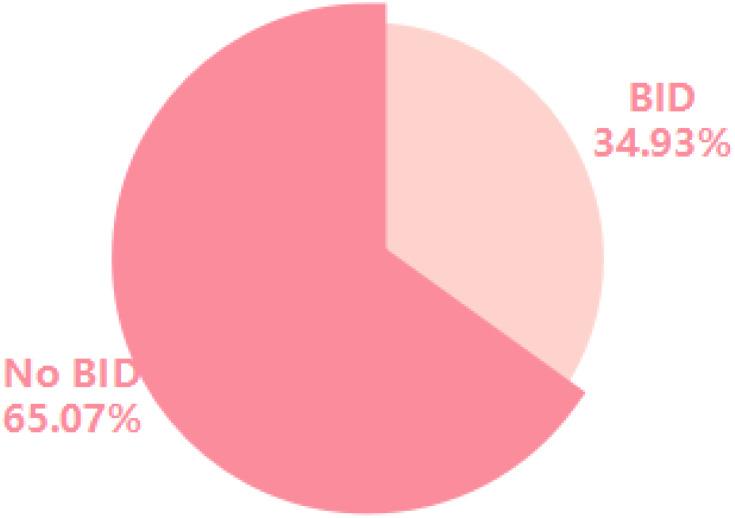
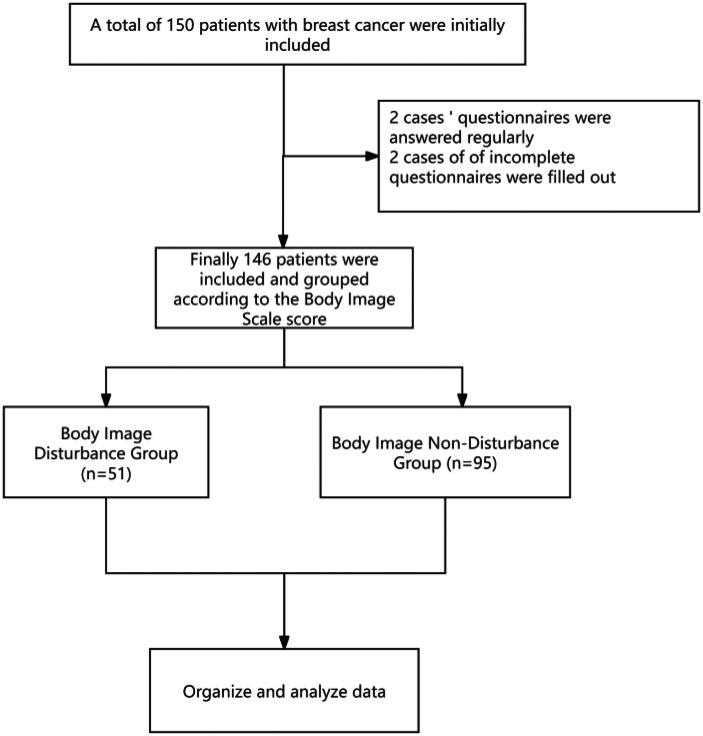
One hundred fifty questionnaires were distributed in this study, and 146 valid questionnaires were collected. Among the 146 patients, 51 (34.93%) experienced body image disturbances after surgery, while 95 (65.07%) did not. The results of univariate and multiple logistic regression analyses showed that educational level, lymphedema in the affected limb, intimate relationships, self-image, self-acceptance, and perceived social support scores were independent risk factors for body image disturbances in breast cancer patients after surgery (P < .05).
CONCLUSION
Body image disturbances in breast cancer patients who undergo unilateral mastectomy need further improvement. Educational level, lymphedema in the affected limb, intimate relationships, self-image, self-acceptance, and perceived social support are the main influencing factors.
背景
因乳腺癌行单侧乳房切除术后的患者可能会出现手术性淋巴水肿、皮瓣缺血和脊柱畸形等身体形象障碍,从而导致抑郁、自卑和社交功能障碍等负面情绪。本研究主要调查分析了单侧乳房切除术后乳腺癌患者身体形象障碍的现状及影响因素。
方法
本研究为横断面研究。选取2023年5月至2024年4月收治的乳腺癌患者作为研究对象。采用一般资料问卷、身体意象量表(BIS)、自我意象量表、自我接纳问卷和领悟社会支持量表收集资料。根据得分将研究对象分为身体形象障碍组和非障碍组。进行单因素和多因素logistic回归分析,以分析乳腺癌患者身体形象障碍的影响因素。
结果
本研究共发放问卷150份,回收有效问卷146份。在146例患者中,51例(34.93%)术后出现身体形象障碍,95例(65.07%)未出现。单因素和多因素logistic回归分析结果显示,文化程度、患侧肢体淋巴水肿、亲密关系、自我意象、自我接纳和领悟社会支持得分是乳腺癌患者术后身体形象障碍的独立危险因素(P<0.05)。
结论
单侧乳房切除术后乳腺癌患者的身体形象障碍情况有待进一步改善。文化程度、患侧肢体淋巴水肿、亲密关系、自我意象、自我接纳和领悟社会支持是主要影响因素。
 Zotero 插件