
三种冷冻疗法对全膝关节置换术后早期疼痛控制的疗效及患者满意度比较:一项随机对照试验
Comparison of three cryotherapy techniques for early post-TKA pain control in terms of efficacy and patient satisfaction: a randomized controlled trial.
作者信息
Chareancholvanich Keerati, Keesukpunt Worawut, Pornrattanamaneewong Chaturong, Narkbunnam Rapeepat, Jarusriwanna Atthakorn
机构信息
Department of Orthopaedic Surgery, Faculty of Medicine Siriraj Hospital, Mahidol University, 2 Wang Lang Road, Siriraj, Bangkok Noi, Bangkok, 10700, Thailand.
Bone and Joint Center, Thonburi Hospital, 34/1 Soi Itsaraphap 44, Ban Chang Lo, Bangkok Noi, Bangkok, 10700, Thailand.
出版信息
Arthroplasty. 2025 Jan 8;7(1):5. doi: 10.1186/s42836-024-00287-7.
BACKGROUND
Cryotherapy is a non-pharmacological option that complements drug therapy to achieve the most comprehensive multimodal analgesia. Various techniques are currently available, including the conventional gel cold pack, the cryo-cuff, and a novel mobile cold compression device (MCCD). This study aimed to evaluate and compare three cryotherapy techniques in terms of efficacy and patient satisfaction in patients undergoing total knee arthroplasty (TKA).
METHODS
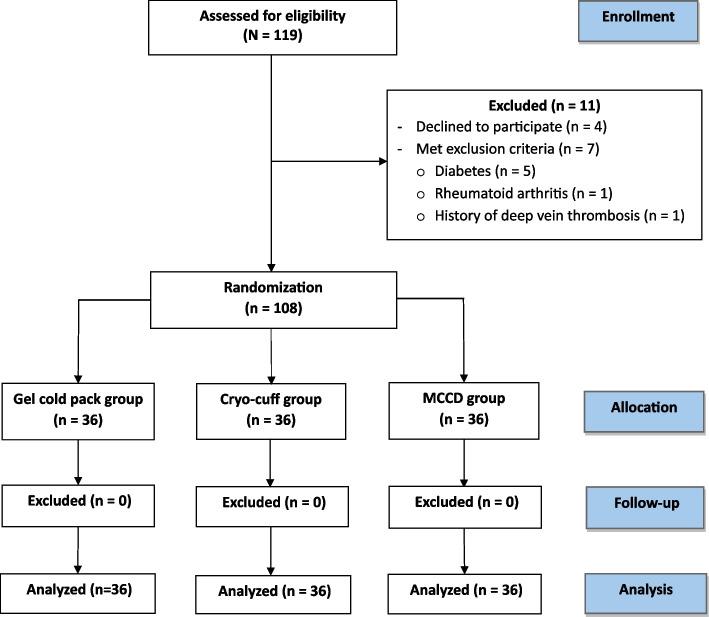
This prospective randomized study included 108 patients who were scheduled for primary unilateral TKA. The patients were allocated to 3 groups for postoperative cryotherapy techniques: gel cold pack, cryo-cuff, and MCCD. Scores on the visual analog scale (VAS) for pain intensity, morphine consumption, knee range of motion (ROM), knee swelling, length of hospital stay, and patient satisfaction were collected.
RESULTS
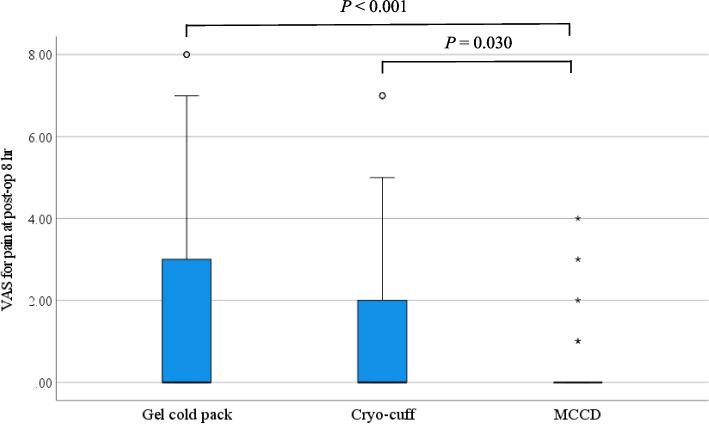
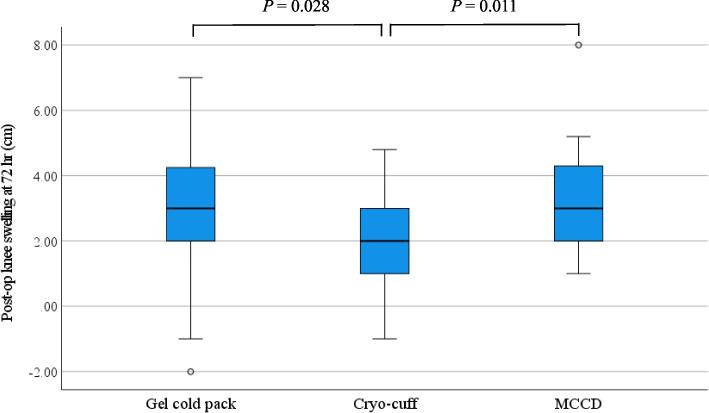
Postoperative VAS scores showed a significant difference among the groups at 8 and 72 h after surgery (P = 0.002 and 0.026, respectively). At the earliest postoperative time point, post hoc analysis demonstrated that patients in the MCCD group had lower pain scores than those in the gel cold pack (P < 0.001) and the cryo-cuff group (P = 0.030). However, cryo-cuff reduced knee swelling significantly compared to gel cold pack (P = 0.028) and MCCD (P = 0.011) at postoperative 72 h. The total satisfaction score was 86.8, 82.8, and 89.1 with gel cold pack, cryo-cuff, and MCCD, respectively.
CONCLUSIONS
Cryotherapy is an adjunct to post-TKA pain control at the surgical site. MCCD has shown superior efficacy in pain reduction during the earliest postoperative period, and achieved high patient satisfaction.
TRIAL REGISTRATION
This study was registered in the Thai Clinical Trials Registry database (no. TCTR20200517002).
背景
冷冻疗法是一种非药物治疗选择,可辅助药物治疗以实现最全面的多模式镇痛。目前有多种技术可供选择,包括传统的凝胶冷敷袋、冷冻袖带和一种新型的移动冷压缩装置(MCCD)。本研究旨在评估和比较三种冷冻疗法技术在全膝关节置换术(TKA)患者中的疗效和患者满意度。
方法
这项前瞻性随机研究纳入了108例计划进行初次单侧TKA的患者。患者被分为3组接受术后冷冻疗法技术:凝胶冷敷袋、冷冻袖带和MCCD。收集疼痛强度视觉模拟量表(VAS)评分、吗啡用量、膝关节活动范围(ROM)、膝关节肿胀情况、住院时间和患者满意度。
结果
术后VAS评分在术后8小时和72小时时组间存在显著差异(分别为P = 0.002和0.026)。在最早的术后时间点,事后分析表明MCCD组患者的疼痛评分低于凝胶冷敷袋组(P < 0.001)和冷冻袖带组(P = 0.030)。然而,在术后72小时时,与凝胶冷敷袋(P = 0.028)和MCCD(P = 0.011)相比,冷冻袖带显著减轻了膝关节肿胀。凝胶冷敷袋、冷冻袖带和MCCD的总满意度评分分别为86.8、82.8和89.1。
结论
冷冻疗法是TKA术后手术部位疼痛控制的辅助手段。MCCD在术后最早阶段显示出更好的镇痛效果,并获得了较高的患者满意度。
试验注册
本研究已在泰国临床试验注册数据库中注册(编号TCTR20200517002)。



 Zotero 插件