
酸性鞘磷脂酶缺乏症和戈谢病:瘦人肝肿大、脾肿大及高密度脂蛋白胆固醇降低的诊断不足且常可治疗的病因。
Acid sphingomyelinase deficiency and Gaucher disease: Underdiagnosed and often treatable causes of hepatomegaly, splenomegaly, and low HDL cholesterol in lean individuals.
作者信息
Mistry Pramod K, Cassiman David, Jones Simon A, Lachmann Robin, Lukina Elena, Prada Carlos E, Wasserstein Melissa P, Thurberg Beth L, Foster Meredith C, Patel Reema M, Underhill Lisa H, Peterschmitt M Judith
机构信息
Department of Internal Medicine, Yale University School of Medicine, New Haven, Connecticut, USA.
Department of Gastroenterology-Hepatology, University Hospitals Leuven, Leuven, Belgium.
出版信息
Hepatol Commun. 2025 Jan 7;9(1). doi: 10.1097/HC9.0000000000000621. eCollection 2025 Jan 1.
BACKGROUND
Acid sphingomyelinase deficiency (ASMD) and Gaucher disease type 1 (GD1) are rare inherited sphingolipid disorders with multisystemic manifestations, including liver disease and dyslipidemia. Despite effective treatments, insufficient disease awareness frequently results in diagnostic delays during which irreversible complications occur. We delineated the shared and distinctive features of hepatic, splenic, and lipoprotein phenotypes in ASMD and GD1.
METHODS
We analyzed baseline hepatic, splenic, and lipoprotein phenotypes of untreated adults in pivotal trials of ASMD (ASCEND, N=36) and GD1 (ENGAGE, N=40).
RESULTS
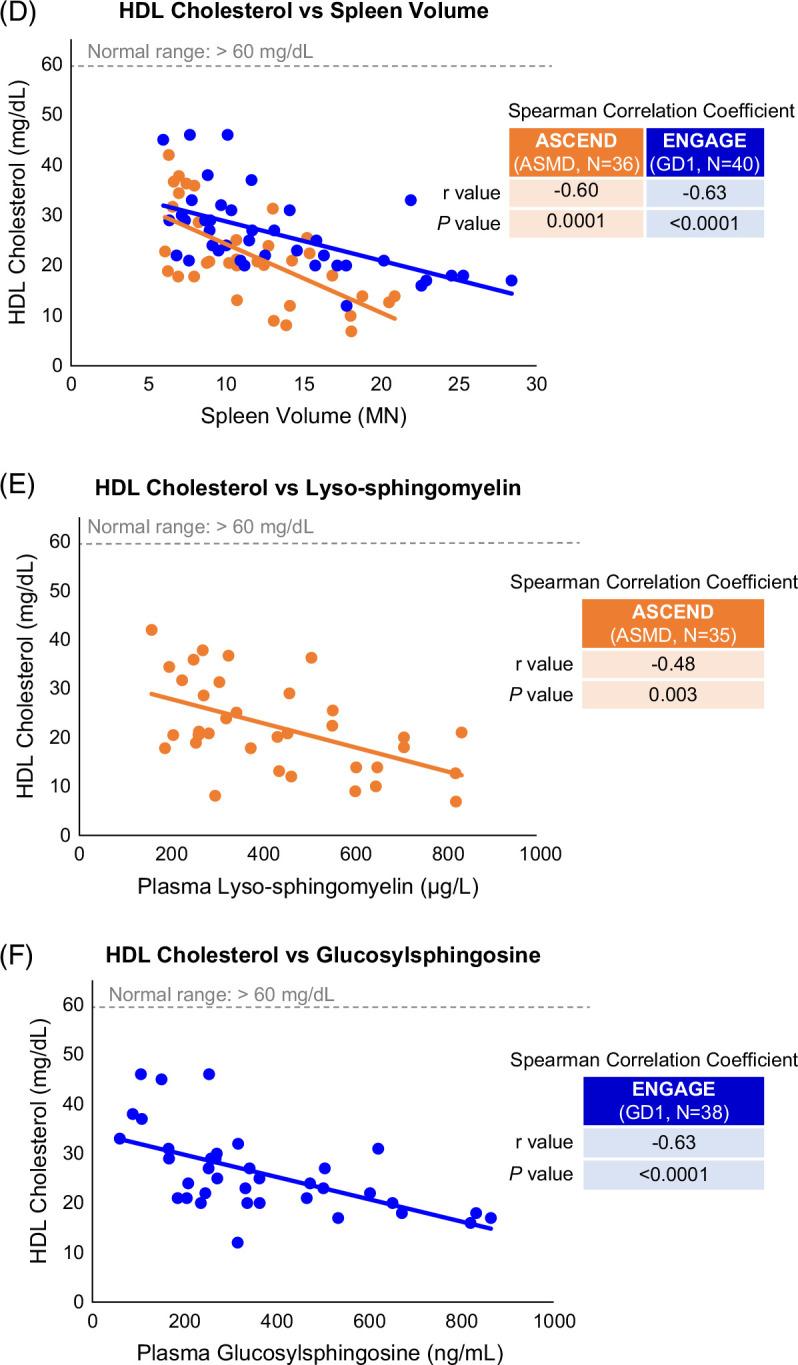
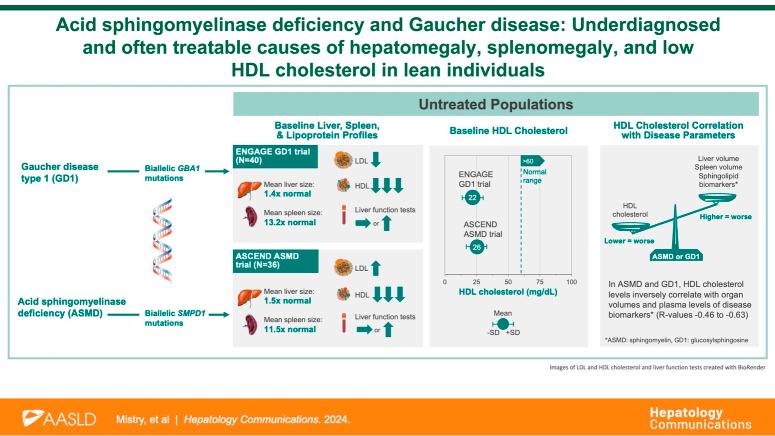
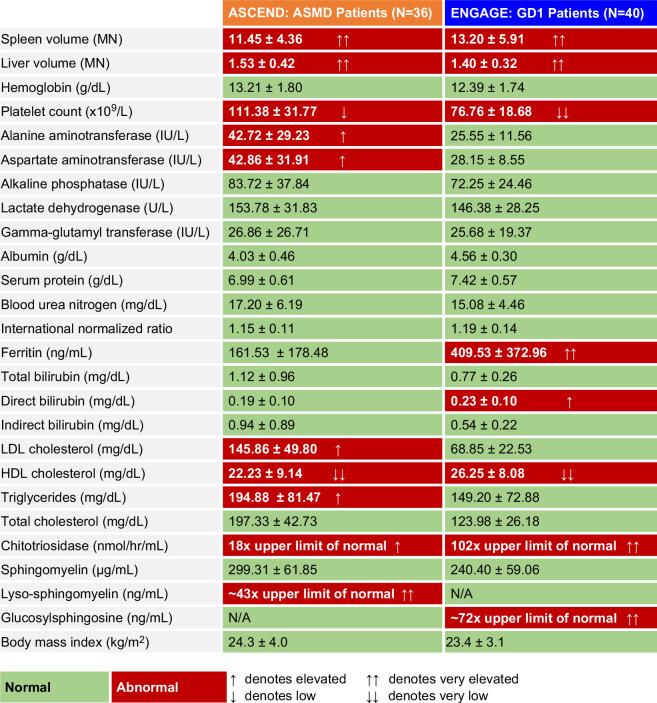
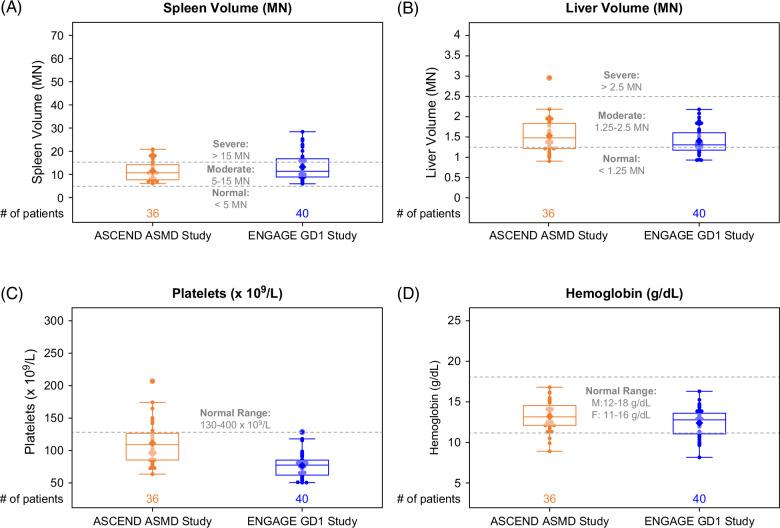
The mean cohort ages were 34.8 years in ASMD and 31.8 years in GD1. Most patients had normal or low body mass index. Moderate hepatosplenomegaly (mean volume in multiples of normal) was common in both cohorts (hepatomegaly 1.53±0.42 and 1.40±0.32, respectively; splenomegaly 11.45±4.36 and 13.20±5.91, respectively). Liver function tests were mildly elevated in ASMD but normal in GD1. In both disorders, mean HDL cholesterol (mg/dL) was profoundly low (22.23±9.14 ASMD; 26.25±8.08 GD1) and correlated inversely with liver volume (r=-0.45 ASMD, p=0.005; r=-0.50 GD1, p=0.001) and spleen volume (r=-0.60 ASMD, p=0.0001; r=-0.63 GD1, p<0.0001). Mean LDL cholesterol (mg/dL) was elevated in ASMD (145.86±49.80) but low in GD1 (68.85±22.53). HDL cholesterol correlated inversely with serum concentrations of lyso-sphingomyelin in ASMD (r=-0.48, p=0.003) and glucosylsphingosine in GD1 (r=-0.63, p<0.0001).
CONCLUSIONS
ASMD and GD1 should be considered in differential diagnosis of patients with unexplained liver and lipid abnormalities, especially young, lean adults with very low HDL and hepatosplenomegaly. HDL emerged as a potential biomarker of disease activity in these sphingolipid disorders.
背景
酸性鞘磷脂酶缺乏症(ASMD)和1型戈谢病(GD1)是罕见的遗传性鞘脂紊乱疾病,具有多系统表现,包括肝脏疾病和血脂异常。尽管有有效的治疗方法,但疾病认知不足常常导致诊断延迟,在此期间会发生不可逆的并发症。我们描述了ASMD和GD1在肝脏、脾脏和脂蛋白表型方面的共同特征和独特特征。
方法
我们分析了ASMD(ASCEND,N = 36)和GD1(ENGAGE,N = 40)关键试验中未治疗成年人的基线肝脏、脾脏和脂蛋白表型。
结果
ASMD队列的平均年龄为34.8岁,GD1队列的平均年龄为31.8岁。大多数患者的体重指数正常或偏低。两个队列中均常见中度肝脾肿大(平均体积为正常倍数)(肝肿大分别为1.53±0.42和1.40±0.32;脾肿大分别为11.45±4.36和13.20±5.91)。ASMD患者的肝功能检查轻度升高,但GD1患者正常。在这两种疾病中,平均高密度脂蛋白胆固醇(mg/dL)极低(ASMD为22.23±9.14;GD1为26.25±8.08),且与肝脏体积呈负相关(ASMD中r = -0.45,p = 0.005;GD1中r = -0.50,p = 0.001)以及脾脏体积呈负相关(ASMD中r = -0.60,p = 0.0001;GD1中r = -0.63,p < 0.0001)。ASMD患者的平均低密度脂蛋白胆固醇(mg/dL)升高(145.86±49.80),而GD1患者则偏低(68.85±22.53)。在ASMD中,高密度脂蛋白胆固醇与溶血鞘磷脂的血清浓度呈负相关(r = -0.48,p = 0.003),在GD1中与葡萄糖神经鞘脂呈负相关(r = -0.63,p < 0.0001)。
结论
对于原因不明的肝脏和脂质异常患者,尤其是年轻、体型偏瘦且高密度脂蛋白极低以及肝脾肿大的成年人,鉴别诊断时应考虑ASMD和GD1。在这些鞘脂紊乱疾病中,高密度脂蛋白成为疾病活动的潜在生物标志物。



 Zotero 插件