
高敏肌钙蛋白T在急性肺栓塞患者中的预测价值及最佳临界值
Predictive value and optimal cut-off level of high-sensitivity troponin T in patients with acute pulmonary embolism.
作者信息
Kim Moojun, Seo Chang-Ok, Kim Yong-Lee, Kim Hangyul, Kim Hye Ree, Cho Yun Ho, Jang Jeong Yoon, Ahn Jong-Hwa, Kang Min Gyu, Kim Kyehwan, Koh Jin-Sin, Hwang Seok-Jae, Hwang Jin Yong, Park Jeong Rang
机构信息
Division of Cardiology, Department of Internal Medicine, Gyeongsang National University Hospital, Gyeongsang National University School of Medicine, Jinju, Korea.
Department of Internal Medicine, Cardiovascular Center, Gyeongsang National University Changwon Hospital, Gyeongsang National University School of Medicine, Changwon, Korea.
出版信息
Korean J Intern Med. 2025 Jan;40(1):65-77. doi: 10.3904/kjim.2024.131. Epub 2025 Jan 1.
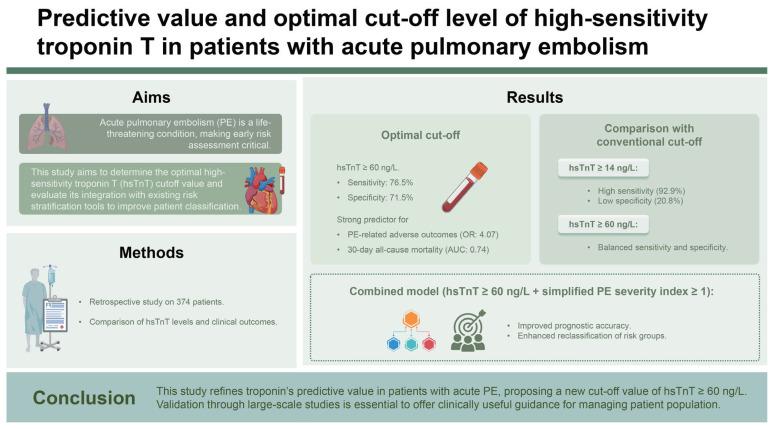
BACKGROUND/AIMS: Elevated troponin levels predict in-hospital mortality and influence decisions regarding thrombolytic therapy in patients with acute pulmonary embolism (PE). However, the usefulness of high-sensitivity troponin T (hsTnT) regarding PE remains uncertain. We aimed to establish the optimal cut-off level and compare its performance for precise risk stratification.
METHODS
374 patients diagnosed with acute PE were reviewed. PE-related adverse outcomes, a composite of PE-related deaths, cardiopulmonary resuscitation incidents, systolic blood pressure < 90 mmHg, and all-cause mortality within 30 days were evaluated. The optimal hsTnT cut-off for all-cause mortality, and the net reclassification index (NRI) was used to assess the incremental value in risk stratification.
RESULTS
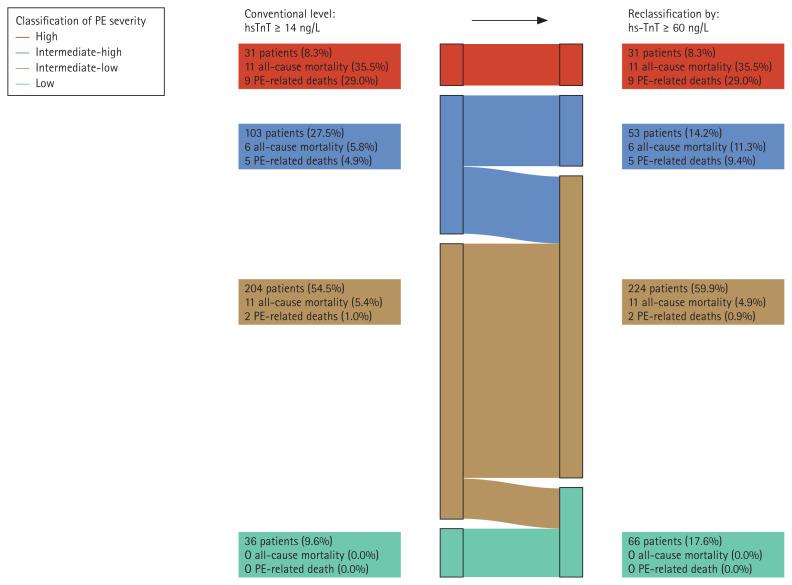
Among 343 normotensive patients, 17 (5.0%) experienced all-cause mortality, while 40 (10.7%) had PE-related adverse outcomes. An optimal hsTnT cut-off value of 60 ng/L for all-cause mortality (AUC 0.74, 95% CI 0.61-0.85, p < 0.001) was identified, which was significantly associated with PE-related adverse outcomes (OR 4.07, 95% CI 2.06-8.06, p < 0.001). Patients with hsTnT ≥ 60 ng/L were older, hypotensive, had higher creatinine levels, and right ventricular dysfunction signs. Combining hsTnT ≥ 60 ng/L with simplified pulmonary embolism severity index ≥1 provided additional prognostic information. Reclassification analysis showed a significant shift in risk categories, with an NRI of 1.016 ± 0.201 (p < 0.001).
CONCLUSION
We refined troponin's predictive value in patients with acute PE, proposing a new cut-off value of hsTnT ≥ 60 ng/L. Validation through large-scale studies is essential to offer clinically useful guidance for managing patient population.
背景/目的:肌钙蛋白水平升高可预测急性肺栓塞(PE)患者的院内死亡率,并影响溶栓治疗决策。然而,高敏肌钙蛋白T(hsTnT)对PE的诊断价值仍不明确。我们旨在确定最佳临界值,并比较其在精确风险分层中的表现。
方法
回顾性分析374例急性PE患者。评估PE相关不良结局,包括PE相关死亡、心肺复苏事件、收缩压<90 mmHg以及30天内全因死亡率的综合情况。确定全因死亡率的最佳hsTnT临界值,并使用净重新分类指数(NRI)评估风险分层中的增加值。
结果
在343例血压正常的患者中,17例(5.0%)发生全因死亡,40例(10.7%)出现PE相关不良结局。确定全因死亡率的最佳hsTnT临界值为60 ng/L(AUC 0.74,95% CI 0.61 - 0.85,p < 0.001),这与PE相关不良结局显著相关(OR 4.07,95% CI 2.06 - 8.06,p < 0.001)。hsTnT≥60 ng/L的患者年龄较大、血压较低、肌酐水平较高且有右心室功能障碍体征。将hsTnT≥60 ng/L与简化肺栓塞严重程度指数≥1相结合可提供额外的预后信息。重新分类分析显示风险类别有显著变化,NRI为1.016±0.201(p < 0.001)。
结论
我们细化了肌钙蛋白在急性PE患者中的预测价值,提出hsTnT≥60 ng/L的新临界值。通过大规模研究进行验证对于为患者群体管理提供临床有用指导至关重要。


 Zotero 插件