
一个错失的机会?探索新冠疫情期间流感疫苗接种覆盖率的变化:来自全球12个国家的数据
A Missed Opportunity? Exploring Changes in Influenza Vaccination Coverage During the COVID-19 Pandemic: Data From 12 Countries Worldwide.
作者信息
Del Riccio Marco, Guida Andrea, Boudewijns Bronke, Heemskerk Susanne, van Summeren Jojanneke, Schneeberger Caroline, Stelma Foekje, van der Velden Koos, Timen Aura, Caini Saverio
机构信息
Department of Health Sciences, University of Florence, Florence, Italy.
Department of Primary and Community Care, Radboud University Medical Centre, Nijmegen, The Netherlands.
出版信息
Influenza Other Respir Viruses. 2025 Jan;19(1):e70057. doi: 10.1111/irv.70057.
BACKGROUND
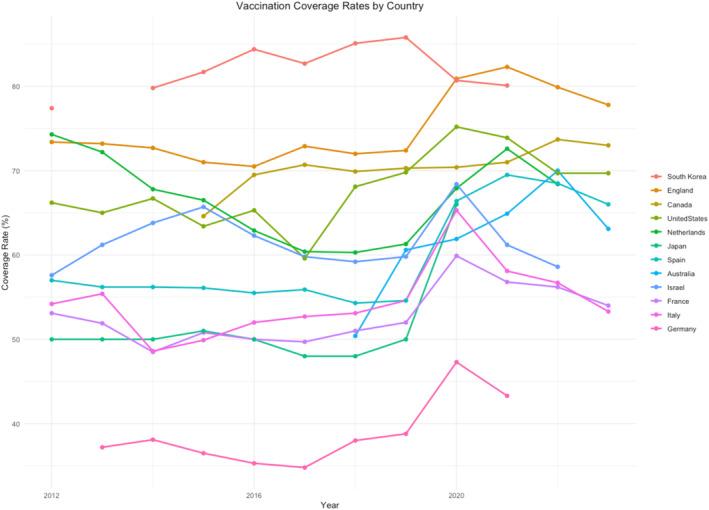
Vaccination is a key measure in influenza control, yet global coverage rates remain low, although previous research reported an increase in influenza vaccination coverage rates (VCR) after the onset of the COVID-19 pandemic. This study aims to assess whether these changes were sustained over time by analyzing VCR trends from 2012 to 2023 in the countries included in the FluCov project.
METHODS
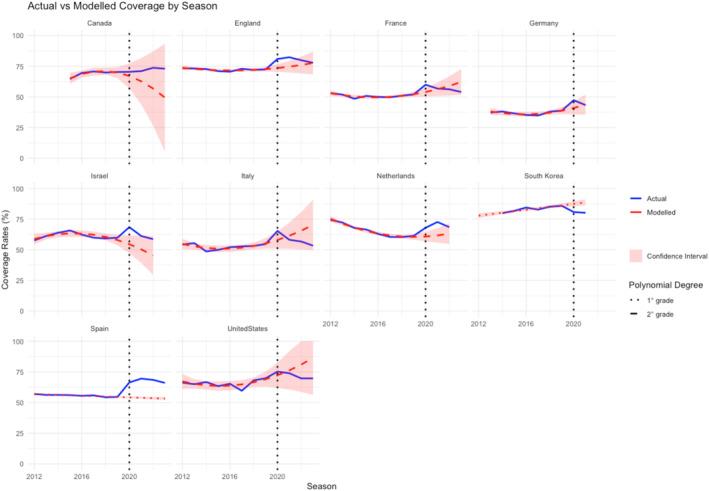
Data on influenza VCR from 2012 to 2023 for different age and risk groups were extracted from national health organizations and international sources for countries included in the FluCov project. For coverage rates in the older adults, segmented regression models were used to test if 2020 marked a significant change in VCR trends. Moreover, polynomial regression models were fitted for each country with VCR in the period 2012 to 2020 to predict coverage rates for 2021 to 2023 and to compare these to the actual coverage rates for 2021 to 2023.
RESULTS
For the elderly, we retrieved influenza VCR data for 12 countries. In 2020, VCR among elderly increased in 10 countries, but the increase was statistically significant in Spain and England only. Moreover, all countries except Spain reverted to levels within the confidence intervals of trends modeled using pre-2020 data.
CONCLUSIONS
Although influenza VCR increased in 2020, these changes were statistically significant in only two out of 12 countries, and no consistent, sustained increase was observed afterward, except in Spain. The findings suggest the need for continuous monitoring of VCR and the implementation of strategies to promote and maintain high vaccination coverage rates.
背景
疫苗接种是控制流感的关键措施,然而全球接种率仍然很低,尽管此前的研究报告称,在新冠疫情爆发后流感疫苗接种率有所上升。本研究旨在通过分析FluCov项目所涵盖国家2012年至2023年的疫苗接种率趋势,评估这些变化是否随时间持续存在。
方法
从国家卫生组织和国际来源提取FluCov项目所涵盖国家2012年至2023年不同年龄和风险组的流感疫苗接种率数据。对于老年人的接种率,采用分段回归模型来检验2020年是否标志着疫苗接种率趋势的显著变化。此外,对2012年至2020年期间每个国家的疫苗接种率进行多项式回归模型拟合,以预测2021年至2023年的接种率,并将其与2021年至2023年的实际接种率进行比较。
结果
对于老年人,我们获取了12个国家的流感疫苗接种率数据。2020年,10个国家老年人的疫苗接种率有所上升,但仅在西班牙和英国,这种上升具有统计学意义。此外,除西班牙外,所有国家的接种率都恢复到了使用2020年前数据建模的趋势置信区间内的水平。
结论
尽管2020年流感疫苗接种率有所上升,但在12个国家中只有两个国家的这种变化具有统计学意义,且除西班牙外,此后未观察到持续一致的上升。研究结果表明需要持续监测疫苗接种率,并实施促进和维持高疫苗接种覆盖率的策略。
 Zotero 插件