
弗林德斯敏感系大鼠的最新生物行为特征:回顾过去十年的研究结果
An Updated Bio-Behavioral Profile of the Flinders Sensitive Line Rat: Reviewing the Findings of the Past Decade.
作者信息
Steyn Stephan F
机构信息
Faculty of Health Sciences, Centre of Excellence for Pharmaceutical Sciences, North-West University, Potchefstroom, South Africa.
出版信息
Pharmacol Res Perspect. 2025 Feb;13(1):e70058. doi: 10.1002/prp2.70058.
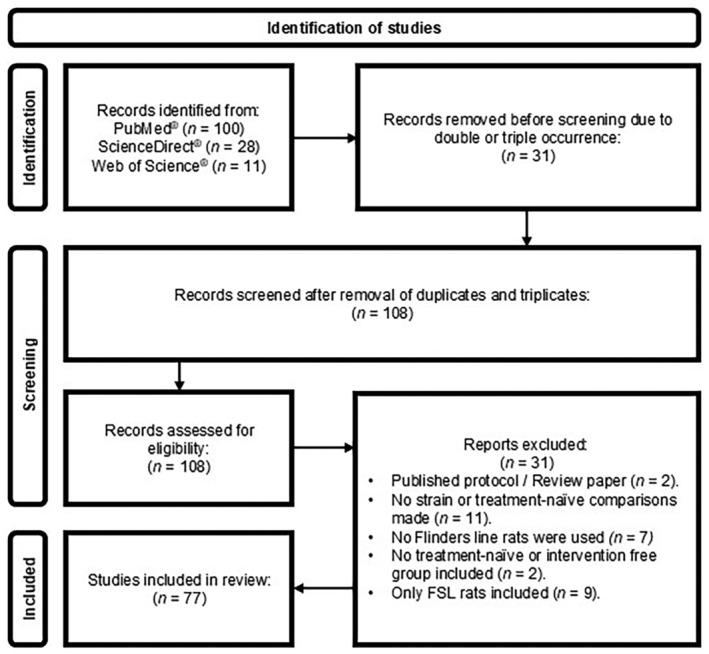
The Flinders sensitive line (FSL) rat is an accepted rodent model for depression that presents with strong face, construct, and predictive validity, thereby making it suitable to investigate novel antidepressant mechanisms. Despite the translatability of this model, available literature on this model has not been reviewed for more than ten years. The PubMed, ScienceDirect and Web of Science databases were searched for relevant articles between 2013 and 2024, with keywords relating to the Flinders line rat, and all findings relevant to treatment naïve animals, included. Following screening, 77 studies were included and used to create behavioral reference standards and calculate FSL favor ratios for the various behavioral parameters. The GRADE and SYRCLE risk of bias tools were used to scale the quality of these studies. Based on these results, FSL rats display reliable and reproducible depressive-like behavior in the forced swim test, together with hyperlocomotor activity across various behavioral tests. Despite reports of increased anhedonia, anxiety-like behavior, and cognitive dysfunction, the reviewed findings indicate that these parameters are comparable between strains. For the various neuro- and biological constructs, oxidative stress, energy production, and glutamatergic, noradrenergic and serotonergic neurotransmission received the most support for strain differences. Taken together, the FSL remains a reliable, popular, and translatable rodent model of depression, with strong face and construct validity. As for predictive validity, similar review approaches should be considered to establish whether the mentioned behavioral aspects and neurochemical constructs may be more sensitive (or resistant) to certain antidepressant strategies.
弗林德斯敏感品系(FSL)大鼠是一种公认的抑郁症啮齿动物模型,具有较强的表面效度、结构效度和预测效度,因此适合用于研究新型抗抑郁机制。尽管该模型具有可转化性,但关于此模型的现有文献已有十多年未被综述。检索了2013年至2024年间PubMed、ScienceDirect和Web of Science数据库中的相关文章,关键词涉及弗林德斯品系大鼠,并纳入了所有与未经治疗的动物相关的研究结果。经过筛选,纳入了77项研究,用于创建行为参考标准并计算各种行为参数的FSL偏好比。使用GRADE和SYRCLE偏倚风险工具对这些研究的质量进行评分。基于这些结果,FSL大鼠在强迫游泳试验中表现出可靠且可重复的抑郁样行为,并且在各种行为测试中均表现出运动活动增加。尽管有报告称快感缺失、焦虑样行为和认知功能障碍有所增加,但综述结果表明这些参数在不同品系之间具有可比性。对于各种神经和生物学结构,氧化应激、能量产生以及谷氨酸能、去甲肾上腺素能和血清素能神经传递在品系差异方面得到的支持最多。综上所述,FSL仍然是一种可靠、常用且可转化的抑郁症啮齿动物模型,具有较强的表面效度和结构效度。至于预测效度,应考虑采用类似的综述方法来确定上述行为方面和神经化学结构是否对某些抗抑郁策略更敏感(或更具抗性)。
 Zotero 插件