
钙调蛋白激酶II神经元中的1型大麻素受体驱动病理性饮食行为中的冲动性。
Cannabinoid type-1 receptors in CaMKII neurons drive impulsivity in pathological eating behavior.
作者信息
Martin-Garcia Elena, Domingo-Rodriguez Laura, Lutz Beat, Maldonado Rafael, Ruiz de Azua Inigo
机构信息
Laboratory of Neuropharmacology-Neurophar, Department of Experimental and Health Sciences, Universitat Pompeu Fabra, 08003, Barcelona, Spain; Department of Psychobiology and Methodology in Health Sciences, Universitat Autonoma de Barcelona, 08193, Bellatera, Spain; Hospital del Mar Medical Research Institute (IMIM), Barcelona, Spain.
Laboratory of Neuropharmacology-Neurophar, Department of Experimental and Health Sciences, Universitat Pompeu Fabra, 08003, Barcelona, Spain; Department of Psychobiology and Methodology in Health Sciences, Universitat Autonoma de Barcelona, 08193, Bellatera, Spain.
出版信息
Mol Metab. 2025 Feb;92:102096. doi: 10.1016/j.molmet.2025.102096. Epub 2025 Jan 7.
OBJECTIVES
Overconsumption of palatable food and energy accumulation are evolutionary mechanisms of survival when food is scarce. These innate mechanisms becom detrimental in obesogenic environment promoting obesity and related comorbidities, including mood disorders. This study aims at elucidating the role of the endocannabinoid system in energy accumulation and hedonic feeding.
METHODS
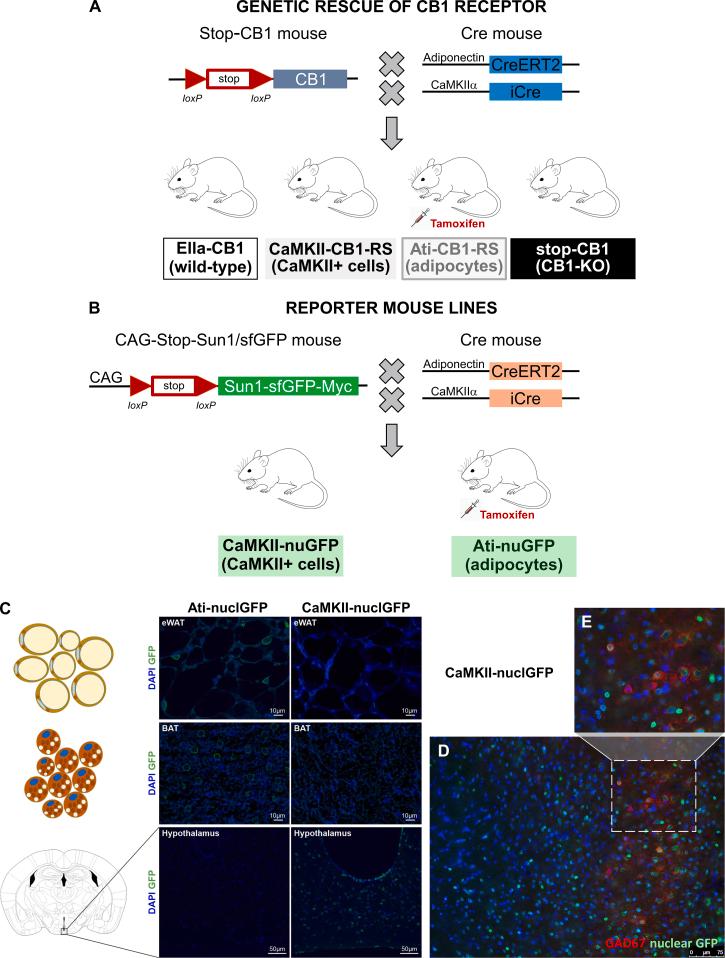
We applied a genetic strategy to reconstitute cannabinoid type-1 receptor (CB1) expression at functional levels specifically in CaMKII+ neurons (CaMKII-CB1-RS) and adipocytes (Ati-CB1-RS), respectively, in a CB1 deficient background.
RESULTS
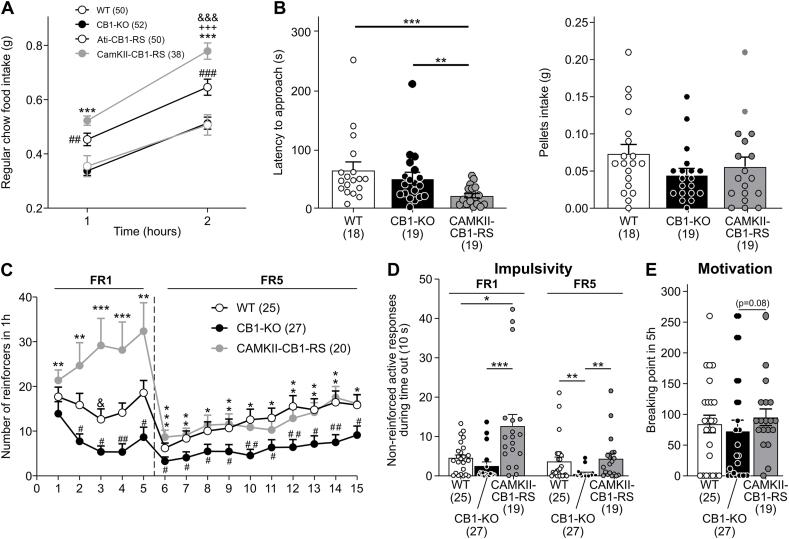
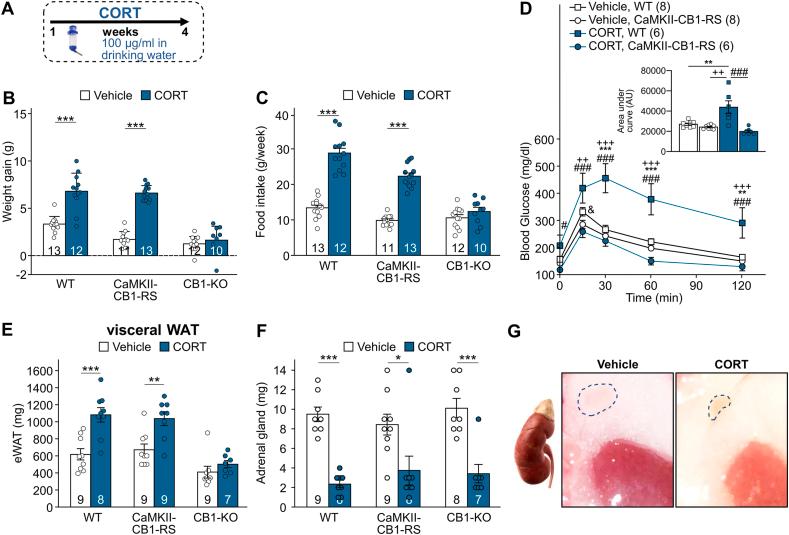
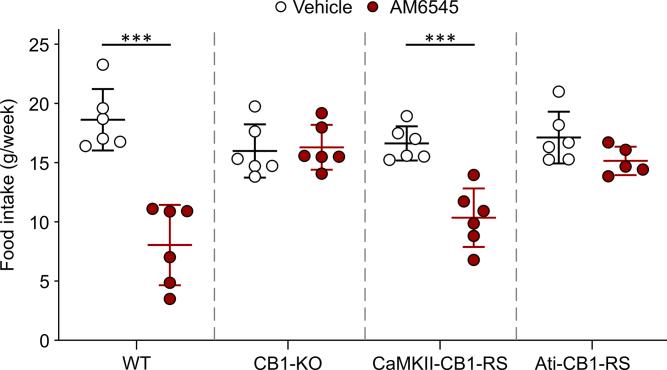
Rescued CB1 expression in CaMKII+ neurons, but not in adipocytes, promotes feeding behavior, leading to fasting-induced hyperphagia, increased motivation, and impulsivity to palatable food seeking. In a diet-induced obesity model, CB1 re-expression in CaMKII+ neurons, but not in adipocytes, compared to complete CB1 deficiency, was sufficient to largely restore weight gain, food intake without any effect on glucose intolerance associated with high-fat diet consumption. In a model of glucocorticoid-mediated metabolic syndrome, CaMKII-CB1-RS mice showed all metabolic alterations linked to the human metabolic syndrome except of glucose intolerance. In a binge-eating model mimicking human pathological feeding, CaMKII-CB1-RS mice showed increased seeking and compulsive behavior to palatable food, suggesting crucial roles in foraging and an enhanced susceptibility to addictive-like eating behaviors. Importantly, other contingent behaviors, including increased cognitive flexibility and reduced anxiety-like behaviors, but not depressive-like behaviors, were also observed.
CONCLUSIONS
CB1 in CaMKII+ neurons is instrumental in feeding behavior and energy storage under physiological conditions. The exposure to risk factors (hypercaloric diet, glucocorticoid dysregulation) leads to obesity, metabolic syndrome, binge-eating and food addiction.
目的
在食物匮乏时,美味食物的过度摄入和能量积累是生存的进化机制。在促进肥胖及相关合并症(包括情绪障碍)的致肥胖环境中,这些先天机制变得有害。本研究旨在阐明内源性大麻素系统在能量积累和享乐性进食中的作用。
方法
我们采用一种基因策略,分别在CB1基因缺陷背景下,在CaMKII⁺神经元(CaMKII-CB1-RS)和脂肪细胞(Ati-CB1-RS)中特异性地在功能水平上重建1型大麻素受体(CB1)的表达。
结果
在CaMKII⁺神经元而非脂肪细胞中挽救的CB1表达促进进食行为,导致禁食诱导的食欲亢进、动机增加以及对美味食物寻求的冲动性。在饮食诱导的肥胖模型中,与完全缺乏CB1相比,在CaMKII⁺神经元而非脂肪细胞中重新表达CB1足以在很大程度上恢复体重增加和食物摄入量,而对与高脂饮食消费相关的葡萄糖不耐受没有任何影响。在糖皮质激素介导的代谢综合征模型中,CaMKII-CB1-RS小鼠表现出与人类代谢综合征相关的所有代谢改变,但不包括葡萄糖不耐受。在模拟人类病理性进食的暴饮暴食模型中,CaMKII-CB1-RS小鼠表现出对美味食物的寻求和强迫行为增加,表明在觅食中起关键作用且对成瘾样进食行为的易感性增强。重要的是,还观察到了其他伴随行为,包括认知灵活性增加和焦虑样行为减少,但不包括抑郁样行为。
结论
CaMKII⁺神经元中的CB1在生理条件下对进食行为和能量储存起作用。暴露于风险因素(高热量饮食、糖皮质激素失调)会导致肥胖、代谢综合征、暴饮暴食和食物成瘾。






 Zotero 插件