
通过荷兰脑研究登记处评估FINGER-NL多领域生活方式干预试验不同招募策略的效率和效果。
Evaluation of efficiency and effectiveness of different recruitment strategies for the FINGER-NL multidomain lifestyle intervention trial via the Dutch Brain Research Registry.
作者信息
Waterink Lisa, Sikkes Sietske A M, Soons Lion M, Beers Sonja, Meijer-Krommenhoek Yvonne, van de Rest Ondine, Nynke Smidt, Oosterman Joukje M, Scherder Erik, Deckers Kay, Vermeiren Yannick, de Heus Rianne A A, Köhler Sebastian, van der Flier Wiesje M, Zwan Marissa D
机构信息
Alzheimer Center Amsterdam Neurology Vrije Universiteit Amsterdam, Amsterdam UMC VUmc Amsterdam The Netherlands.
Amsterdam Neuroscience, Neurodegeneration Amsterdam The Netherland.
出版信息
Alzheimers Dement (N Y). 2025 Jan 9;11(1):e70017. doi: 10.1002/trc2.70017. eCollection 2025 Jan-Mar.
INTRODUCTION
Recruitment of participants for intervention studies is challenging. We evaluated the effectiveness and efficiency of a participant recruitment campaign through an online registry for the FINGER-NL study, a multi-domain lifestyle intervention trial targeting cognitively healthy individuals aged 60-79 with dementia prevention potential. Additionally, we explored which recruitment strategy successfully reached individuals from underrepresented groups in research.
METHODS
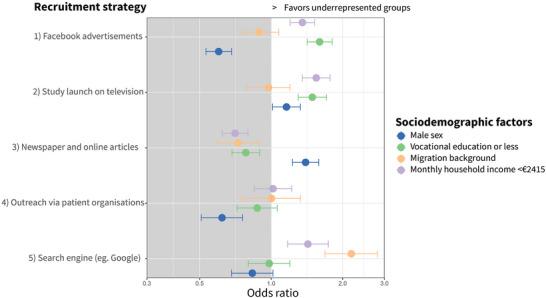
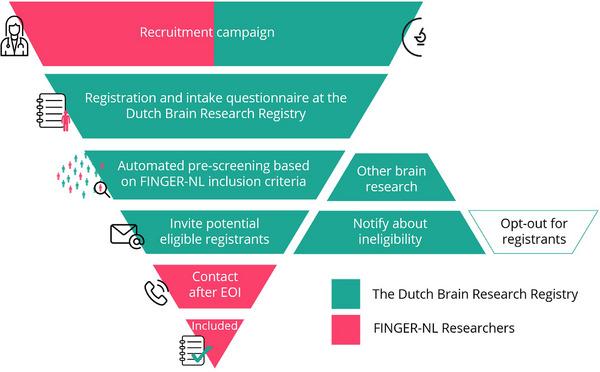
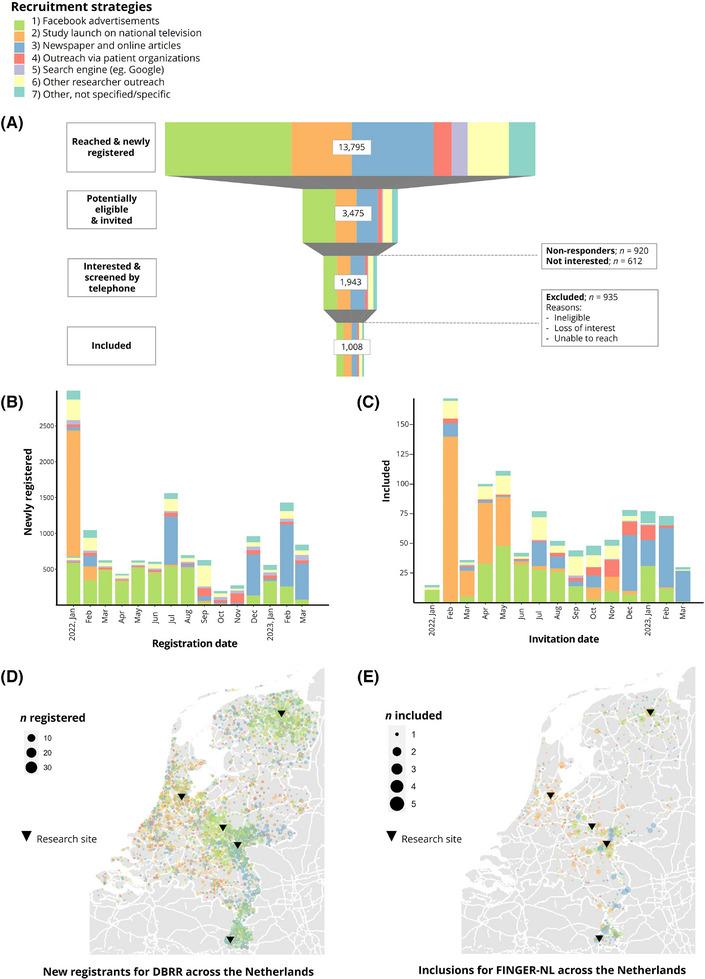
The campaign entailed seven recruitment strategies referring to The Dutch Brain Research Registry (DBRR): (1) Facebook advertisements, (2) appearance on national television, (3) newspaper articles, (4) researcher outreach, (5) patient organizations, (6) search engines, and (7) other. For each strategy, we describe the number of individuals (a) registered, (b) potentially eligible, and (c) included in FINGER-NL. Subsequently, the efficiency, defined by the eligibility ratio (eligible/registered), and effectiveness, defined by the inclusion ratio (included/registered) were calculated. Associations between recruitment strategies and sociodemographic factors of underrepresented groups were tested with binomial logistic regressions.
RESULTS
The campaign resulted in 13,795 new DBRR registrants, of which = 3475 were eligible (eligibility ratio = 0.25) and = 1008 were included (inclusion ratio = 0.07). The Facebook advertisements and television appearance resulted in the highest numbers of registrants ( = 4678 and = 2182) which translated to the highest number of inclusions ( = 288 and = 262). The appearance on national television (eligibility ratio = 0.35), newspaper articles (0.26), and Facebook campaigns (0.26) were the most efficient strategies. The national television appearance (inclusion ratio = 0.13) was the most effective strategy. The Facebook campaign and appearance on national television performed relatively better in recruiting individuals from underrepresented groups.
DISCUSSION
A multipronged recruitment campaign via a national online recruitment registry is efficient and effective in recruiting and prescreening an adequate number of individuals aged 60-79 years with prevention potential for a multi-site intervention trial within a limited time frame of 15 months. Social media advertisements and television are preferred strategies to recruit individuals from underrepresented groups.
HIGHLIGHTS
An online brain research registry recruited eligible participants successfully.Mass media recruitment strategies are efficient for reaching large numbers.Direct recruitment through researchers and patient organizations seems more effective.Online registries offer automated prescreening and alternatives for screen-failures.Tailored strategies are needed to reach underrepresented groups to improve diversity.
引言
为干预研究招募参与者具有挑战性。我们通过一项针对FINGER-NL研究的在线登记处评估了参与者招募活动的有效性和效率。FINGER-NL研究是一项多领域生活方式干预试验,目标是60-79岁具有预防痴呆症潜力的认知健康个体。此外,我们还探讨了哪种招募策略能够成功覆盖研究中代表性不足群体的个体。
方法
该活动采用了七种参考荷兰大脑研究登记处(DBRR)的招募策略:(1)脸书广告,(2)在国家电视台亮相,(3)报纸文章,(4)研究人员外展,(5)患者组织,(6)搜索引擎,以及(7)其他。对于每种策略,我们描述了(a)登记的个体数量、(b)潜在符合条件的个体数量以及(c)纳入FINGER-NL研究的个体数量。随后,计算了由合格比例(合格/登记)定义的效率和由纳入比例(纳入/登记)定义的有效性。使用二项逻辑回归测试招募策略与代表性不足群体的社会人口学因素之间的关联。
结果
该活动产生了13795名新的DBRR登记者,其中3475名符合条件(合格比例=0.25),1008名被纳入(纳入比例=0.07)。脸书广告和在国家电视台亮相带来了最多的登记者(分别为4678名和2182名),这也转化为最多的纳入人数(分别为288名和262名)。在国家电视台亮相(合格比例=0.35)、报纸文章(0.26)和脸书活动(0.26)是最有效的策略。在国家电视台亮相(纳入比例=0.13)是最有效的策略。脸书活动和在国家电视台亮相在招募代表性不足群体的个体方面表现相对更好。
讨论
通过国家在线招募登记处开展的多管齐下的招募活动在15个月的有限时间内,对于招募和预筛选足够数量的60-79岁具有预防潜力的个体以进行多中心干预试验是有效且高效的。社交媒体广告和电视是招募代表性不足群体个体时的首选策略。
要点
一个在线大脑研究登记处成功招募到了符合条件的参与者。大众媒体招募策略在覆盖大量人群方面效率较高。通过研究人员和患者组织进行的直接招募似乎更有效。在线登记处提供自动预筛选以及针对筛选未通过者的替代方案。需要采用量身定制的策略来覆盖代表性不足的群体以提高多样性。
 Zotero 插件