
克服头颈癌对放化疗的内在和获得性耐药的策略
Strategies to Overcome Intrinsic and Acquired Resistance to Chemoradiotherapy in Head and Neck Cancer.
作者信息
de Bakker Tycho, Maes Anouk, Dragan Tatiana, Martinive Philippe, Penninckx Sébastien, Van Gestel Dirk
机构信息
Radiotherapy Department, Institut Jules Bordet, Université Libre de Bruxelles (ULB), 1070 Brussels, Belgium.
Medical Physics Department, Institut Jules Bordet, Université Libre de Bruxelles (ULB), 1070 Brussels, Belgium.
出版信息
Cells. 2024 Dec 27;14(1):18. doi: 10.3390/cells14010018.
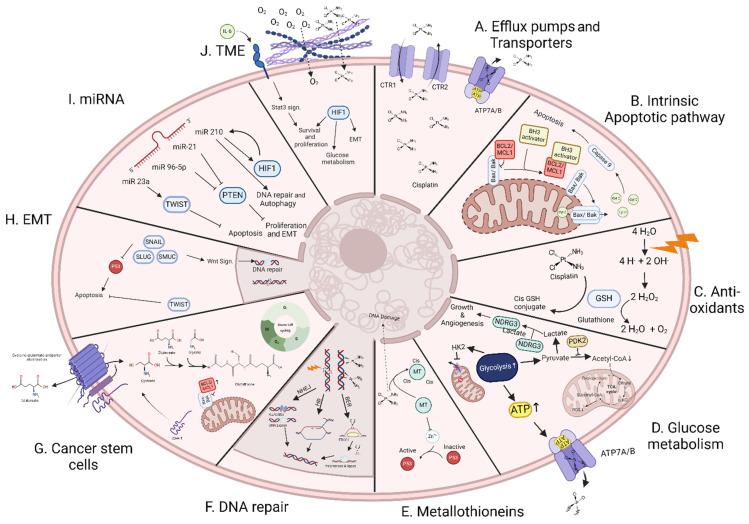
Definitive chemoradiotherapy (CRT) is a cornerstone of treatment for locoregionally advanced head and neck cancer (HNC). Research is ongoing on how to improve the tumor response to treatment and limit normal tissue toxicity. A major limitation in that regard is the growing occurrence of intrinsic or acquired treatment resistance in advanced cases. In this review, we will discuss how overexpression of efflux pumps, perturbation of apoptosis-related factors, increased expression of antioxidants, glucose metabolism, metallotheionein expression, increased DNA repair, cancer stem cells, epithelial-mesenchymal transition, non-coding RNA and the tumour microenvironment contribute towards resistance of HNC to chemotherapy and/or radiotherapy. These mechanisms have been investigated for years and been exploited for therapeutic gain in resistant patients, paving the way to the development of new promising drugs. Since in vitro studies on resistance requires a suitable model, we will also summarize published techniques and treatment schedules that have been shown to generate acquired resistance to chemo- and/or radiotherapy that most closely mimics the clinical scenario.
确定性放化疗(CRT)是局部晚期头颈癌(HNC)治疗的基石。关于如何提高肿瘤对治疗的反应并限制正常组织毒性的研究正在进行中。在这方面的一个主要限制是晚期病例中内在或获得性治疗抵抗的发生率不断增加。在这篇综述中,我们将讨论外排泵的过表达、凋亡相关因子的扰动、抗氧化剂表达增加、葡萄糖代谢、金属硫蛋白表达、DNA修复增加、癌症干细胞、上皮-间质转化、非编码RNA和肿瘤微环境如何导致HNC对化疗和/或放疗产生抗性。这些机制已经研究多年,并已被用于为耐药患者带来治疗益处,为开发新的有前景的药物铺平了道路。由于关于抗性的体外研究需要合适的模型,我们还将总结已发表的技术和治疗方案,这些技术和方案已被证明能产生与临床情况最相似的对化疗和/或放疗的获得性抗性。
 Zotero 插件