
CAR-T疗法在B细胞血液系统恶性肿瘤之外的应用
CAR-T Therapy Beyond B-Cell Hematological Malignancies.
作者信息
Canichella Martina, de Fabritiis Paolo
机构信息
Hematology, St. Eugenio Hospital, ASL Roma2, 00144 Rome, Italy.
Department of Biomedicina e Prevenzione, Tor Vergata University, 00133 Rome, Italy.
出版信息
Cells. 2025 Jan 3;14(1):41. doi: 10.3390/cells14010041.
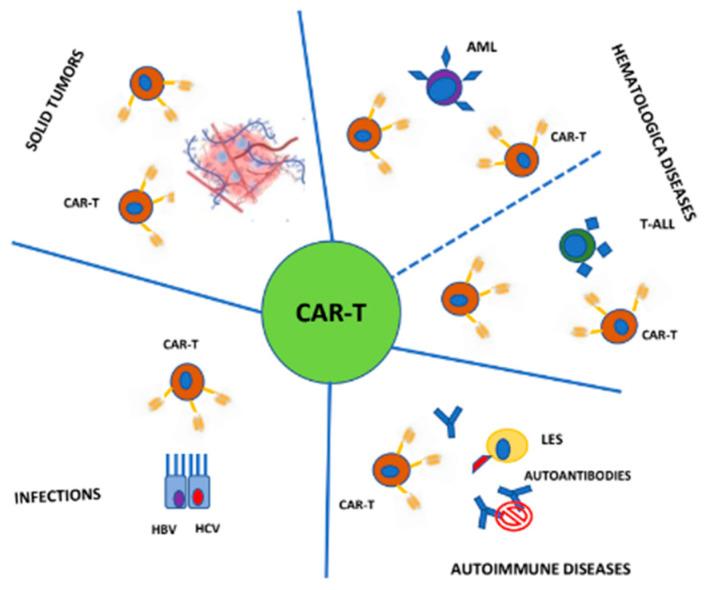
Despite the advances of CAR-T cells in certain hematological malignancies, mostly from B-cell derivations such as non-Hodgkin lymphomas, acute lymphoblastic leukemia and multiple myeloma, a significant portion of other hematological and non-hematological pathologies can benefit from this innovative treatment, as the results of clinical studies are demonstrating. The clinical application of CAR-T in the setting of acute T-lymphoid leukemia, acute myeloid leukemia, solid tumors, autoimmune diseases and infections has encountered limitations that are different from those of hematological B-cell diseases. To overcome these restrictions, strategies based on different molecular engineering platforms have been devised and will be illustrated below. The aim of this manuscript is to provide an overview of the CAR-T application in pathologies other than those currently treated, highlighting both the limits and results obtained with these settings.
尽管嵌合抗原受体T细胞(CAR-T)在某些血液系统恶性肿瘤中取得了进展,这些肿瘤大多源自B细胞,如非霍奇金淋巴瘤、急性淋巴细胞白血病和多发性骨髓瘤,但正如临床研究结果所示,其他大量血液系统和非血液系统疾病也能从这种创新疗法中受益。CAR-T在急性T淋巴细胞白血病、急性髓细胞白血病、实体瘤、自身免疫性疾病和感染中的临床应用遇到了与血液系统B细胞疾病不同的限制。为克服这些限制,已设计出基于不同分子工程平台的策略,将在下文进行阐述。本手稿旨在概述CAR-T在目前所治疗疾病以外的其他病症中的应用,突出这些情况下所取得的局限性和成果。
 Zotero 插件