
使用当代肠杆菌科分离株对哌拉西林-他唑巴坦纸片进行评估表明需要对纸片效力进行优化。
Evaluation of piperacillin-tazobactam disks using contemporary Enterobacterales isolates suggests the need for disk potency optimization.
作者信息
Khan Ayesha, Manuel Carmila, Maynard Richard, Humphries Romney M
机构信息
Department of Pathology, Microbiology and Immunology, Vanderbilt University Medical Center, Nashville, Tennessee, USA.
出版信息
J Clin Microbiol. 2025 Feb 19;63(2):e0159924. doi: 10.1128/jcm.01599-24. Epub 2025 Jan 10.
UNLABELLED
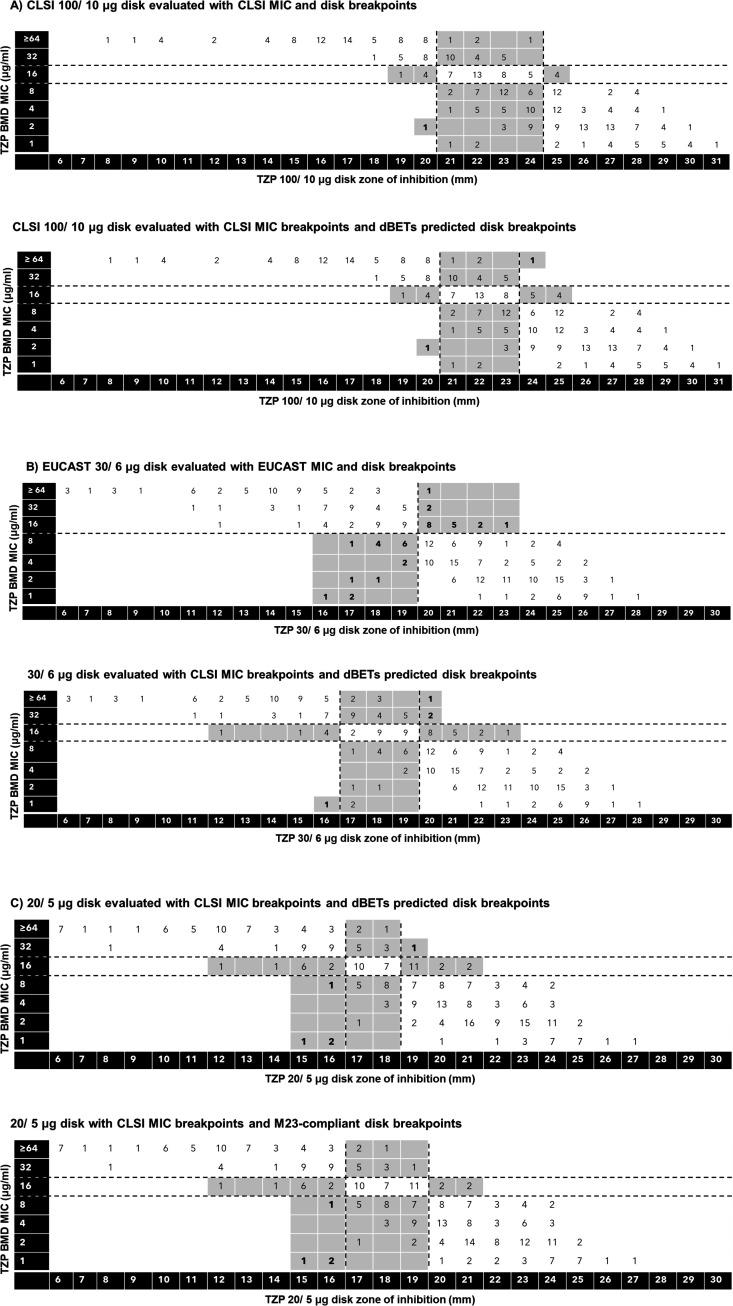
Piperacillin-tazobactam (TZP) is a commonly used broad-spectrum agent. OXA-1 β-lactamases drive global Enterobacterales TZP resistance and raise MICs to the clinical breakpoints (8/4-16/4 µg/mL), making susceptibility testing challenging. Two TZP disks are used globally. The first with 100 µg piperacillin and 10 µg tazobactam, established in 1992, is used by laboratories following U.S. FDA and Clinical and Laboratory Standards Institute (CLSI) standards. The second, with 30 µg piperacillin and 6 µg tazobactam, was developed by the European Committee on Antimicrobial Susceptibility Testing (EUCAST). When CLSI updated Enterobacterales TZP MIC breakpoints in 2022, it became apparent that the 100/10 µg disk may not accurately predict TZP resistance or susceptibility. In this study, we performed a disk mass titration study using 100 contemporary Enterobacterales isolates, including 40 harboring bla. Relative to reference broth microdilution with CLSI breakpoints, categorical agreement (CA) for the 100/10 µg disk was 68% with 0.6% major errors (MEs) and 32% minor errors. The CA for the 30/6 µg disk against EUCAST breakpoints was 88% with 15% very major errors and 10% ME. A third disk developed in this study, 20/5 µg, yielded 81% CA with CLSI MIC breakpoints and disk breakpoints generated using the error-rate-bounded method. CA was 62.4%, 63.2%, and 70.9% for isolates with bla using the 100/10, 30/6, and 20/5 µg disks, respectively, whereas it was 71.6%, 86.9%, and 83.1% for isolates without bla. Decreasing TZP disk potency improved the overall performance of disk diffusion and improved separation between susceptible and non-susceptible isolates, particularly those harboring OXA-1, but no disk yielded optimal results.
IMPORTANCE
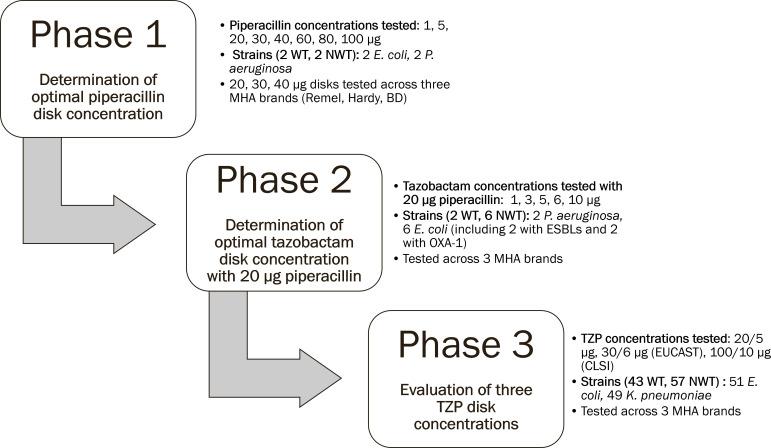
In this article, we address major gaps in contemporary data for piperacillin-tazobactam (TZP) susceptibility testing and evaluate the performance of disk diffusion. TZP is the most common empiric broad-spectrum agent against Gram-negative pathogens and is used as a carbapenem-sparing regimen. OXA-1 β-lactamases drive global Enterobacterales TZP resistance and raise MICs to the clinical breakpoints, making susceptibility testing challenging. In 2022, CLSI revised the Enterobacterales TZP MIC breakpoints. Due to the lack of contemporary correlates, disk diffusion breakpoints were revised using outdated historical data from 1991 and 2003 and yielded unacceptable error rates. Additionally, there is a lack of global consensus on disk potency. The EUCAST TZP disks contain 30 μg piperacillin and 6 μg tazobactam. The CLSI disks, established after TZP approval in 1979 and prior to the widespread prevalence of ESBLs, contain 100 μg piperacillin and 10 μg tazobactam. Here, we evaluate disk diffusion using the 100/10 and 30/6 μg TZP disks with 100 contemporary Enterobacterales isolates, including 40 harboring bla. We conducted a disk development study to determine if an alternative potency might address accuracy issues with TZP susceptibility testing. We demonstrate that decreasing TZP potency improves the performance of disk diffusion and improves separation between susceptible and non-susceptible isolates, particularly those harboring OXA-1, but no disk yielded optimal results. The alternative 20/5 μg disk yielded the lowest errors using CLSI MIC breakpoints and the best separation between susceptible isolates and isolates harboring bla. Our study addresses an unmet need, shows that further optimization of the TZP disk potency is possible, and provides clinical laboratories with a better understanding of the performance of TZP disks using contemporary, challenging isolates. A larger, multicenter study is needed for further optimization but has been limited by a lack of funding for an off-patent antimicrobial. Our struggles in accessing funding underscore the frequent challenge with AST for older but heavily used antimicrobials.
未标注
哌拉西林-他唑巴坦(TZP)是一种常用的广谱抗菌药物。OXA-1β-内酰胺酶导致全球范围内肠杆菌科细菌对TZP耐药,并使最低抑菌浓度(MIC)升高至临床断点(8/4 - 16/4μg/mL),这使得药敏试验颇具挑战性。全球使用两种TZP药敏纸片。第一种含100μg哌拉西林和10μg他唑巴坦,于1992年确定,遵循美国食品药品监督管理局(FDA)和临床与实验室标准协会(CLSI)标准的实验室使用。第二种含30μg哌拉西林和6μg他唑巴坦,由欧洲抗菌药物敏感性试验委员会(EUCAST)研发。2022年CLSI更新肠杆菌科细菌TZP的MIC断点时,发现100/10μg药敏纸片可能无法准确预测TZP耐药性或敏感性。在本研究中,我们使用100株当代肠杆菌科细菌分离株进行了纸片质量滴定研究,其中40株携带bla。相对于采用CLSI断点的参考肉汤稀释法,100/10μg药敏纸片的分类一致性(CA)为68%,主要错误(ME)为0.6%,次要错误为32%。30/6μg药敏纸片相对于EUCAST断点的CA为88%,极主要错误为15%,ME为10%。本研究研发的第三种药敏纸片20/5μg,与CLSI的MIC断点以及使用错误率界定法生成的纸片断点的CA为81%。对于携带bla的分离株,使用100/10、30/6和20/5μg药敏纸片时CA分别为62.4%、63.2%和70.9%,而对于不携带bla的分离株,CA分别为71.6%、86.9%和83.1%。降低TZP药敏纸片的效力可改善纸片扩散法的整体性能,并改善敏感和非敏感分离株之间的区分,尤其是携带OXA-1的分离株,但没有一种药敏纸片能产生最佳结果。
重要性
在本文中,我们填补了当代哌拉西林-他唑巴坦(TZP)药敏试验数据的主要空白,并评估了纸片扩散法的性能。TZP是针对革兰氏阴性病原体最常用的经验性广谱抗菌药物,用作碳青霉烯类药物的替代方案。OXA-1β-内酰胺酶导致全球范围内肠杆菌科细菌对TZP耐药,并使MIC升高至临床断点,这使得药敏试验颇具挑战性。2022年,CLSI修订了肠杆菌科细菌TZP的MIC断点。由于缺乏当代相关性,纸片扩散断点是使用1991年和2003年过时的历史数据修订的,导致错误率不可接受。此外,关于药敏纸片效力缺乏全球共识。EUCAST的TZP药敏纸片含30μg哌拉西林和6μg他唑巴坦。CLSI的药敏纸片于1979年TZP获批后、超广谱β-内酰胺酶广泛流行之前确定,含100μg哌拉西林和10μg他唑巴坦。在此,我们使用100/10和30/6μg的TZP药敏纸片对100株当代肠杆菌科细菌分离株(包括40株携带bla的分离株)评估纸片扩散法。我们开展了一项药敏纸片研发研究,以确定是否有其他效力可解决TZP药敏试验的准确性问题。我们证明降低TZP效力可改善纸片扩散法的性能,并改善敏感和非敏感分离株之间的区分,尤其是携带OXA-1的分离株,但没有一种药敏纸片能产生最佳结果。替代的20/5μg药敏纸片在使用CLSI的MIC断点时错误率最低,且在敏感分离株和携带bla的分离株之间区分最佳。我们的研究满足了一项未满足的需求,表明TZP药敏纸片效力的进一步优化是可行的,并使临床实验室能更好地了解使用当代具有挑战性的分离株时TZP药敏纸片的性能。需要开展更大规模的多中心研究进行进一步优化,但因缺乏对已过专利期抗菌药物的资金支持而受限。我们在获取资金方面的困难凸显了针对使用广泛但较老的抗菌药物进行抗菌药物敏感性试验时经常面临的挑战。
 Zotero 插件