
将人工智能与机制性流行病学建模相结合:机遇与挑战的范围综述
Integrating artificial intelligence with mechanistic epidemiological modeling: a scoping review of opportunities and challenges.
作者信息
Ye Yang, Pandey Abhishek, Bawden Carolyn, Sumsuzzman Dewan Md, Rajput Rimpi, Shoukat Affan, Singer Burton H, Moghadas Seyed M, Galvani Alison P
机构信息
Center for Infectious Disease Modeling and Analysis, Yale School of Public Health, New Haven, CT, USA.
Department of Microbiology and Immunology, McGill University, Montréal, QC, Canada.
出版信息
Nat Commun. 2025 Jan 10;16(1):581. doi: 10.1038/s41467-024-55461-x.
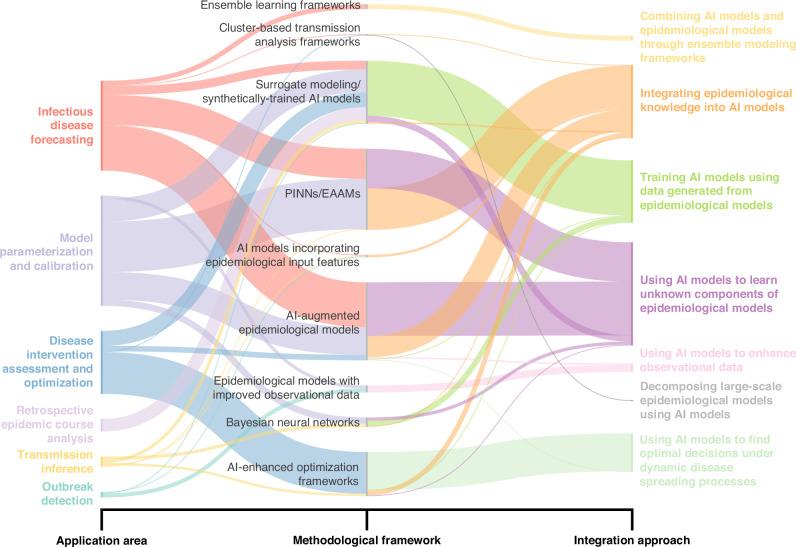
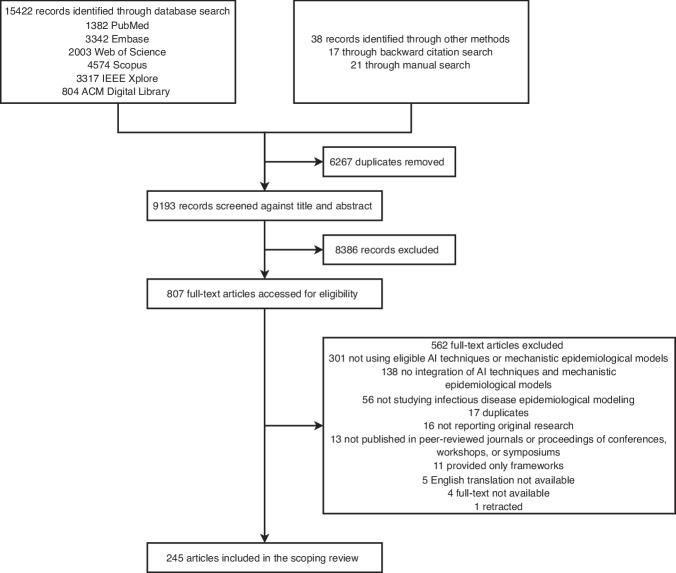
Integrating prior epidemiological knowledge embedded within mechanistic models with the data-mining capabilities of artificial intelligence (AI) offers transformative potential for epidemiological modeling. While the fusion of AI and traditional mechanistic approaches is rapidly advancing, efforts remain fragmented. This scoping review provides a comprehensive overview of emerging integrated models applied across the spectrum of infectious diseases. Through systematic search strategies, we identified 245 eligible studies from 15,460 records. Our review highlights the practical value of integrated models, including advances in disease forecasting, model parameterization, and calibration. However, key research gaps remain. These include the need for better incorporation of realistic decision-making considerations, expanded exploration of diverse datasets, and further investigation into biological and socio-behavioral mechanisms. Addressing these gaps will unlock the synergistic potential of AI and mechanistic modeling to enhance understanding of disease dynamics and support more effective public health planning and response.
将机制模型中嵌入的先前流行病学知识与人工智能(AI)的数据挖掘能力相结合,为流行病学建模带来了变革潜力。虽然人工智能与传统机制方法的融合正在迅速推进,但相关工作仍较为零散。本综述全面概述了应用于各类传染病的新兴综合模型。通过系统的检索策略,我们从15460条记录中确定了245项符合条件的研究。我们的综述突出了综合模型的实用价值,包括疾病预测、模型参数化和校准方面的进展。然而,关键的研究差距依然存在。这些差距包括需要更好地纳入现实的决策考量、扩大对不同数据集的探索,以及进一步研究生物和社会行为机制。解决这些差距将释放人工智能与机制建模的协同潜力,以增进对疾病动态的理解,并支持更有效的公共卫生规划和应对。

 Zotero 插件