
微调聚乳酸纳米颗粒的物理化学性质以实现 BET 抑制剂 JQ1 的控释:聚乙烯醇浓度的影响
Fine-Tuning the Physicochemical Properties of Poly(lactic Acid) Nanoparticles for the Controlled Release of the BET Inhibitor JQ1: Influence of PVA Concentration.
作者信息
Kedjar Nedjla, Iannuzzi Eleonora, Kreuzer Martin, Alonso-Moreno Carlos, Moya-Lopez Carmen
机构信息
Laboratory of Applied Chemistry (LAC), Faculty of Sciences Technology, University of Ain Temouchent Belhadj Bouchaib, Ain Temouchent 46000, Algeria.
Facultad de Farmacia-Centro de Innovación en Química Avanzada (ORFEO-CINQA), Unidad nanoDrug, Departamento de Química Inorgánica, Orgánica y Bioquímica, Universidad de Castilla-La Mancha, 02071 Albacete, Albacete, Spain.
出版信息
Polymers (Basel). 2025 Jan 6;17(1):123. doi: 10.3390/polym17010123.
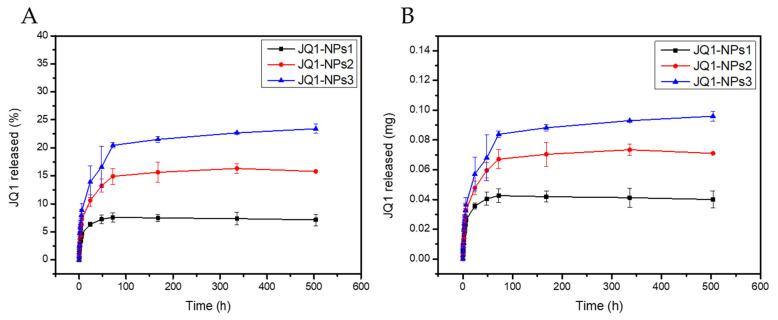
The compounds targeting the bromo and extra terminal domain proteins (BET), such as the JQ1, present potent anti-cancer activity in preclinical models, however, the application of JQ1 at the clinical level is limited by its short half-life, rapid clearance, and non-selective inhibition of BET family proteins, leading to off-target effects and resistance. To address these challenges, the optimization of JQ1 delivery has been accomplished through polylactide (PLA) nanoparticles. PLA derivatives with varying molecular weights were synthesized via ring-opening polymerization using a zinc-based initiator and characterized using thermogravimetric analysis, differential scanning calorimetry, and infrared spectroscopy. PLA nanoparticles (NPs) were subsequently formulated, and the effects of key parameters-including PLA molecular weight, organic phase concentration, and surfactant concentration-on particle size, polydispersity index (PDI), and encapsulation efficiency were systematically investigated. PLA molecular weight and organic phase concentration mainly influenced the NPs size whilst the thermodynamic state of the NPs was unaffected by these two parameters. The surfactant concentration is correlated to the encapsulation efficacy of JQ1 as well as the release profile, suggesting the potential tool that the variation of these parameters represent for customizing the release of JQ1 according to specific needs.
靶向溴结构域和额外末端结构域蛋白(BET)的化合物,如JQ1,在临床前模型中具有强大的抗癌活性,然而,JQ1在临床层面的应用受到其半衰期短、清除迅速以及对BET家族蛋白的非选择性抑制的限制,从而导致脱靶效应和耐药性。为应对这些挑战,已通过聚丙交酯(PLA)纳米颗粒实现了JQ1递送的优化。使用锌基引发剂通过开环聚合合成了不同分子量的PLA衍生物,并使用热重分析、差示扫描量热法和红外光谱对其进行了表征。随后制备了PLA纳米颗粒(NPs),并系统研究了包括PLA分子量、有机相浓度和表面活性剂浓度在内的关键参数对粒径、多分散指数(PDI)和包封率的影响。PLA分子量和有机相浓度主要影响NPs的大小,而这两个参数不影响NPs的热力学状态。表面活性剂浓度与JQ1的包封效率以及释放曲线相关,表明这些参数的变化代表了根据特定需求定制JQ1释放的潜在工具。


 Zotero 插件