
使用超声造影诊断肝脏局灶性病变的挑战
Challenges in Diagnosing Focal Liver Lesions Using Contrast-Enhanced Ultrasound.
作者信息
Moga Tudor Voicu, Lupusoru Raluca, Danila Mirela, Ghiuchici Ana Maria, Popescu Alina, Miutescu Bogdan, Ratiu Iulia, Burciu Calin, Bizerea-Moga Teofana, Voron Anca, Sporea Ioan, Sirli Roxana
机构信息
Department of Gastroenterology and Hepatology, "Victor Babeș" University of Medicine and Pharmacy, 300041 Timișoara, Romania.
Center of Advanced Research in Gastroenterology and Hepatology, "Victor Babeș" University of Medicine and Pharmacy, 300041 Timisoara, Romania.
出版信息
Diagnostics (Basel). 2024 Dec 28;15(1):46. doi: 10.3390/diagnostics15010046.
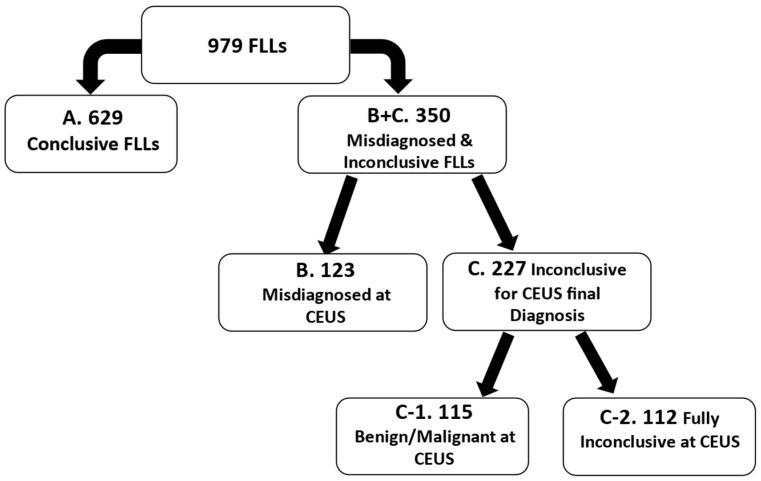
Contrast-enhanced ultrasound (CEUS) has become the preferred method for many clinicians in evaluating focal liver lesions (FLLs) initially identified through standard ultrasound. However, in clinical practice, certain lesions may deviate from the typical enhancement patterns outlined in EFSUMB guidelines. This study aims to assess FLLs that remained inconclusive or misdiagnosed after CEUS evaluation, spanning eight years of single-center experience. Following CEUS, all FLLs underwent secondary imaging (CT, MRI) or histopathological analysis for diagnostic confirmation. From the initial 979 FLLs, 350 lesions (35.7%) were either inconclusive or misdiagnosed by CEUS, with hepatocellular carcinoma (HCC) and liver metastases constituting the majority of these cases. The most frequent enhancement pattern in inconclusive lesions at CEUS was hyper-iso-iso. Factors such as advanced liver fibrosis, adenomas, and cholangiocarcinoma were significantly associated with higher rates of diagnostic inaccuracies. Advanced liver fibrosis, adenomas, and cholangiocarcinoma were significantly associated with increased diagnostic challenges, emphasizing the need for supplementary imaging techniques.
超声造影(CEUS)已成为许多临床医生在评估最初通过标准超声发现的肝脏局灶性病变(FLLs)时的首选方法。然而,在临床实践中,某些病变可能偏离欧洲超声医学与生物学联合会(EFSUMB)指南中概述的典型增强模式。本研究旨在评估在CEUS评估后仍不确定或误诊的FLLs,涵盖了八年的单中心经验。CEUS检查后,所有FLLs均接受二次成像(CT、MRI)或组织病理学分析以确诊。在最初的979个FLLs中,350个病变(35.7%)通过CEUS检查结果不确定或被误诊,其中肝细胞癌(HCC)和肝转移瘤占这些病例的大多数。CEUS检查中不确定病变最常见的增强模式是高-等-等。晚期肝纤维化、腺瘤和胆管癌等因素与较高的诊断不准确率显著相关。晚期肝纤维化、腺瘤和胆管癌与增加的诊断挑战显著相关,强调了补充成像技术的必要性。


 Zotero 插件