
通过体外和体内实验探索药用辅料聚乙二醇400对霉酚酸药代动力学的影响。
Exploring the Impact of Pharmaceutical Excipient PEG400 on the Pharmacokinetics of Mycophenolic Acid Through In Vitro and In Vivo Experiments.
作者信息
Li Chaoji, Zhang Min, Zhao Yanni, Yang Dan, Zhao Mei, Shang Leyuan, Sun Xiaodong, Zhang Shuo, Wang Pengjiao, Gao Xiuli
机构信息
State Key Laboratory of Functions and Applications of Medicinal Plants, School of Pharmaceutical Sciences, Guizhou Medical University, Guiyang 550025, China.
Center of Microbiology and Biochemical Pharmaceutical Engineering, Department of Education of Guizhou, Guiyang 550025, China.
出版信息
Int J Mol Sci. 2024 Dec 25;26(1):72. doi: 10.3390/ijms26010072.
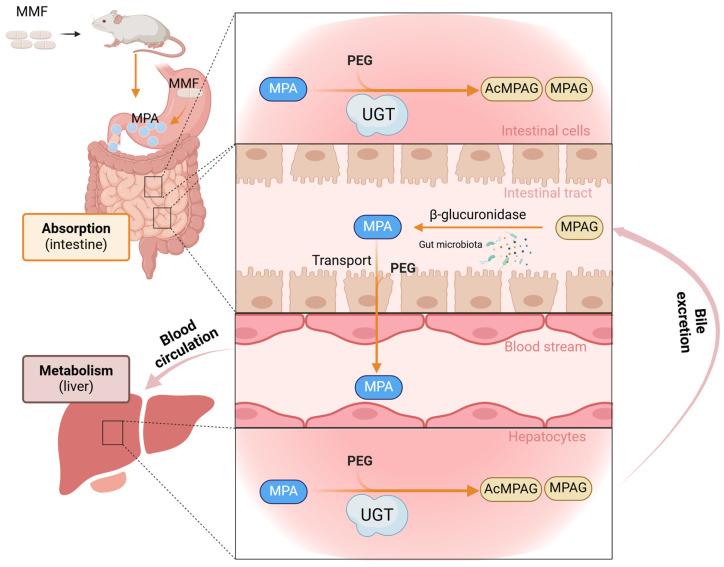
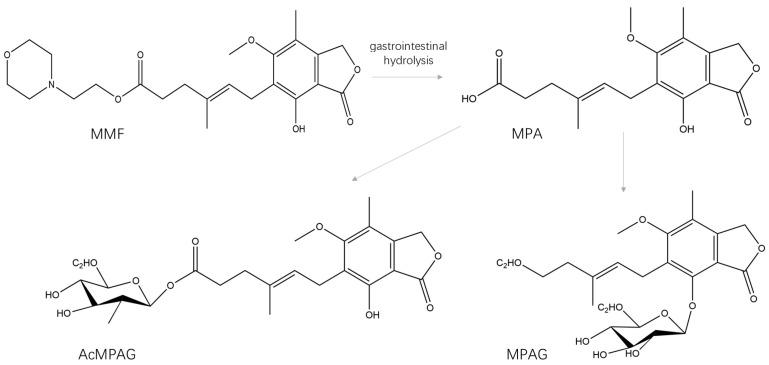
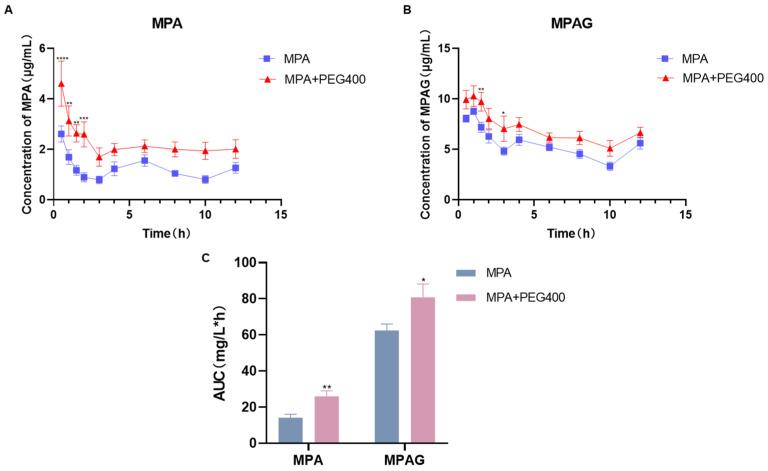
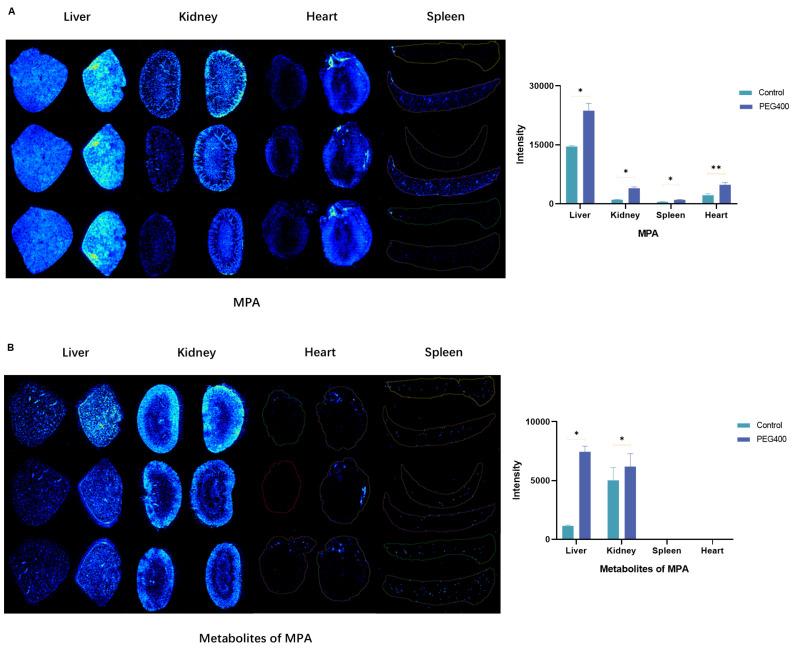
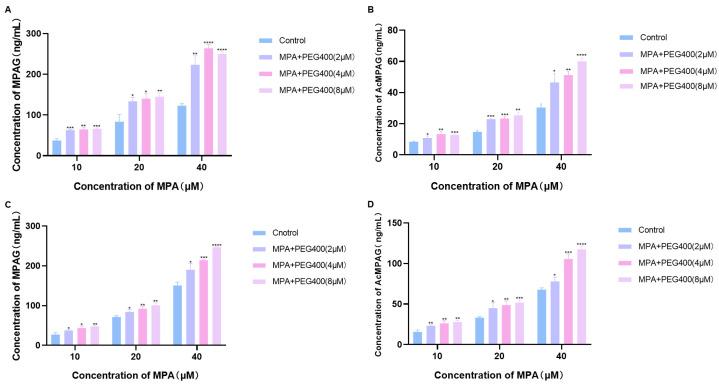
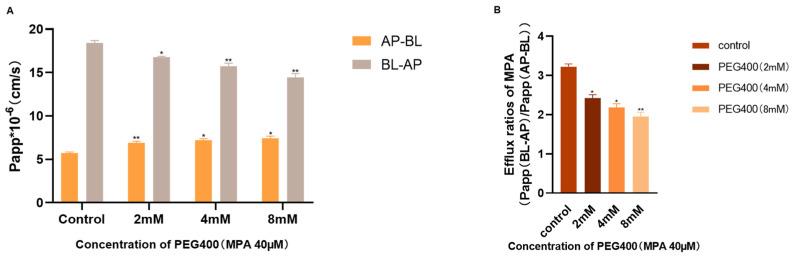
Mycophenolic acid (MPA) is a commonly used immunosuppressant. In the human body, MPA is metabolized into mycophenolic acid 7-O-glucuronide (MPAG) and mycophenolic acid acyl-glucuronide (AcMPAG) mainly through liver glucuronidation, which involves UDP-glucuronosyltransferase (UGTs) and transfer proteins. Research has indicated that the pharmaceutical excipient PEG400 can impact drug processes in the body, potentially affecting the pharmacokinetics of MPA. Due to the narrow therapeutic window of MPA, combination therapy is often used, and PEG400 is widely used in pharmaceutical preparations. Therefore, investigating the pharmacokinetic influence of PEG400 on MPA could offer valuable insights for optimizing MPA's clinical use. In this study, we examined the impact of a single oral dose of PEG400 on the blood levels of MPA in rats through pharmacokinetic analysis. We also investigated the distribution of MPA in various tissues using mass spectrometry imaging. We explored the potential mechanism by which PEG400 affects the metabolism of MPA using hepatic and intestinal microsomes and the Caco-2 cellular transporter model. Our findings reveal that the overall plasma concentrations of MPA were elevated in rats following the co-administration of PEG400, with the AUC of MPA and its metabolite MPAG increasing by 45.53% and 29.44%, respectively. Mass spectrometry imaging showed increased MPA content in tissues after PEG400 administration, with significant differences in the metabolites observed across different tissues. Microsomal and transport experiments showed that PEG400 accelerated the metabolism of MPA, promoted the uptake of MPA, and inhibited efflux. In conclusion, PEG400 alters the in vivo metabolism of MPA, potentially through the modulation of metabolic enzymes and transport.
霉酚酸(MPA)是一种常用的免疫抑制剂。在人体内,MPA主要通过肝脏葡萄糖醛酸化代谢为霉酚酸7 - O - 葡萄糖醛酸苷(MPAG)和霉酚酸酰基 - 葡萄糖醛酸苷(AcMPAG),这一过程涉及尿苷二磷酸葡萄糖醛酸转移酶(UGTs)和转运蛋白。研究表明,药用辅料聚乙二醇400(PEG400)会影响药物在体内的过程,可能会影响MPA的药代动力学。由于MPA的治疗窗较窄,常采用联合治疗,且PEG400广泛应用于药物制剂中。因此,研究PEG400对MPA药代动力学的影响可为优化MPA的临床应用提供有价值的见解。在本研究中,我们通过药代动力学分析研究了单次口服PEG400对大鼠体内MPA血药浓度的影响。我们还使用质谱成像研究了MPA在各种组织中的分布。我们利用肝微粒体和肠微粒体以及Caco - 2细胞转运模型探讨了PEG400影响MPA代谢的潜在机制。我们的研究结果表明,在大鼠中联合给予PEG400后,MPA的总体血浆浓度升高,MPA及其代谢物MPAG的曲线下面积分别增加了45.53%和29.44%。质谱成像显示,给予PEG400后组织中MPA含量增加,不同组织中观察到的代谢物存在显著差异。微粒体和转运实验表明,PEG400加速了MPA的代谢,促进了MPA的摄取,并抑制了外排。总之,PEG400可能通过调节代谢酶和转运来改变MPA在体内的代谢。


 Zotero 插件