
信息意识对日本民众人乳头瘤病毒疫苗接种意愿态度的影响。
Effect of information awareness on attitudes toward human papillomavirus vaccination intentions in Japan.
作者信息
Takahashi Takayuki, Kinoshita Takahiro, Shigemi Daisuke, Imanishi Yousuke, Sakamoto Masahiko, Ichimiya Megumi, Mitsunami Makiko, Song Mihyon, Inaba Kanako
机构信息
Department of Obstetrics and Gynecology, Federation of National Public Service Personnel Mutual Aid Associations, Tachikawa Hospital, Tokyo, Japan.
Minpapi Association, Tokyo, Japan.
出版信息
Vaccine X. 2024 Dec 10;22:100599. doi: 10.1016/j.jvacx.2024.100599. eCollection 2025 Jan.
BACKGROUND
The Human Papillomavirus (HPV) vaccination rate among Japanese high school girls remains critically low, reflecting ongoing public apprehension and misinformation. This study explores the relationship between information presentation and attitudes toward HPV vaccination in Japan.
METHODS
We conducted a web-based survey of female high school students aged 15 to 16 and mothers of daughters of similar age across Japan. The first screening questionnaire investigated the vaccine uptake among eligible students. The detailed questions assessing awareness of HPV vaccination information, including vaccine eligibility and its cost, effectiveness, lifetime prevalence of HPV infection, and vaccine safety, were asked to the respondents. After presenting each piece of information, we investigated how the information influenced the vaccination attitudes of unvaccinated students and mothers of unvaccinated girls.
RESULTS
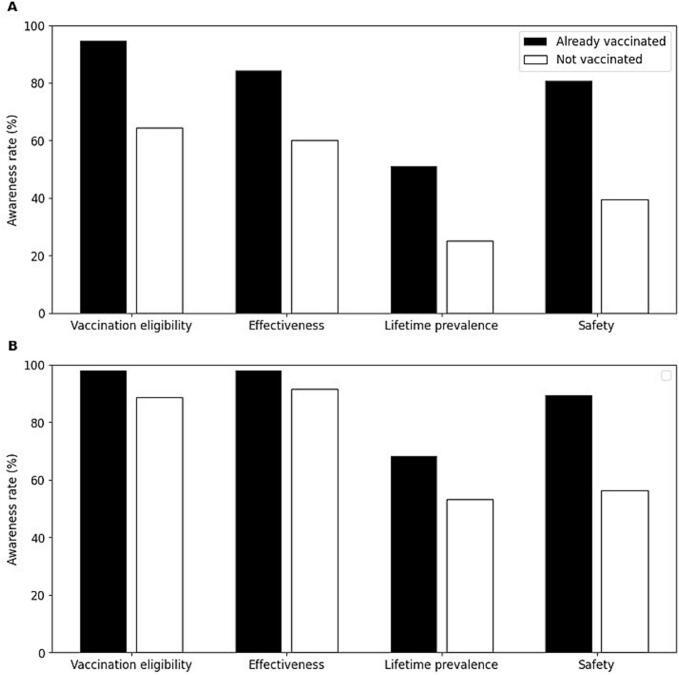
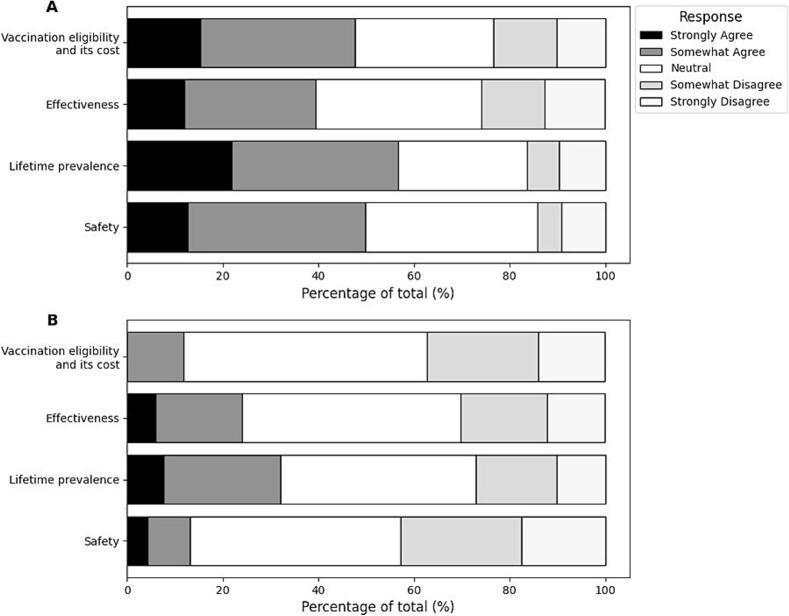
Data collection occurred from August 20 to August 24, 2021. Of 473 students, 68 (14.4 %) had already been vaccinated before the study. Over half of the 245 participating students were aware of vaccine eligibility and cost (68.7 %) and effectiveness (63.6 %), but fewer understood lifetime prevalence (28.7 %) and safety (45.3 %). In contrast, awareness of the same questions in 245 mothers was higher than that in the students: 90.2 %, 92.5 %, 55.4 %, and 61.1 %, respectively. Among unvaccinated students and mothers of unvaccinated girls, the intention to get vaccinated increased the most after being informed about the lifetime risks of HPV infection; 50.5 % of students and 38.8 % of mothers showed a positive attitude toward the HPV vaccination.
CONCLUSIONS
Bridging the awareness gap between students and mothers is crucial for improving HPV vaccination rates. The findings underscore the potential of specific, targeted information to influence vaccination intentions, particularly regarding the HPV infection rate.
背景
日本高中女生的人乳头瘤病毒(HPV)疫苗接种率仍然极低,这反映出公众持续存在的担忧和错误信息。本研究探讨了日本信息呈现方式与对HPV疫苗接种态度之间的关系。
方法
我们对日本全国15至16岁的高中女生以及同龄女孩的母亲进行了一项基于网络的调查。首轮筛查问卷调查了符合条件的学生的疫苗接种情况。向受访者询问了评估HPV疫苗接种信息知晓情况的详细问题,包括疫苗接种资格及其费用、有效性、HPV感染的终生患病率以及疫苗安全性。在呈现每条信息后,我们调查了这些信息如何影响未接种疫苗的学生以及未接种疫苗女孩的母亲的接种态度。
结果
数据收集于2021年8月20日至8月24日进行。在473名学生中,68名(14.4%)在研究之前已经接种了疫苗。在245名参与调查的学生中,超过一半的人知晓疫苗接种资格和费用(68.7%)以及有效性(63.6%),但了解终生患病率(28.7%)和安全性(45.3%)的人较少。相比之下,245名母亲对相同问题的知晓率高于学生,分别为90.2%、92.5%、55.4%和61.1%。在未接种疫苗的学生以及未接种疫苗女孩的母亲中,在得知HPV感染的终生风险后,接种意愿增加最为明显;50.5%的学生和38.8%的母亲对HPV疫苗接种持积极态度。
结论
弥合学生和母亲之间的认知差距对于提高HPV疫苗接种率至关重要。研究结果强调了特定的、有针对性的信息影响接种意愿的潜力,特别是关于HPV感染率的信息。




 Zotero 插件