
多发性骨髓瘤、髓外疾病和浆细胞白血病中骨髓浆细胞外泌体的微小RNA分析
MicroRNA Profiling of Bone Marrow Plasma Extracellular Vesicles in Multiple Myeloma, Extramedullary Disease, and Plasma Cell Leukemia.
作者信息
Gregorova Jana, Vlachova Monika, Vychytilova-Faltejskova Petra, Dostalova Adela, Ruzickova Tereza, Vecera Marek, Radova Lenka, Pospichalova Vendula, Sladecek Stanislava, Hyzdalova Martina, Kotaskova Jana, Jarosova Marie, Masek Josef, Benesova Klara, Jarkovsky Jiri, Rihova Lucie, Bezdekova Renata, Almasi Martina, Boichuk Ivanna, Stork Martin, Pour Ludek, Sevcikova Sabina
机构信息
Babak Myeloma Group, Department of Pathophysiology, Faculty of Medicine, Masaryk University, Brno, Czech Republic.
Centre for Molecular Medicine, Central European Institute of Technology, Masaryk University, Brno, Czech Republic.
出版信息
Hematol Oncol. 2025 Jan;43(1):e70036. doi: 10.1002/hon.70036.
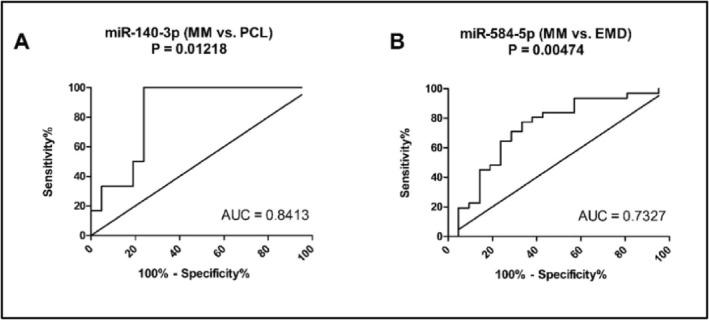
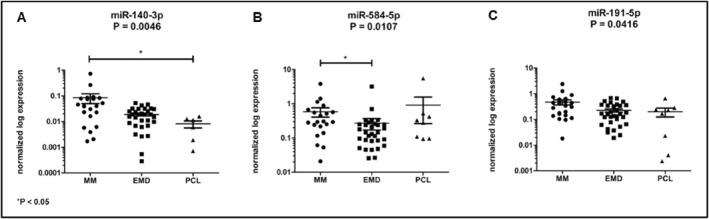
Multiple myeloma is a plasma cell malignancy characterized by an abnormal increase in monoclonal immunoglobulins. Despite significant advances in treatment, some patients progress to more aggressive forms of multiple myeloma, including extramedullary disease or plasma cell leukemia. Although the exact molecular mechanisms are not known, several studies have confirmed the involvement of small extracellular vesicle-enriched microRNAs in multiple myeloma progression. Therefore, we performed expression profiling of these molecules in bone marrow plasma of multiple myeloma, extramedullary disease, and plasma cell leukemia patients using small RNA sequencing to identify novel molecules involved in disease pathogenesis. In total, 42 microRNAs were significantly dysregulated among analyzed subgroups. Independent validation by RT-qPCR confirmed elevated levels of miR-140-3p, miR-584-5p, miR-191-5p, and miR-143-3p in multiple myeloma patients compared to extramedullary disease and plasma cell leukemia patients. Subsequent statistical analysis revealed significant correlations between patient clinical characteristics or flow cytometry parameters and microRNA expression. These results indicate that dysregulation of microRNAs could contribute to multiple myeloma progression.
多发性骨髓瘤是一种浆细胞恶性肿瘤,其特征为单克隆免疫球蛋白异常增加。尽管治疗取得了显著进展,但一些患者会进展为更具侵袭性的多发性骨髓瘤形式,包括髓外疾病或浆细胞白血病。虽然确切的分子机制尚不清楚,但多项研究已证实富含小细胞外囊泡的微小RNA参与了多发性骨髓瘤的进展。因此,我们使用小RNA测序对多发性骨髓瘤、髓外疾病和浆细胞白血病患者的骨髓浆中的这些分子进行表达谱分析,以鉴定参与疾病发病机制的新分子。在分析的亚组中,共有42种微小RNA显著失调。通过RT-qPCR进行的独立验证证实,与髓外疾病和浆细胞白血病患者相比,多发性骨髓瘤患者中miR-140-3p、miR-584-5p、miR-191-5p和miR-143-3p的水平升高。随后的统计分析显示,患者临床特征或流式细胞术参数与微小RNA表达之间存在显著相关性。这些结果表明,微小RNA的失调可能促进多发性骨髓瘤的进展。

 Zotero 插件