
急性髓系白血病中坏死性凋亡相关基因的筛选及其预后能力、临床价值和拷贝数变异影响的评估
Screening of necroptosis-related genes and evaluating the prognostic capacity, clinical value, and the effect of their copy number variations in acute myeloid leukemia.
作者信息
Wen Dake, Yan Ru, Zhang Lin, Zhang Haoyang, Chen Xuyang, Zhou Jian
机构信息
The Affiliated Wuxi People's Hospital of Nanjing Medical University, Wuxi Children's Hospital, Wuxi, 214023, China.
Department of Pediatric Laboratory, The Affiliated Wuxi People's Hospital of Nanjing Medical University, Wuxi Children's Hospital, 299-1, QingYang Road, Wuxi, 214023, China.
出版信息
BMC Cancer. 2025 Jan 13;25(1):71. doi: 10.1186/s12885-025-13439-y.
BACKGROUND
Acute myeloid leukemia (AML) is an aggressive hematological neoplasm. Little improvement in survival rates has been achieved over the past few decades. Necroptosis has relationship with certain types of malignancies outcomes. Here, we evaluated the diagnostic ability, prognostic capacity of necroptosis-related genes (NRGs) and the effect of their copy number variations (CNVs) in AML.
METHODS
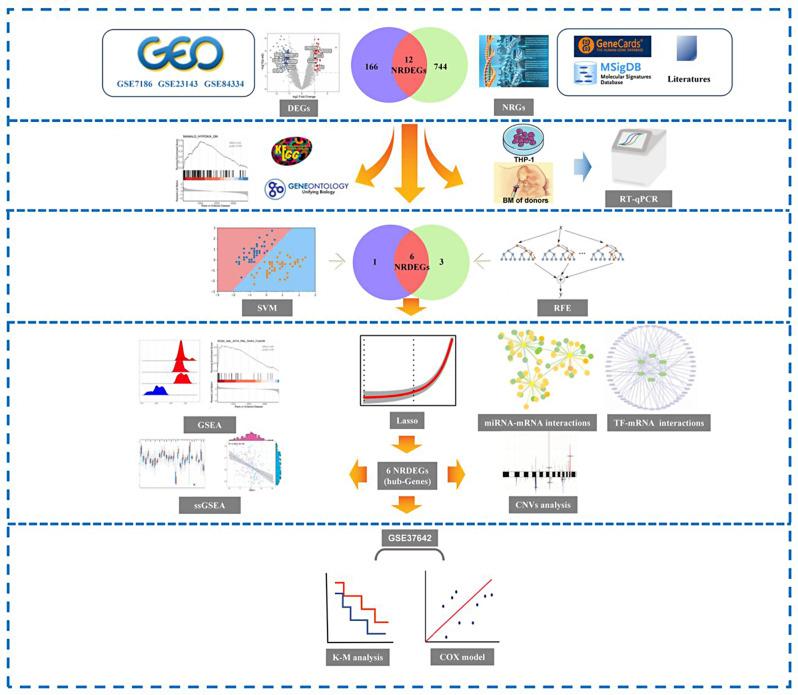
Necroptosis-related differentially expressed genes (NRDEGs) were identified after intersecting differentially expressed genes (DEGs) from the Gene Expression Omnibus(GEO) database with NRGs from GeneCards, the Molecular Signatures Database (MSigDB) and literatures. Machine learning was applied to obtain hub-NRDEGs. The expression levels of the hub-NRDEGs were validated in vitro. The mRNA-miRNA and mRNA-TF interaction networks with the hub-NRDEGs were screened using Cytoscape. Single-sample gene set enrichment analysis (ssGSEA) was utilized to calculate correlations between the hub-NRDEGs and immune cells. CNV analysis of the hub-NRDEGs was carried out on the TCGA-LAML datasets from the TCGA database. Kaplan-Meier (K-M) survival analyses were utilized to evaluate the prognostic values along with Cox model.
RESULTS
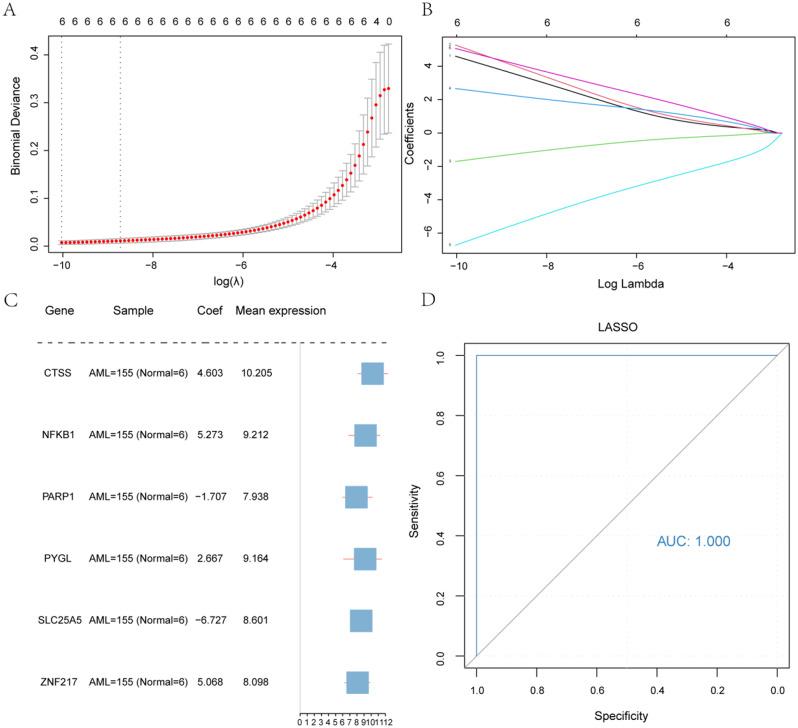
Six hub-NRDEGs (SLC25A5, PARP1, CTSS, ZNF217, NFKB1, and PYGL) were obtained and their expression changes derived from CNVs in AML were visualized. In total, 65 mRNA-miRNA and 80 mRNA-TF interaction networks with hub-NRDEGs were screened. The ssGSEA result showed the expression of RAPR1 was inversely related to CD56 natural killer cells and the expression of CTSS was positive related to Myeloid-derived suppressor cells (MDSCs) in AML. The K-M results demonstrated that ZNF217 had significant difference in the duration of survival in AML patients. Cox regression models revealed that the hub-NRDEGs had better predictive power at year-1 and year-5.
CONCLUSION
These screened NRDEGs can be exploited as clinical prognostic predictions in AML patients, as well as potential biomarkers for diagnosis and therapeutic targeting.
背景
急性髓系白血病(AML)是一种侵袭性血液肿瘤。在过去几十年中,生存率几乎没有提高。坏死性凋亡与某些类型的恶性肿瘤预后有关。在此,我们评估了坏死性凋亡相关基因(NRGs)在AML中的诊断能力、预后价值及其拷贝数变异(CNVs)的影响。
方法
将来自基因表达综合数据库(GEO)的差异表达基因(DEGs)与来自基因卡、分子特征数据库(MSigDB)和文献的NRGs进行交叉,以鉴定坏死性凋亡相关差异表达基因(NRDEGs)。应用机器学习获得核心NRDEGs。在体外验证核心NRDEGs的表达水平。使用Cytoscape筛选与核心NRDEGs相关的mRNA-miRNA和mRNA-TF相互作用网络。利用单样本基因集富集分析(ssGSEA)计算核心NRDEGs与免疫细胞之间的相关性。对来自TCGA数据库的TCGA-LAML数据集进行核心NRDEGs的CNV分析。采用Kaplan-Meier(K-M)生存分析和Cox模型评估预后价值。
结果
获得了6个核心NRDEGs(SLC25A5、PARP1、CTSS、ZNF217、NFKB1和PYGL),并可视化了AML中由CNVs引起的它们的表达变化。总共筛选出65个与核心NRDEGs相关的mRNA-miRNA和80个mRNA-TF相互作用网络。ssGSEA结果显示,在AML中,RAPR1的表达与CD56自然杀伤细胞呈负相关,CTSS的表达与髓系来源的抑制细胞(MDSCs)呈正相关。K-M结果表明,ZNF217在AML患者的生存时间上有显著差异。Cox回归模型显示,核心NRDEGs在第1年和第5年具有更好的预测能力。
结论
这些筛选出的NRDEGs可作为AML患者临床预后预测指标,以及诊断和治疗靶点的潜在生物标志物。


 Zotero 插件