
原位黑色素瘤替代诊断标签对管理选择和心理结果的影响:一项在线随机研究方案
Impact of alternative diagnostic labels for melanoma in situ on management choices and psychological outcomes: protocol for an online randomised study.
作者信息
Wu Zhuohan, Nickel Brooke, Boroumand Farzaneh, Elder David, Ferguson Peter M, Scolyer Richard A, O'Brien Blake, Barnhill Raymond, Adamson Adewole S, van Akkooi Alexander C J, Emery Jon, Parker Lisa, Low Donald, Low Cynthia, Davies Elspeth, Liu Sherrie, Lewis Stacey, Spongberg-Ross Bella, Bell Katy Jl
机构信息
Wiser Healthcare collabration, Sydney School of Public Health, Faculty of Medicine and Health, The University of Sydney, Sydney, New South Wales, Australia.
Sydney School of Public Health, Faculty of Medicine and Health, University of Sydney, Sydney, New South Wales, Australia.
出版信息
BMJ Open. 2024 Dec 20;14(12):e089558. doi: 10.1136/bmjopen-2024-089558.
INTRODUCTION
A diagnosis of melanoma in situ presents negligible risk to a person's lifespan or physical well-being, but existing terminology makes it difficult for patients to distinguish these from higher risk invasive melanomas. This study aims to explore whether using an alternative label for melanoma in situ may influence patients' management choices and anxiety levels.
METHODS AND ANALYSIS
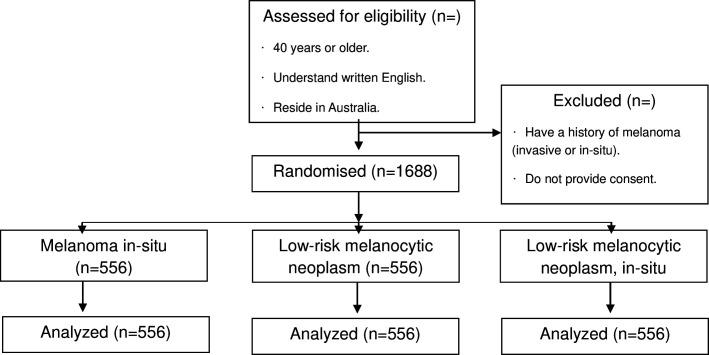
This study is a between-subjects randomised online experiment, using hypothetical scenarios. Following consent, eligible participants will be randomised 1:1:1 to three labels: 'melanoma in situ' (control), 'low-risk melanocytic neoplasm' (intervention 1) and 'low-risk melanocytic neoplasm, in situ' (intervention 2). The required sample size is 1668 people. The co-primary outcomes are (1) choice between no further surgery or further surgery to ensure clear histological margins greater than 5 mm and (2) choice between patient-initiated clinical follow-up when needed (patient-led surveillance) and regular routinely scheduled clinical follow-up (clinician-led surveillance). Secondary outcomes include diagnosis anxiety, perceived risk of invasive melanoma and of dying from melanoma and management choice anxiety (after surgery choice and follow-up choice). We will make pairwise comparisons across the three diagnostic label groups using regression models (univariable and multivariable).
ETHICS AND DISSEMINATION
The study has been registered with the Australian New Zealand Clinical Trials Registry (ACTRN12624000740594). Ethics approval has been received from The University of Sydney Human Research Ethics Committee (2024/HE000019). The results of the study will be published in a peer-reviewed medical journal, and a plain language summary of the findings will be shared on the Wiser Healthcare publication page (https://www.wiserhealthcare.org.au/category/publications/).
TRIAL REGISTRATION NUMBER
Australian New Zealand Clinical Trials Registry (ID 386943).
引言
原位黑色素瘤的诊断对一个人的寿命或身体健康造成的风险可忽略不计,但现有的术语使患者难以将其与更高风险的侵袭性黑色素瘤区分开来。本研究旨在探讨使用原位黑色素瘤的替代标签是否会影响患者的治疗选择和焦虑水平。
方法与分析
本研究是一项采用假设情景的组间随机在线实验。获得同意后,符合条件的参与者将按1:1:1随机分配到三个标签组:“原位黑色素瘤”(对照组)、“低风险黑素细胞肿瘤”(干预1组)和“原位低风险黑素细胞肿瘤”(干预2组)。所需样本量为1668人。共同主要结局为:(1)在不进行进一步手术与进行进一步手术以确保组织学切缘清晰大于5毫米之间的选择;(2)在必要时患者自主发起临床随访(患者主导监测)与定期常规安排的临床随访(临床医生主导监测)之间的选择。次要结局包括诊断焦虑、侵袭性黑色素瘤的感知风险、因黑色素瘤死亡的感知风险以及治疗选择焦虑(手术选择和随访选择之后)。我们将使用回归模型(单变量和多变量)对三个诊断标签组进行两两比较。
伦理与传播
该研究已在澳大利亚新西兰临床试验注册中心注册(注册号:ACTRN12624000740594)。已获得悉尼大学人类研究伦理委员会的伦理批准(2024/HE000019)。研究结果将发表在同行评审的医学杂志上,研究结果的通俗易懂的总结将在明智医疗保健出版物页面(https://www.wiserhealthcare.org.au/category/publications/)上分享。
试验注册号
澳大利亚新西兰临床试验注册中心(编号:386943)
 Zotero 插件