
在埃塞俄比亚女性队列中,连续护理过程中的多次咨询接触对产后计划生育使用情况的影响:剂量反应分析
Effect of multiple counselling contacts along the continuum of care on use of postpartum family planning in a cohort of Ethiopian women: a dose-response analysis.
作者信息
Pfitzer Anne, Jima Gebi Husein, Sitrin Deborah, Ayalew Firew, Ahmed Saifuddin
机构信息
MOMENTUM Country and Global Leadership, Jhpiego Corporation, Baltimore, Maryland, USA
Department of Public Health, College of Health Sciences, Arsi University, Asella, Oromia, Ethiopia.
出版信息
BMJ Open. 2024 Dec 20;14(12):e084247. doi: 10.1136/bmjopen-2024-084247.
OBJECTIVE
Dose-response analysis of the effect of each additional contact where family planning (FP) was discussed during antenatal, delivery, postnatal or immunisation visits on the uptake of postpartum family planning (PPFP) within 12 months.
DESIGN
A cohort where pregnant women were enrolled and reinterviewed approximately 12 months postpartum. Life table analyses examined differentials in probabilities of adopting contraception over 12 months postpartum by level of exposure to FP counselling. Competing risks regression analysis examined the dose effects in HRs by the number of maternal, newborn or child health (MNCH) contacts where FP was discussed, adjusted for confounding covariates.
SETTING
Two Arsi zone woredas: Oromia and Ethiopia.
PARTICIPANTS AND MEASURES
722 pregnant women enrolled, and 706 successfully reinterviewed 12 months postpartum about each MNCH contact during pregnancy, delivery and later visits, whether these included any PPFP counselling and PPFP use.
MAIN RESULTS
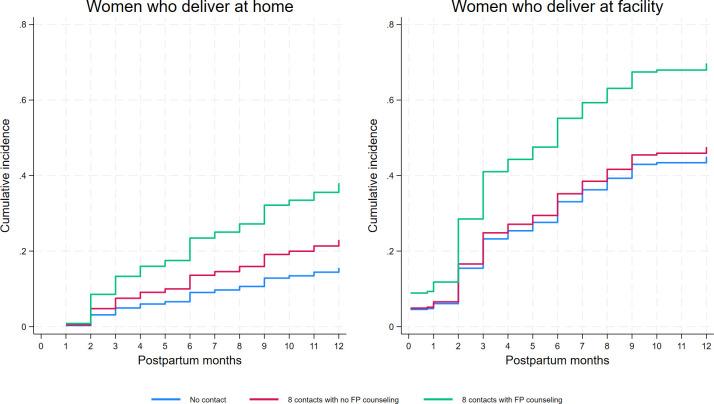
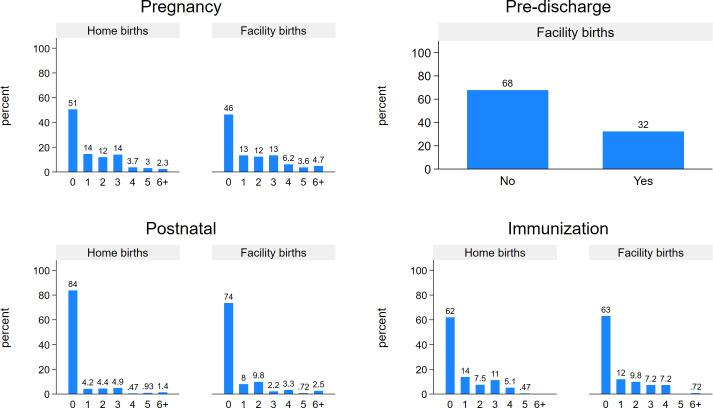
Two-thirds of the cohort delivered at home. The average number of MNCH contacts women received was 7.6, while the average number where FP was discussed was 2.8. The cumulative probability of PPFP uptake was higher for women who received FP information during at least one MNCH contact, regardless of place of delivery. Each additional MNCH contact where FP was discussed increased the likelihood of PPFP uptake by 14% (95% CI 8% to 20%) or 9% (95% CI 5% to 13%), depending on place of birth. PPFP did not increase with additional contacts without FP information.
CONCLUSIONS
While PPFP conversations immediately after a facility birth generated the greatest chance of affecting use, integrating at every visit in the continuum had more impact.
TRIAL REGISTRATION NUMBER
ClinicalTrials.gov, NCT03585361.
目的
分析在产前、分娩、产后或免疫接种访视期间每增加一次讨论计划生育(FP)的接触对产后12个月内产后计划生育(PPFP)采用率的剂量反应。
设计
一项队列研究,纳入孕妇并在产后约12个月进行再次访谈。生命表分析通过接触FP咨询的程度来研究产后12个月内采用避孕措施概率的差异。竞争风险回归分析通过讨论FP的孕产妇、新生儿或儿童健康(MNCH)接触次数来检验风险比(HRs)中的剂量效应,并对混杂协变量进行调整。
地点
奥罗米亚和埃塞俄比亚的两个阿尔西地区沃雷达斯。
参与者和测量方法
纳入722名孕妇,706名在产后12个月成功接受再次访谈,询问她们在孕期、分娩及后续访视期间的每次MNCH接触情况,包括是否有任何PPFP咨询及PPFP的使用情况。
主要结果
队列中三分之二的产妇在家分娩。女性接受的MNCH接触平均次数为7.6次,而讨论FP的平均次数为2.8次。无论分娩地点如何,至少在一次MNCH接触中获得FP信息的女性,PPFP采用的累积概率更高。根据出生地点,每增加一次讨论FP的MNCH接触,PPFP采用的可能性增加14%(95%可信区间8%至20%)或9%(95%可信区间5%至13%)。没有FP信息的额外接触不会增加PPFP采用率。
结论
虽然在机构分娩后立即进行PPFP对话对影响使用的机会最大,但在连续的每次访视中纳入相关内容影响更大。
试验注册号
ClinicalTrials.gov,NCT03585361。


 Zotero 插件