
巴基斯坦信德省农村和郊区院外心脏骤停的特征与结局:一项横断面研究。
Characteristics and outcomes of out-of-hospital-cardiac-arrest in rural and suburban areas of Sindh, Pakistan: A cross-sectional study.
作者信息
Noor Ali Baig Mirza, Fatmi Zafar, Khan Nadeem Ullah, Rahim Khan Uzma, Raheem Ahmed, Abdul Razzak Junaid
机构信息
Department of Emergency Medicine, The Aga Khan University Hospital, Karachi, Pakistan.
Centre of Excellence for Trauma & Emergencies, The Aga Khan University, Karachi, Pakistan.
出版信息
Resusc Plus. 2024 Dec 12;21:100840. doi: 10.1016/j.resplu.2024.100840. eCollection 2025 Jan.
BACKGROUND
Despite extensive research on OHCA in urban centres worldwide, there is a significant gap in knowledge regarding these events in less urbanized regions, especially in Low-Middle-Income Countries (LMICs).
AIM
To determine the characteristics and outcomes of adult out-of-hospital cardiac arrest (OHCA) in rural and suburban districts of Sindh, Pakistan.
METHODS
Data of OHCA patients (>18 years) was collected retrospectively from January 2020 to December 2022, from the medical records of district and tehsil hospitals of the province of Sindh Data analysis was performed using the Statistical Package Software for the Social Sciences (SPSS) Statistics 29.
RESULTS
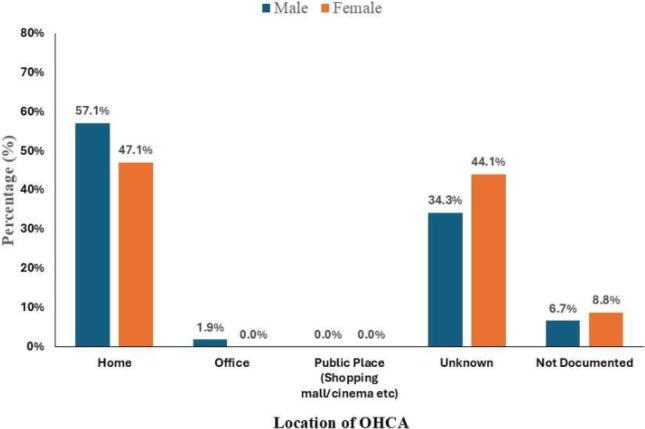
Out of 139 OHCA patients, 75.5 % were males, and 24.5 % were females, with a mean age of 52.78 ± 13.1 years. Most cardiac arrests occurred at home (54.75 %). Only 0.7 % of patients were transported by emergency medical services (EMS), while 59 % arrived via private transport, such as cars or vans. An additional 4.3 % were brought by other ambulance services, including private and philanthropic organizations, and for 36 % of patients, the mode of transportation was undocumented. Cardiac arrests were witnessed in 43.2 % of cases. CPR (either in-hospital or pre-hospital) was performed on 59 % of patients, but only 6.1 % received pre-hospital CPR (Bystander: 1.22 %, Ambulance Staff: 2.44 %, Family Member: 2.44 %). Return of spontaneous circulation (ROSC) was achieved in 14.63 % of patients, while 4.88 % were alive at hospital admission.
CONCLUSION
This study highlights significant gaps in the chain of survival for OHCA patients in rural and suburban Sindh, Pakistan, including inadequate EMS utilization, low bystander CPR rates, and delayed hospital care, contributing to poor outcomes. The findings may underestimate true rates due to missing and inconsistent data, emphasizing the need for improved documentation and prospective studies.
背景
尽管全球范围内对城市中心地区的院外心脏骤停(OHCA)进行了广泛研究,但在城市化程度较低的地区,尤其是在中低收入国家(LMICs),关于这些事件的知识仍存在重大差距。
目的
确定巴基斯坦信德省农村和郊区成人院外心脏骤停(OHCA)的特征和结局。
方法
回顾性收集2020年1月至2022年12月期间信德省地区和乡级医院医疗记录中OHCA患者(>18岁)的数据。使用社会科学统计软件包(SPSS)Statistics 29进行数据分析。
结果
在139例OHCA患者中,75.5%为男性,24.5%为女性,平均年龄为52.78±13.1岁。大多数心脏骤停发生在家中(54.75%)。只有0.7%的患者由紧急医疗服务(EMS)转运,而59%的患者通过私人交通工具(如汽车或货车)抵达。另外4.3%的患者由其他救护车服务(包括私人和慈善组织)送来,36%患者的交通方式未记录。43.2%的病例中有人目睹心脏骤停。59%的患者接受了心肺复苏(院内或院前),但只有6.1%的患者接受了院前心肺复苏(旁观者:1.22%,救护人员:2.44%,家庭成员:2.44%)。14.63%的患者实现了自主循环恢复(ROSC),4.88%的患者入院时存活。
结论
本研究突出了巴基斯坦信德省农村和郊区OHCA患者生存链中的重大差距,包括紧急医疗服务利用不足、旁观者心肺复苏率低以及医院护理延迟,导致结局不佳。由于数据缺失和不一致,研究结果可能低估了实际发生率,强调了改进记录和前瞻性研究的必要性。
 Zotero 插件