
基于生物信息学方法和实验验证探索迷迭香酸治疗肺腺癌的机制
Exploring the mechanism of rosmarinic acid in the treatment of lung adenocarcinoma based on bioinformatics methods and experimental validation.
作者信息
Zhou Chaowang, Zhong Ruqian, Zhang Lei, Yang Renyi, Luo Yuxin, Lei Huijun, Li Liang, Cao Jianzhong, Yuan Zhiying, Tan Xiaoning, Xie Mengzhou, Qu Haoyu, He Zuomei
机构信息
Hunan University of Chinese Medicine, 300 Xueshi Road, Yuelu District, Changsha, 410208, Hunan, China.
Hunan Provincial Key Laboratory of Traditional Chinese Medicine Diagnostics, Changsha, 410208, Hunan, China.
出版信息
Discov Oncol. 2025 Jan 15;16(1):47. doi: 10.1007/s12672-025-01784-0.
OBJECTIVE
Rosmarinic acid (RosA) is a natural polyphenol compound that has been shown to be effective in the treatment of inflammatory disease and a variety of malignant tumors. However, its specific mechanism for the treatment of lung adenocarcinoma (LUAD) has not been fully elucidated. Therefore, this study aims to clarify the mechanism of RosA in the treatment of LUAD by integrating bioinformatics, network pharmacology and in vivo experiments, and to explore the potential of the active ingredients of traditional Chinese medicine in treating LUAD.
METHODS
Firstly, the network pharmacology was used to screen the RosA targets, and LUAD-related differential expressed genes (DEGs) were acquired from the GEO database. The intersection of LUAD regulated by RosA (RDEGs) was obtained through the Venn diagram. Secondly, GO and KEGG enrichment analysis of RDEGs were performed, and protein-protein interaction networks (PPIs) were constructed to identify and visualize hub RDEGs. Then, molecular docking between hub RDEGs and RosA was performed, and further evaluation was carried out by using bioinformatics for the predictive value of the hub RDEGs. Finally, the mechanism of RosA in the treatment of LUAD was verified by establishing a xenograft model of NSCLC in nude mouse.
RESULTS
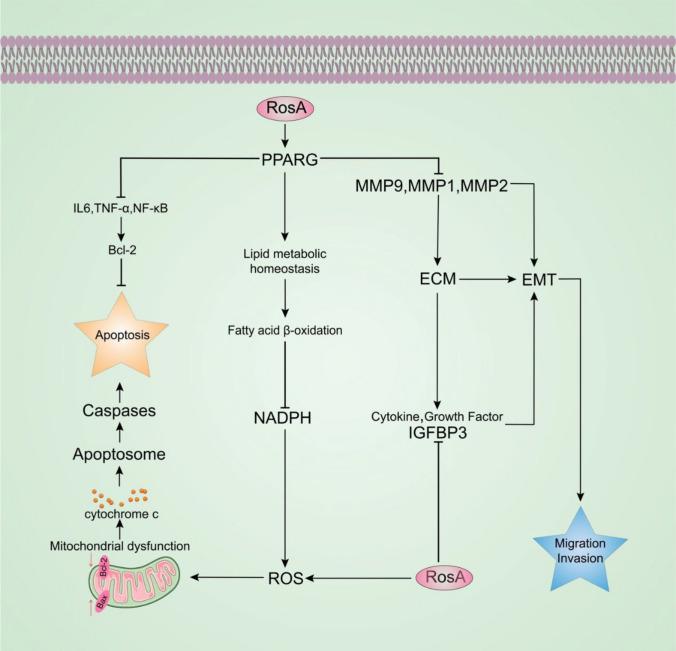
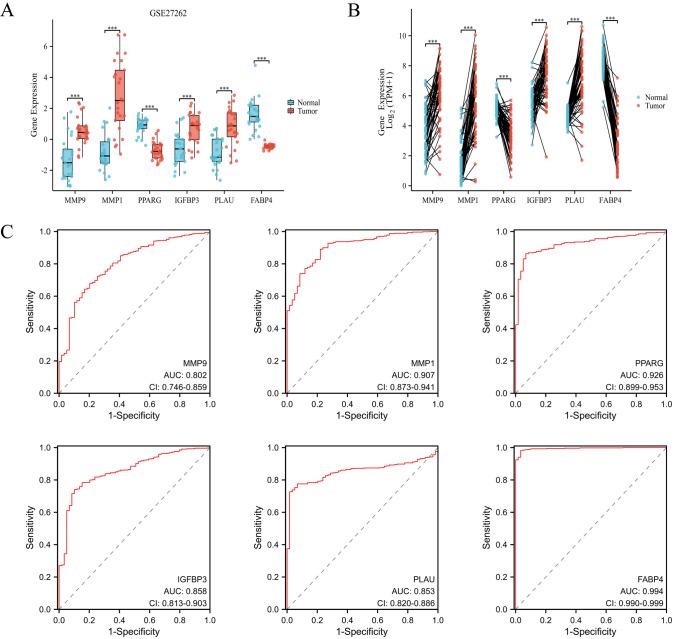
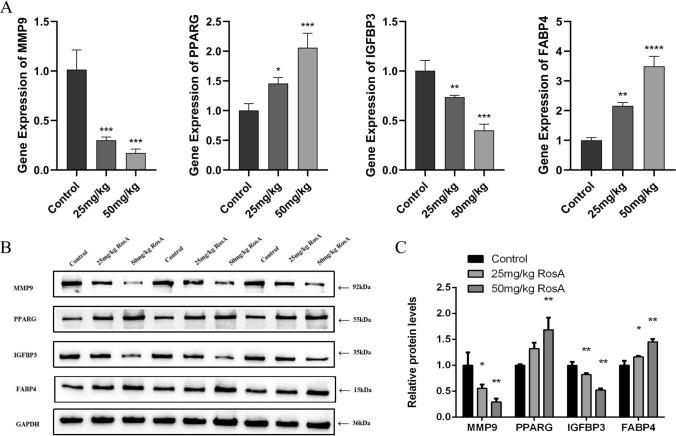
Bioinformatics and other analysis showed that, compared with the control group, the expressions of MMP-1, MMP-9, IGFBP3 and PLAU in LUAD tissues were significantly up-regulated, and the expressions of PPARG and FABP4 were significantly down-regulated, and these hub RDEGs had potential predictive value for LUAD. In vivo experimental results showed that RosA could inhibit the growth of transplanted tumors in nude mice bearing tumors of lung cancer cells, reduce the positive expression of Ki67 in lung tumor tissue, and hinder the proliferation of lung tumor cells. Upregulated expression of PPARG and FABP4 by activating the PPAR signaling pathway increases the level of ROS in lung tumor tissues and promotes apoptosis of lung tumor cells. In addition, RosA can also reduce the expression of MMP-9 and IGFBP3, inhibit the migration and invasion of lung tumor tissue cells.
CONCLUSIONS
This study demonstrated that RosA could induce apoptosis by regulating the PPAR signaling pathway and the expression of MMP-9, inhibit the proliferation, migration and invasion of lung cancer cells, thereby exerting anti-LUAD effects. This study provides new insight into the potential mechanism of RosA in treating LUAD and provides a new therapeutic avenue for treatment of LUAD.
目的
迷迭香酸(RosA)是一种天然多酚化合物,已被证明在治疗炎症性疾病和多种恶性肿瘤方面有效。然而,其治疗肺腺癌(LUAD)的具体机制尚未完全阐明。因此,本研究旨在通过整合生物信息学、网络药理学和体内实验来阐明RosA治疗LUAD的机制,并探索中药活性成分治疗LUAD的潜力。
方法
首先,利用网络药理学筛选RosA靶点,并从GEO数据库中获取LUAD相关的差异表达基因(DEGs)。通过维恩图获得RosA调控的LUAD(RDEGs)的交集。其次,对RDEGs进行基因本体(GO)和京都基因与基因组百科全书(KEGG)富集分析,并构建蛋白质-蛋白质相互作用网络(PPIs)以识别和可视化核心RDEGs。然后,进行核心RDEGs与RosA之间的分子对接,并利用生物信息学对核心RDEGs的预测价值进行进一步评估。最后,通过建立裸鼠非小细胞肺癌(NSCLC)异种移植模型来验证RosA治疗LUAD的机制。
结果
生物信息学等分析表明,与对照组相比,LUAD组织中基质金属蛋白酶-1(MMP-1)、基质金属蛋白酶-9(MMP-9)、胰岛素样生长因子结合蛋白3(IGFBP3)和胎盘型纤溶酶原激活物(PLAU)的表达显著上调,而过氧化物酶体增殖物激活受体γ(PPARG)和脂肪酸结合蛋白4(FABP4)的表达显著下调,且这些核心RDEGs对LUAD具有潜在的预测价值。体内实验结果表明,RosA可抑制荷肺癌细胞裸鼠移植瘤的生长,降低肺肿瘤组织中Ki67的阳性表达,阻碍肺肿瘤细胞的增殖。通过激活PPAR信号通路上调PPARG和FABP4的表达可增加肺肿瘤组织中活性氧(ROS)水平,促进肺肿瘤细胞凋亡。此外,RosA还可降低MMP-9和IGFBP3的表达,抑制肺肿瘤组织细胞的迁移和侵袭。
结论
本研究表明,RosA可通过调节PPAR信号通路和MMP-9的表达诱导细胞凋亡,抑制肺癌细胞的增殖、迁移和侵袭,从而发挥抗LUAD作用。本研究为RosA治疗LUAD的潜在机制提供了新的见解,并为LUAD的治疗提供了新的治疗途径。




 Zotero 插件