
调整中国动态清零政策后估算新冠病毒病的累计感染率
Estimating cumulative infection rate of COVID-19 after adjusting the dynamic zero-COVID policy in China.
作者信息
Zhou Sijia, Lai Miao, Tang Shuhan, Liu Wen, Shen Mingwang, Peng Zhihang
机构信息
School of Public Health, Nanjing Medical University, Nanjing, 211166, China.
Chengdu Center for Disease Control and Prevention, Chengdu, 610041, China.
出版信息
Infect Dis Model. 2024 Dec 18;10(2):429-438. doi: 10.1016/j.idm.2024.12.012. eCollection 2025 Jun.
BACKGROUND
At the end of 2022, China adjusted its coronavirus disease 2019 (COVID-19) prevention and control strategy. How this adjustment affected the cumulative infection rate is debated, and how second booster dose vaccination affected the pandemic remains unclear.
METHODS
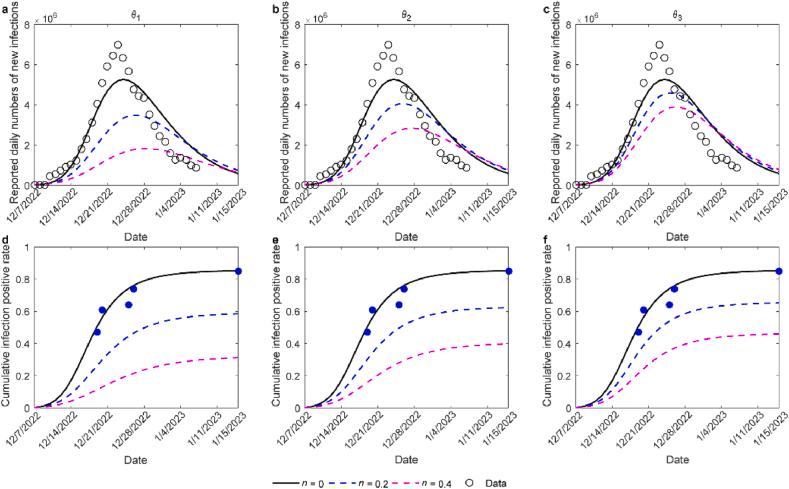
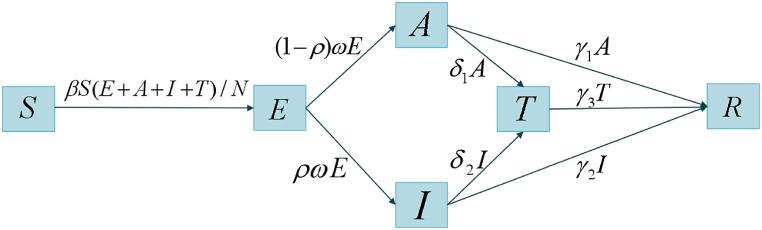
We collected COVID-19 case data for China's mainland from December 7, 2022, to January 7, 2023, reported by the World Health Organization. We also collected cumulative infection rate data from five large-scale population-based surveys. Next, we developed a dynamic transmission compartment model to characterize the COVID-19 pandemic and to estimate the cumulative infection rate. In addition, we estimated the impact of second booster vaccination on the pandemic by examining nine scenarios with different vaccination coverages (0%, 20%, and 40%) and vaccine effectiveness (30%, 50%, and 70%).
RESULTS
By January 7, 2023, when COVID-19 was classified as a Class B infectious disease, the cumulative infection rate of the Omicron variant nationwide had reached 84.11% (95% confidence interval [CI]: 78.13%-90.08%). We estimated that the cumulative infection rates reached 50.50% (95% CI: 39.58%-61.43%), 56.15% (95% CI: 49.05%-67.22%), 73.82% (95% CI: 64.63%-83.02%), 75.76% (95% CI: 67.02%-84.50%), and 84.99% (95% CI: 79.45%-90.53%) on December 19, 20, 25, and 26, 2022, and on January 15, 2023, respectively. These results are similar to those of the population survey conducted on the corresponding dates, that is 46.93%, 61%, 63.52%, 74%, and 84.7%, respectively. In addition, we estimated that by January 7, 2023, the cumulative infection rate decreased to 29.55% (64.25%) if vaccination coverage and the effectiveness of second booster vaccination were 40% (20%) and 70% (30%), respectively.
CONCLUSION
We estimate that, in late 2022, the cumulative infection rate was approximately 84% and that second booster vaccination before the policy adjustment was effective in reducing this rate.
背景
2022年底,中国调整了新型冠状病毒肺炎(COVID-19)防控策略。此次调整如何影响累计感染率存在争议,而第二剂加强针接种对疫情的影响仍不明确。
方法
我们收集了世界卫生组织报告的2022年12月7日至2023年1月7日中国大陆的COVID-19病例数据。我们还从五项大规模的人群调查中收集了累计感染率数据。接下来,我们建立了一个动态传播隔间模型来描述COVID-19疫情并估计累计感染率。此外,我们通过考察九种不同疫苗接种覆盖率(0%、20%和40%)和疫苗效力(30%、50%和70%)的情景,估计了第二剂加强针接种对疫情的影响。
结果
到2023年1月7日,当COVID-19被列为乙类传染病时,全国范围内奥密克戎变异株的累计感染率已达到84.11%(95%置信区间[CI]:78.13%-90.08%)。我们估计在2022年12月19日、20日、25日、26日以及2023年1月15日,累计感染率分别达到50.50%(95%CI:39.58%-61.43%)、56.15%(95%CI:49.05%-67.22%)、73.82%(95%CI:64.63%-83.02%)、75.76%(95%CI:67.02%-84.50%)和84.99%(95%CI:79.45%-90.53%)。这些结果与在相应日期进行的人群调查结果相似,即分别为46.93%、61%、63.52%、74%和84.7%。此外,我们估计到2023年1月7日,如果第二剂加强针接种覆盖率和效力分别为40%(20%)和70%(30%),累计感染率将降至29.55%(64.25%)。
结论
我们估计,在2022年末,累计感染率约为84%,并且政策调整前的第二剂加强针接种有效地降低了这一比率。


 Zotero 插件