
拉丁美洲的心脏妇产科实践:普通心脏病专家的区域调查
Cardio-Obstetrics Practice in Latin America: A Regional Survey of General Cardiologists.
作者信息
Herrera César J, Mateo Jenniffer, Goldberg Rachel, Romero Larissa M, Henríquez Pura M, Cruz Licurgo Jacob, Pimentel Carolina, Lorenzatti Alberto J, Higa Claudio César, Saldarriaga Clara I, Múnera Echeverri Ana Girleza, Escudero Xavier, Rivas Estany Eduardo, Cornejo José Antonio, Avilés Edgar O, Rossel Víctor A, Piña-Santana Pamela, Harrington Colleen M
机构信息
CEDIMAT Cardiovascular Center, Santo Domingo, Dominican Republic.
Massachusetts General Hospital, Boston, Massachusetts, USA.
出版信息
JACC Adv. 2024 Oct 16;3(12):101295. doi: 10.1016/j.jacadv.2024.101295. eCollection 2024 Dec.
BACKGROUND
Cardiovascular (CV) disease is a leading cause of death in pregnant women globally, especially in low- and middle-income countries including Latin America (LATAM), where there is lack of data on how cardiologists are trained in cardio-obstetrics (CO) and the practice patterns in the care of pregnant patients.
OBJECTIVES
The authors aimed to identify CO competency and practice patterns among LATAM general cardiologists.
METHODS
An anonymous cross-sectional Google-based electronic survey was sent via email to clinical cardiologists through local American College of Cardiology chapters and CV societies. Demographics, prior CO training, and practice patterns related to pregnant patients with CV disease were assessed.
RESULTS
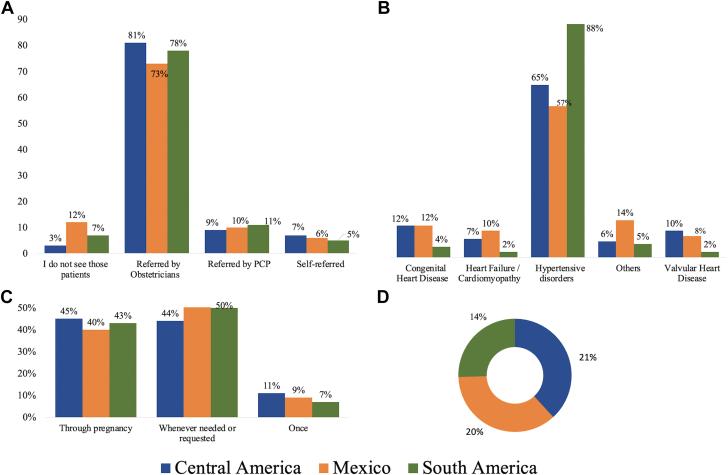
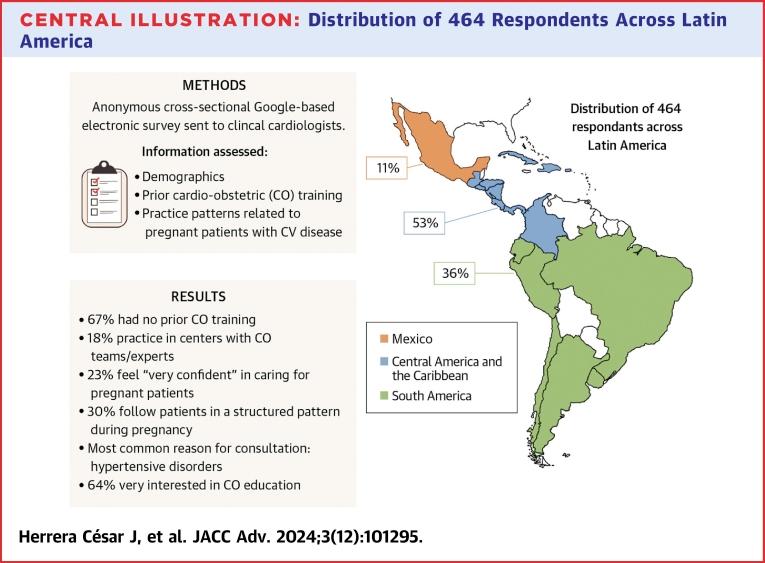
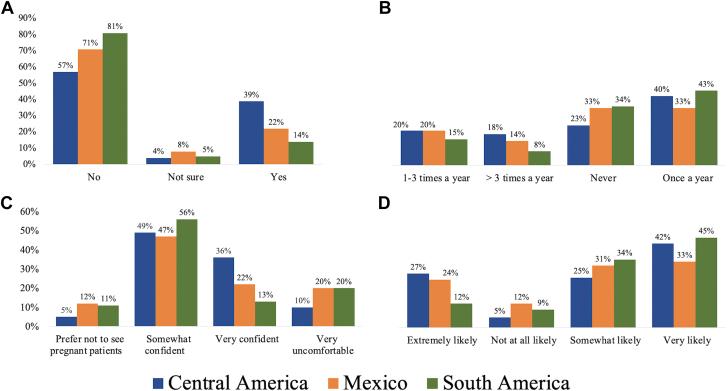
A total of 464 participants responded: 53% male, 52.5% from Central America and the Caribbean, 36.5% from South America, and 11% from Mexico. Most (67%) had not received didactic education in CO during fellowship; the majority expressed interest in participation in educational activities on this field, and only 18% reported practicing in centers equipped with CO teams or experts. Specific characteristics of CO practices in the region are shown in the figures.
CONCLUSIONS
Based on this survey, the CV care and follow-up of pregnant patients in LATAM is suboptimal; most cardiologists report lack of CO formal education during training and feel uncomfortable providing care during pregnancy although expressed interest in enhancing their knowledge in this field.
背景
心血管疾病是全球孕妇死亡的主要原因,尤其是在包括拉丁美洲(LATAM)在内的低收入和中等收入国家,在这些地区,缺乏关于心脏病专家如何接受心脏产科(CO)培训以及在照顾孕妇方面的实践模式的数据。
目的
作者旨在确定拉丁美洲普通心脏病专家的心脏产科能力和实践模式。
方法
通过电子邮件向当地美国心脏病学会分会和心血管学会的临床心脏病专家发送基于谷歌的匿名横断面电子调查问卷。评估了人口统计学、先前的心脏产科培训以及与患有心血管疾病的孕妇相关的实践模式。
结果
共有464名参与者做出回应:53%为男性,52.5%来自中美洲和加勒比地区,36.5%来自南美洲,11%来自墨西哥。大多数(67%)在 fellowship 期间未接受过心脏产科的系统教育;大多数人表示有兴趣参加该领域的教育活动,只有18%的人报告在配备了心脏产科团队或专家的中心执业。该地区心脏产科实践的具体特征如图所示。
结论
基于这项调查,拉丁美洲对孕妇的心血管护理和随访情况欠佳;大多数心脏病专家报告在培训期间缺乏心脏产科的正规教育,并且在孕期提供护理时感到不自在,尽管他们表示有兴趣增加在该领域的知识。
 Zotero 插件