
英国人群中生活方式的代谢组学特征与新发慢性肾脏病潜伏期之间的关联。
The association between metabolomic profiles of lifestyle and the latent phase of incident chronic kidney disease in the UK Population.
作者信息
Jin Tingting, Wu Yunqi, Zhang Siyi, Peng Ya, Lin Yao, Zhou Saijun, Liu Hongyan, Yu Pei
机构信息
NHC Key Lab of Hormones and Development and Tianjin Key Lab of Metabolic Diseases, Tianjin Medical University Chu Hsien-I Memorial Hospital & Institute of Endocrinology, Tianjin, 300134, China.
Department of Nephrology & Blood Purification Center, The Second Hospital of Tianjin Medical University, Tianjin, 300211, China.
出版信息
Sci Rep. 2025 Jan 17;15(1):2299. doi: 10.1038/s41598-025-86030-x.
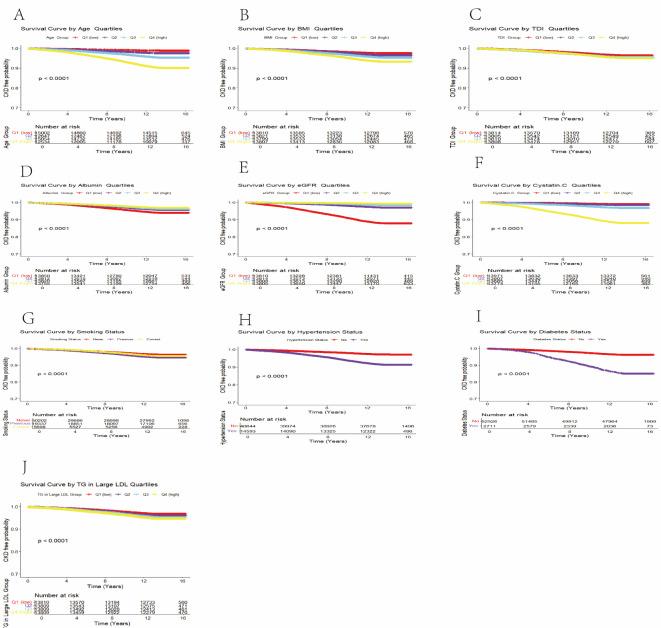
Chronic kidney disease (CKD) is a global health challenge associated with lifestyle factors such as diet, alcohol, BMI, smoking, sleep, and physical activity. Metabolomics, especially nuclear magnetic resonance(NMR), offers insights into metabolic profiles' role in diseases, but more research is needed on its connection to CKD and lifestyle factors. Therefore, we utilized the latest metabolomics data from the UK Biobank to explore the relationship between plasma metabolites and lifestyle factors, as well as to investigate the associations between various factors, including lifestyle-related metabolites, and the latent phase of CKD onset. The study enrolled approximately 500,000 participants from the UK Biobank (UKB) between 2006 and 2010, excluding 447,163 individuals with missing data for any metabolite in the NMR metabolomics, any biomarker in the blood chemistry (including eGFR, albumin, or cystatin C), any factor required for constructing the lifestyle score, or a baseline diagnosis of CKD. Lifestyle scores (LS) were calculated based on several factors, including diet, alcohol consumption, smoking, BMI, physical activity, and sleep. Each healthy lifestyle component contributed to the overall score, which ranged from 0 to 6. A total of 249 biological metabolites covering multiple categories were determined by the NMR Metabolomics Platform. Random forest algorithms and LASSO regression were employed to identify lifestyle-related metabolites. Subsequently, accelerated failure time models(AFT) were used to assess the relationship between multiple factors, including traditional CKD-related biomarkers (such as eGFR, cystatin C, and albumin) and lifestyle-related metabolites, with the latent phase of incident CKD. Finally, we performed Kaplan-Meier survival curve analysis on the significant variables identified in the AFT model. Over a mean follow-up period of 13.86 years, 2,279 incident chronic kidney disease (CKD) cases were diagnosed. Among the 249 metabolites analyzed, 15 were identified as lifestyle-related, primarily lipid metabolites. Notably, among these metabolites, each 1 mmol/L increase in triglycerides in large LDL particles accelerated the onset of CKD by 24%. Diabetes, hypertension, and smoking were associated with a 56.6%, 31.5% and 22.3% faster onset of CKD, respectively. Additionally, each unit increase in age, BMI, TDI, and cystatin C was linked to a 3.2%, 1.4%, 1.6% and 32.3% faster onset of CKD. In contrast, higher levels of albumin and eGFR slowed the onset of CKD, reducing the speed of progression by 3.0% and 3.9% per unit increase, respectively. Nuclear magnetic resonance metabolomics offers new insights into renal health, though further validation studies are needed in the future.
慢性肾脏病(CKD)是一项全球性的健康挑战,与饮食、酒精、体重指数(BMI)、吸烟、睡眠和身体活动等生活方式因素相关。代谢组学,尤其是核磁共振(NMR),有助于深入了解代谢谱在疾病中的作用,但在其与CKD及生活方式因素的关联方面仍需更多研究。因此,我们利用英国生物银行的最新代谢组学数据,探索血浆代谢物与生活方式因素之间的关系,并研究包括与生活方式相关的代谢物在内的各种因素与CKD发病潜伏期之间的关联。该研究纳入了2006年至2010年间来自英国生物银行(UKB)的约50万名参与者,排除了在NMR代谢组学中任何代谢物、血液化学中的任何生物标志物(包括估算肾小球滤过率[eGFR]、白蛋白或胱抑素C)、构建生活方式评分所需的任何因素或CKD基线诊断存在缺失数据的447,163人。生活方式评分(LS)基于饮食、饮酒、吸烟、BMI、身体活动和睡眠等多个因素进行计算。每个健康生活方式成分都对总分有贡献,总分范围为0至6分。NMR代谢组学平台确定了总共249种涵盖多个类别的生物代谢物。采用随机森林算法和套索回归来识别与生活方式相关的代谢物。随后,使用加速失效时间模型(AFT)来评估包括传统CKD相关生物标志物(如eGFR、胱抑素C和白蛋白)以及与生活方式相关的代谢物在内的多个因素与新发CKD潜伏期之间的关系。最后,我们对AFT模型中确定的显著变量进行了Kaplan-Meier生存曲线分析。在平均13.86年的随访期内,诊断出2279例新发慢性肾脏病(CKD)病例。在分析的249种代谢物中,有15种被确定为与生活方式相关,主要是脂质代谢物。值得注意的是,在这些代谢物中,大LDL颗粒中的甘油三酯每增加1 mmol/L,CKD发病加速24%。糖尿病、高血压和吸烟分别使CKD发病加快56.6%、31.5%和22.3%。此外,年龄、BMI、总糖尿病指数(TDI)和胱抑素C每增加一个单位,CKD发病加快3.2%、1.4%、1.6%和32.3%。相比之下,较高水平的白蛋白和eGFR减缓了CKD的发病,每增加一个单位,进展速度分别降低3.0%和3.9%。核磁共振代谢组学为肾脏健康提供了新的见解,不过未来还需要进一步的验证研究。


 Zotero 插件