
基于真实世界数据的24个月鲁马卡托-依伐卡托治疗期间儿童囊性纤维化患者的身体成分变化及临床结局
Body composition changes and clinical outcomes in pediatric cystic fibrosis during 24 months of lumacaftor ivacaftor therapy based on real-world data.
作者信息
Imrei Marcell, Kéri Adrienn F, Gács Éva, Gönczi Ildikó, Meláth Melinda, Kosaras Éva, Demeter Botond, Péterfia Csaba, Vass Klára, Székely Gyöngyi, Ocskay Klementina, Párniczky Andrea
机构信息
Heim Pál National Pediatric Institute, Budapest, Hungary.
Institute for Translational Medicine, Medical School, University of Pécs, Pécs, Hungary.
出版信息
Sci Rep. 2025 Jan 17;15(1):2247. doi: 10.1038/s41598-025-86010-1.
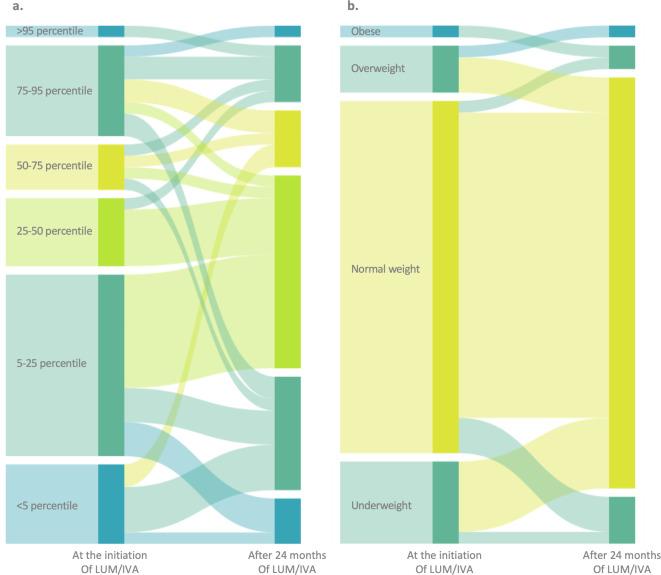
Clinical trials demonstrate the short-term efficacy of dual CFTR modulators, but long-term real-world data is limited. We aimed to investigate the effects of 24-month lumacaftor/ivacaftor (LUM/IVA) therapy in pediatric CF patients (pwCF). This observational study included pwCF homozygous for F508del mutation treated between 2021 and 2023. We report data for the first 24 months from therapy initiation. Variables were analyzed separately for ages 2-5, 6-11, and over 12. Data from 49 pwCF (median age: 9.3 years (5.5-14.2)) showed that ppFEV1 values after a transient increase at 12 months, decreased from 102% (82-114) at baseline to 87% (74-96) at 24 months. The decrease was more pronounced with higher initial ppFEV1. Median sweat chloride concentration decreased from 75 mmol/L (69-82) to 57 mmol/L (43-70) without any association with respiratory function change. Median BMI z-score increased from - 0.81 (- 1.37-0.49) to - 0.39 (- 0.88 to - 0.04) (p = 0.288), and the proportion of underweight and overweight children decreased. Skeletal muscle mass remained stable, while fat mass significantly increased (p = 0.011). Fecal elastase levels improved, especially among younger patients. These findings underscore the potential benefits of early initiation of CFTR modulator therapy in pediatric CF patients, highlighting improvements in nutritional status and pancreatic function.
临床试验证明了双重CFTR调节剂的短期疗效,但长期的真实世界数据有限。我们旨在研究24个月的鲁马卡托/依伐卡托(LUM/IVA)治疗对儿科囊性纤维化患者(pwCF)的影响。这项观察性研究纳入了2021年至2023年期间接受治疗的F508del突变纯合子pwCF。我们报告了从治疗开始的前24个月的数据。对2至5岁、6至11岁和12岁以上的患者分别分析变量。49名pwCF患者(中位年龄:9.3岁(5.5 - 14.2岁))的数据显示,ppFEV1值在12个月时短暂升高后,从基线时的102%(82 - 114)降至24个月时的87%(74 - 96)。初始ppFEV1越高,下降越明显。中位汗液氯化物浓度从75 mmol/L(69 - 82)降至57 mmol/L(43 - 70),与呼吸功能变化无任何关联。中位BMI z评分从 - 0.81(- 1.37 - 0.49)增至 - 0.39(- 0.88至 - 0.04)(p = 0.288),体重过轻和超重儿童的比例下降。骨骼肌质量保持稳定,而脂肪量显著增加(p = 0.011)。粪便弹性蛋白酶水平有所改善,尤其是在较年轻的患者中。这些发现强调了在儿科CF患者中早期开始CFTR调节剂治疗的潜在益处,突出了营养状况和胰腺功能的改善。


 Zotero 插件