
从伊拉克患者分离出的呼吸道合胞病毒糖蛋白基因可变区的系统发育和序列分析
Phylogenetic and Sequence Analyses of the Variable Region in the Glycoprotein Gene of the Respiratory Syncytial Virus Isolated from Iraqi Patients.
作者信息
Wali Mohammed Hussein, Naif Hassan Mohammad, Abdul Rahim Nur Arzuar, Yunus Muhammad Amir
机构信息
Department of Biomedical Sciences, Advanced Medical and Dental Institute, Universiti Sains Malaysia, Pulau Pinang, Malaysia.
Department of Molecular and Medical Biotechnology, College of Biotechnology, Al-Nahrain University, Baghdad, Iraq.
出版信息
Malays J Med Sci. 2024 Dec;31(6):133-147. doi: 10.21315/mjms2024.31.6.11. Epub 2024 Dec 31.
BACKGROUND
Respiratory syncytial virus (RSV) is a common aetiological agent that causes respiratory infections, especially among infants. Identifying circulating RSV genotypes is an essential strategy for understanding the spread of the virus in a certain area. Sequencing the variable regions of the attachment glycoprotein (G) gene of RSV is a quick and direct approach for identifying the genotypes.
METHODS
This study was aimed to sequence the G gene region of RSV isolated from patients admitted to hospitals in Baghdad, Iraq, during the autumn of 2022 and winter of 2023. To achieve this goal, 150 patients with lower respiratory symptoms were screened for RSV infections. RSV-positive samples were detected and confirmed using the reverse transcription-quantitative polymerase chain reaction (RT-qPCR) approach, which involved the use of specific TaqMan primer sets targeting RSV subgroups. Then, a G gene region that included hypervariable region 2 (HVR2) was amplified and sequenced using the Sanger sequencing method. Furthermore, molecular and phylogenetic analyses were performed on the G gene region to determine the variability profile of the tested specimens.
RESULTS
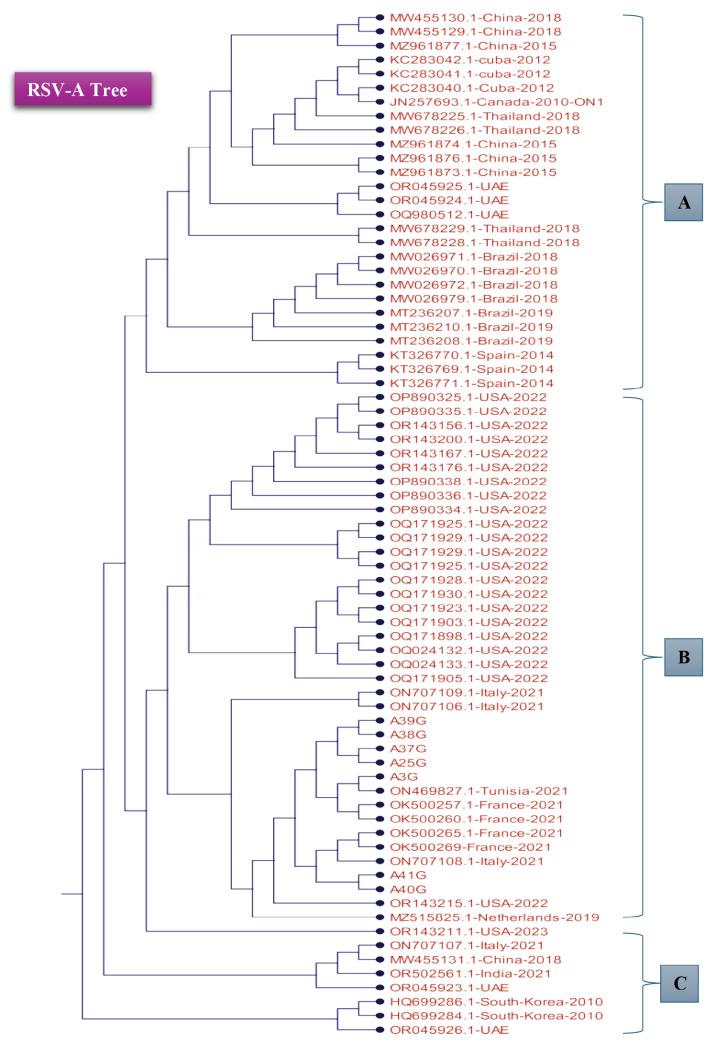
There were 41 (26.6%) RSV-positive cases. Of these, the RSV-B subgroup was the most prevalent (82.90%), while the RSV-A subgroup incidence rate was 17.07%. The phylogenetic analysis showed that the RSV-B isolates were related to the BA genotype and shared nucleotide sequence similarities with isolates from India, Australia and the UK. The RSV-A isolates belonged to the ON genotype and had some degree of similarities with isolates from Italy, Tunisia, and France.
CONCLUSION
Seasonal tracking of the RSV isolates would facilitate a better understanding of virus evolution, viral pathogenesis, and genetic diversity.
背景
呼吸道合胞病毒(RSV)是引起呼吸道感染的常见病原体,尤其是在婴儿中。确定流行的RSV基因型是了解该病毒在特定地区传播情况的重要策略。对RSV附着糖蛋白(G)基因的可变区进行测序是鉴定基因型的快速直接方法。
方法
本研究旨在对2022年秋季和2023年冬季从伊拉克巴格达医院收治的患者中分离出的RSV的G基因区域进行测序。为实现这一目标,对150例有下呼吸道症状的患者进行了RSV感染筛查。使用逆转录定量聚合酶链反应(RT-qPCR)方法检测并确认RSV阳性样本,该方法使用针对RSV亚组的特异性TaqMan引物组。然后,使用桑格测序法扩增并测序包含高变区2(HVR2)的G基因区域。此外,对G基因区域进行分子和系统发育分析,以确定测试样本的变异性特征。
结果
有41例(26.6%)RSV阳性病例。其中,RSV-B亚组最为常见(82.90%),而RSV-A亚组的发病率为17.07%。系统发育分析表明,RSV-B分离株与BA基因型相关,与来自印度、澳大利亚和英国的分离株具有核苷酸序列相似性。RSV-A分离株属于ON基因型,与来自意大利、突尼斯和法国的分离株有一定程度的相似性。
结论
对RSV分离株进行季节性追踪将有助于更好地了解病毒进化、病毒发病机制和遗传多样性。


 Zotero 插件