
对(不)同意使用电子教练应用程序以降低网络使用障碍倾向的人群心理特征的洞察。
Insights into psychological characteristics of persons (not) agreeing to use an e-coach-application to reduce elevated Internet Use Disorder tendencies.
作者信息
Montag Christian, Elhai Jon D, Kannen Christopher, Bischof Anja, Brandt Dominique, Schmidt Hannah, Rozgonjuk Dmitri, Rumpf Hans-Jürgen
机构信息
Department of Molecular Psychology, Institute of Psychology and Education, Ulm University, Ulm, Germany.
Department of Psychology, and Department of Psychiatry, University of Toledo, Toledo, OH, United States.
出版信息
Addict Behav Rep. 2024 Sep 26;20:100564. doi: 10.1016/j.abrep.2024.100564. eCollection 2024 Dec.
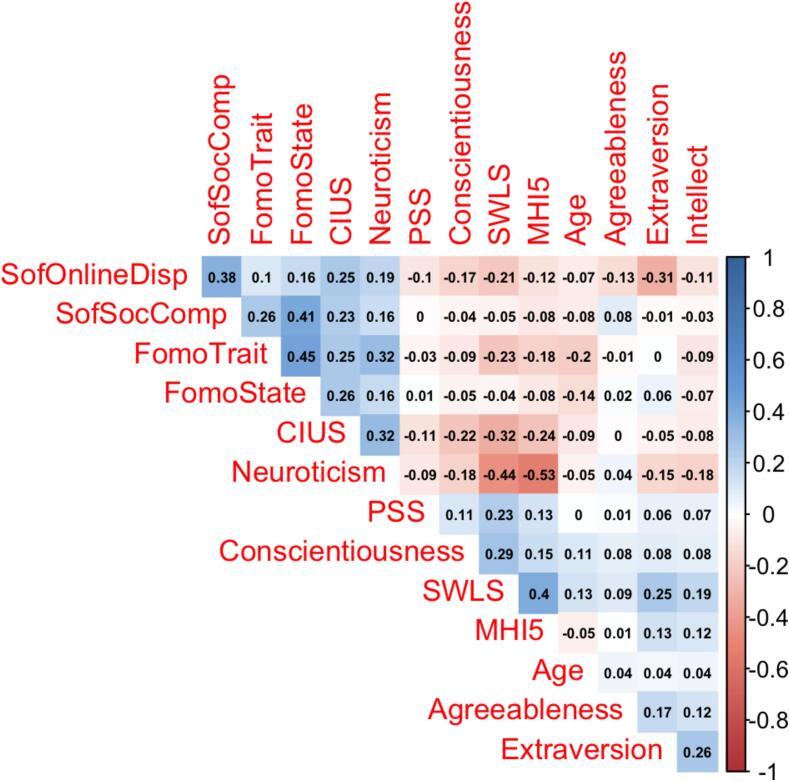
The present work aims to shed light on the question of whether certain psychological characteristics go along with choosing an e-coach offer to support healthy Internet use when reporting elevated Internet Use Disorder (IUD) tendencies. Data were from a large-scale stepped care approach study to treat persons with varying degrees of IUD tendencies. Recruitment for advertising the download of a smartphone app included social media, videos by influencers, paid ads, TV, radio, newspapers, workshops, and vocational schools. We contrasted a final sample of 184 declining, 907 agreeing, and 216 agreeing but not providing follow-up details needed to use such an e-coach, as well as 995 who did not explicitly decline or agree to participate (but refrained from using the e-coach). Participants were compared on several study variables, including sociodemographics, mental health, fear of missing out, personality, perceived stress, and IUD tendencies. Interestingly, we observed only two significant findings when contrasting the aforementioned groups using ANOVA. First, the group not agreeing to use the e-coach was associated with the lowest IUD tendencies and highest conscientiousness scores. Second, agreeing to use the e-coach was associated with older age. Further significant differences could be observed, but in general the accompanying effect sizes were very mild. In sum, the present study findings support the idea that greater subjective burden of IUD might result in more willingness to seek e-help, but also the personality trait of conscientiousness and a person's age might play a role here.
本研究旨在探讨在报告存在较高的网络使用障碍(IUD)倾向时,某些心理特征是否与选择电子教练服务以支持健康的网络使用这一问题相关。数据来自一项针对不同程度IUD倾向人群的大规模阶梯式护理方法研究。宣传智能手机应用程序下载的招募途径包括社交媒体、有影响力的人制作的视频、付费广告、电视、广播、报纸、研讨会和职业学校。我们对比了一个最终样本,其中有184人拒绝、907人同意、216人同意但未提供使用此类电子教练所需的后续细节,以及995人未明确拒绝或同意参与(但未使用电子教练)。对参与者在几个研究变量上进行了比较,包括社会人口统计学、心理健康、错失恐惧、个性、感知压力和IUD倾向。有趣的是,当使用方差分析对比上述组时,我们仅观察到两个显著结果。第一,不同意使用电子教练的组IUD倾向最低,尽责性得分最高。第二,同意使用电子教练与年龄较大相关。还可以观察到进一步的显著差异,但总体而言伴随的效应量非常小。总之,本研究结果支持这样一种观点,即IUD更大的主观负担可能导致更愿意寻求电子帮助,但尽责性的人格特质和一个人的年龄在这里也可能起作用。
 Zotero 插件