
通过可逆硫杂-迈克尔反应用于3D打印的可再加工和可回收材料。
Reprocessable and Recyclable Materials for 3D Printing via Reversible Thia-Michael Reactions.
作者信息
Su Yong-Liang, Yue Liang, Paul McKinley K, Kern Joseph, Otte Kaitlyn S, Ramprasad Rampi, Qi H Jerry, Gutekunst Will R
机构信息
School of Chemistry and Biochemistry, Georgia Institute of Technology, Atlanta, Georgia, 30332, United States.
School of Mechanical Engineering, Georgia Institute of Technology.
出版信息
Angew Chem Int Ed Engl. 2025 Feb 17;64(8):e202423522. doi: 10.1002/anie.202423522. Epub 2025 Jan 28.
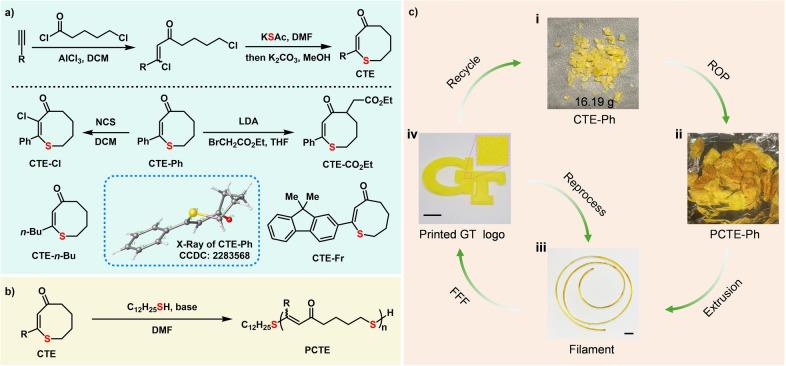
The development of chemically recyclable polymers for sustainable 3D printing is crucial to reducing plastic waste and advancing towards a circular polymer economy. Here, we introduce a new class of polythioenones (PCTE) synthesized via Michael addition-elimination ring-opening polymerization (MAEROP) of cyclic thioenone (CTE) monomers. The designed monomers are straightforward to synthesize, scalable and highly modular, and the resulting polymers display mechanical performance superior to commodity polyolefins such as polyethylene and polypropylene. The material was successfully employed in 3D printing using fused-filament fabrication (FFF), showcasing excellent printability and mechanical recyclability. Notably, PCTE-Ph retains its tensile strength and thermal stability after multiple mechanical recycling cycles. Furthermore, PCTE-Ph can be depolymerized back to its original monomer with a 90 % yield, allowing for repolymerization and establishing a successful closed-loop life cycle, making it a sustainable alternative for additive manufacturing applications.
开发用于可持续3D打印的可化学回收聚合物对于减少塑料废物和迈向循环聚合物经济至关重要。在此,我们介绍了一类通过环状硫代烯酮(CTE)单体的迈克尔加成-消除开环聚合(MAEROP)合成的新型聚硫代烯酮(PCTE)。设计的单体易于合成、可扩展且高度模块化,所得聚合物的机械性能优于聚乙烯和聚丙烯等商品聚烯烃。该材料通过熔丝制造(FFF)成功应用于3D打印,展示了出色的可打印性和机械可回收性。值得注意的是,PCTE-Ph在多次机械回收循环后仍保留其拉伸强度和热稳定性。此外,PCTE-Ph可以以90%的产率解聚回其原始单体,实现再聚合并建立成功的闭环生命周期,使其成为增材制造应用的可持续替代品。
 Zotero 插件