
预测肝细胞癌破裂后术后腹膜转移的机器学习模型:一项中国的多中心队列研究。
Machine learning models for predicting postoperative peritoneal metastasis after hepatocellular carcinoma rupture: a multicenter cohort study in China.
作者信息
Xia Feng, Chen Qian, Liu Zhicheng, Zhang Qiao, Guo Bin, Fan Feimu, Huang Zhiyuan, Zheng Jun, Gao Hengyi, Xia Guobing, Ren Li, Mei Hongliang, Chen Xiaoping, Cheng Qi, Zhang Bixiang, Zhu Peng
机构信息
Department of Hepatic Surgery, Tongji Hospital, Tongji Medical College of Huazhong University of Science and Technology, Wuhan, Hubei, People's Republic of China.
Department of Emergency Medicine, Zhongshan People's Hospital Affiliated to Guangdong Medical University, Zhongshan, Guangdong, People's Republic of China.
出版信息
Oncologist. 2025 Jan 17;30(1). doi: 10.1093/oncolo/oyae341.
BACKGROUND
Peritoneal metastasis (PM) after the rupture of hepatocellular carcinoma (HCC) is a critical issue that negatively affects patient prognosis. Machine learning models have shown great potential in predicting clinical outcomes; however, the optimal model for this specific problem remains unclear.
METHODS
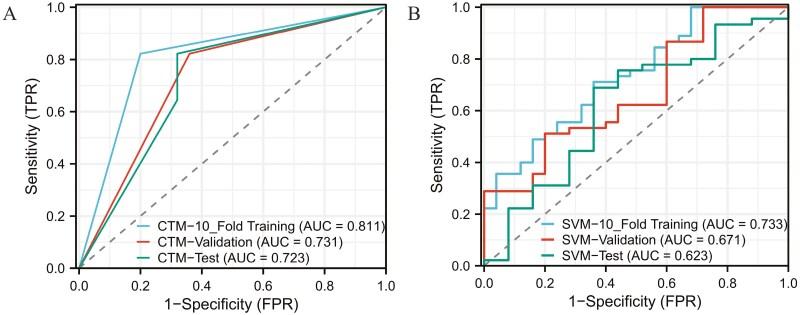
Clinical data were collected and analyzed from 522 patients with ruptured HCC who underwent surgery at 7 different medical centers. Patients were assigned to the training, validation, and test groups in a random manner, with a distribution ratio of 7:1.5:1.5. Overall, 78 (14.9%) patients experienced postoperative PM. Five different types of models, including logistic regression, support vector machines, classification trees, random forests, and deep learning (DL) models, were trained using these data and evaluated based on their receiver operating characteristic curve and area under the curve (AUC) values and F1 scores.
RESULTS
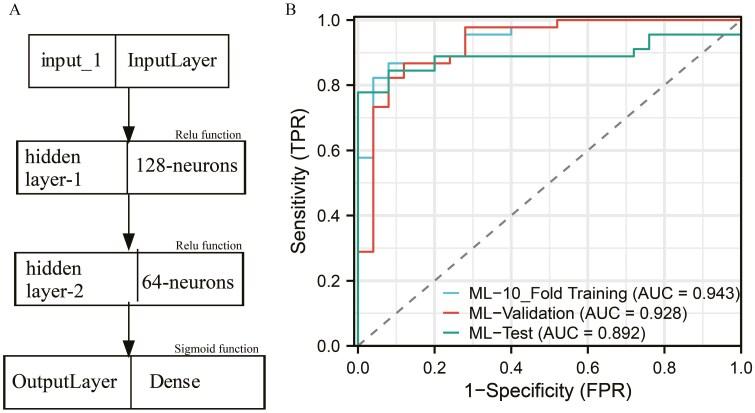
The DL models achieved the highest AUC values (10-fold training cohort: 0.943, validation set: 0.928, and test set: 0.892) and F1 scores (10-fold training set: 0.917, validation cohort: 0.908, and test set:0.899) The results of the analysis indicate that tumor size, timing of hepatectomy, alpha-fetoprotein levels, and microvascular invasion are the most important predictive factors closely associated with the incidence of postoperative PM.
CONCLUSION
The DL model outperformed all other machine learning models in predicting postoperative PM after the rupture of HCC based on clinical data. This model provides valuable information for clinicians to formulate individualized treatment plans that can improve patient outcomes.
背景
肝细胞癌(HCC)破裂后的腹膜转移(PM)是一个严重影响患者预后的关键问题。机器学习模型在预测临床结果方面显示出巨大潜力;然而,针对这一特定问题的最佳模型仍不明确。
方法
收集并分析了来自7个不同医疗中心接受手术的522例HCC破裂患者的临床数据。患者以随机方式分配到训练组、验证组和测试组,分配比例为7:1.5:1.5。总体而言,78例(14.9%)患者术后发生PM。使用这些数据训练了包括逻辑回归、支持向量机、分类树、随机森林和深度学习(DL)模型在内的五种不同类型的模型,并根据其受试者工作特征曲线、曲线下面积(AUC)值和F1分数进行评估。
结果
DL模型获得了最高的AUC值(10倍训练队列:0.943,验证集:0.928,测试集:0.892)和F1分数(10倍训练集:0.917,验证队列:0.908,测试集:0.899)。分析结果表明,肿瘤大小、肝切除时间、甲胎蛋白水平和微血管侵犯是与术后PM发生率密切相关的最重要预测因素。
结论
基于临床数据,DL模型在预测HCC破裂后术后PM方面优于所有其他机器学习模型。该模型为临床医生制定可改善患者预后的个体化治疗方案提供了有价值的信息。


 Zotero 插件