
表征酿酒酵母在羟基脲暴露期间H2A.Z和SWR1-C对基因表达的调控作用。
Characterizing the regulatory effects of H2A.Z and SWR1-C on gene expression during hydroxyurea exposure in Saccharomyces cerevisiae.
作者信息
Brewis Hilary T, Stirling Peter C, Kobor Michael S
机构信息
Department of Medical Genetics, Centre for Molecular Medicine and Therapeutics, BC Children's Hospital Research Institute, Edwin S.H. Leong Centre for Healthy Aging, University of British Columbia, Vancouver, British Columbia, Canada.
Department of Medical Genetics, Terry Fox Laboratory, BC Cancer Research Institute, University of British Columbia, Vancouver, British Columbia, Canada.
出版信息
PLoS Genet. 2025 Jan 21;21(1):e1011566. doi: 10.1371/journal.pgen.1011566. eCollection 2025 Jan.
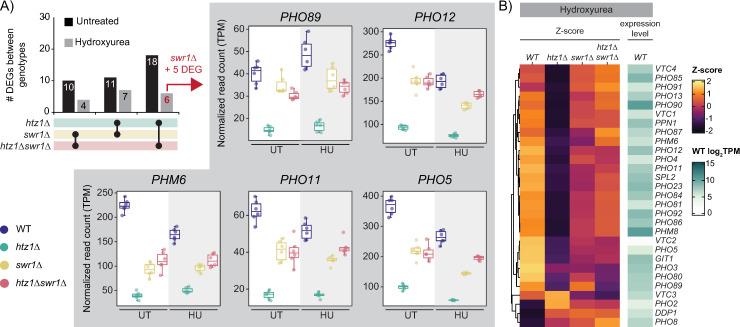
Chromatin structure and DNA accessibility are partly modulated by the incorporation of histone variants. H2A.Z, encoded by the non-essential HTZ1 gene in S. cerevisiae, is an evolutionarily conserved H2A histone variant that is predominantly incorporated at transcription start sites by the SWR1-complex (SWR1-C). While H2A.Z has often been implicated in transcription regulation, htz1Δ mutants exhibit minimal changes in gene expression compared to wild-type. However, given that growth defects of htz1Δ mutants are alleviated by simultaneous deletion of SWR1-C subunits, previous work examining the role of H2A.Z in gene expression regulation may be confounded by deleterious activity caused by SWR1-C when missing its H2A.Z substrate (apo-SWR1-C). Furthermore, as H2A.Z mutants only display significant growth defects in genotoxic stress conditions, a more substantive role for H2A.Z in gene expression may only be uncovered after exposure to cellular stress. To explore this possibility, we generated mRNA transcript profiles for wild-type, htz1Δ, swr1Δ, and htz1Δswr1Δ mutants before and after exposure to hydroxyurea (HU), which induces DNA replication stress. Our data showed that H2A.Z played a more prominent role in gene activation than repression during HU exposure, and its incorporation was important for proper upregulation of several HU-induced genes. We also observed that apo-SWR1-C contributed to gene expression defects in the htz1Δ mutant, particularly for genes involved in phosphate homeostasis regulation. Furthermore, mapping H2A.Z incorporation before and after treatment with HU revealed that decreases in H2A.Z enrichment at transcription start sites was correlated with, but generally not required for, the upregulation of genes during HU exposure. Together this study characterized the regulatory effects of H2A.Z incorporation during the transcriptional response to HU.
染色质结构和DNA可及性部分受到组蛋白变体掺入的调控。H2A.Z由酿酒酵母中非必需的HTZ1基因编码,是一种进化上保守的H2A组蛋白变体,主要由SWR1复合物(SWR1-C)掺入转录起始位点。虽然H2A.Z常与转录调控有关,但与野生型相比,htz1Δ突变体在基因表达上的变化极小。然而,鉴于htz1Δ突变体的生长缺陷可通过同时缺失SWR1-C亚基得到缓解,之前研究H2A.Z在基因表达调控中作用的工作可能因SWR1-C缺少其H2A.Z底物(无H2A.Z的SWR1-C,apo-SWR1-C)时产生的有害活性而受到混淆。此外,由于H2A.Z突变体仅在基因毒性应激条件下表现出显著的生长缺陷,H2A.Z在基因表达中的更重要作用可能只有在细胞受到应激后才会被发现。为了探究这种可能性,我们生成了野生型、htz1Δ、swr1Δ和htz1Δswr1Δ突变体在暴露于羟基脲(HU)(其诱导DNA复制应激)前后的mRNA转录谱。我们的数据表明,在HU暴露期间,H2A.Z在基因激活方面比基因抑制方面发挥了更突出的作用,并且其掺入对于几个HU诱导基因的适当上调很重要。我们还观察到,无H2A.Z的SWR1-C导致了htz1Δ突变体中的基因表达缺陷,特别是对于参与磷酸盐稳态调节的基因。此外,绘制HU处理前后H2A.Z的掺入情况发现,转录起始位点处H2A.Z富集的减少与HU暴露期间基因的上调相关,但通常不是必需的。这项研究共同表征了在对HU的转录反应中H2A.Z掺入的调控作用。
 Zotero 插件