
功能失调的支链氨基酸降解通过增强PP2Ac相互作用,破坏AMPK-线粒体轴,引发神经元损伤。
Dysfunctional BCAA degradation triggers neuronal damage through disrupted AMPK-mitochondrial axis due to enhanced PP2Ac interaction.
作者信息
Wu Shih-Cheng, Chen Yan-Jhen, Su Shih-Han, Fang Pai-Hsiang, Liu Rei-Wen, Tsai Hui-Ying, Chang Yen-Jui, Li Hsing-Han, Li Jian-Chiuan, Chen Chun-Hong
机构信息
Department of Clinical Laboratory Sciences and Medical Biotechnology, College of Medicine, National Taiwan University, Taipei, 10048, Taiwan.
Department of Laboratory Medicine, National Taiwan University Hospital, College of Medicine, National Taiwan University, Taipei, 10021, Taiwan.
出版信息
Commun Biol. 2025 Jan 21;8(1):105. doi: 10.1038/s42003-025-07457-6.
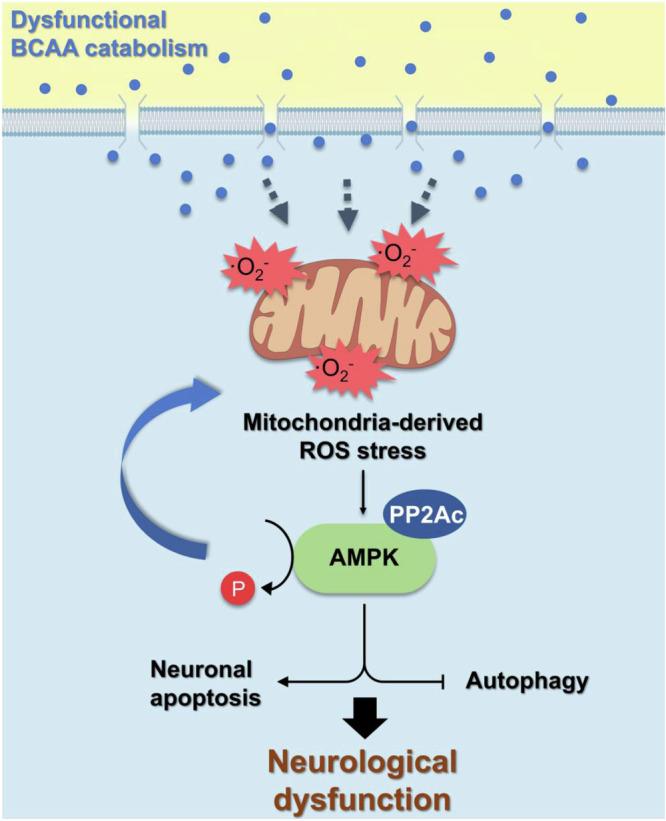
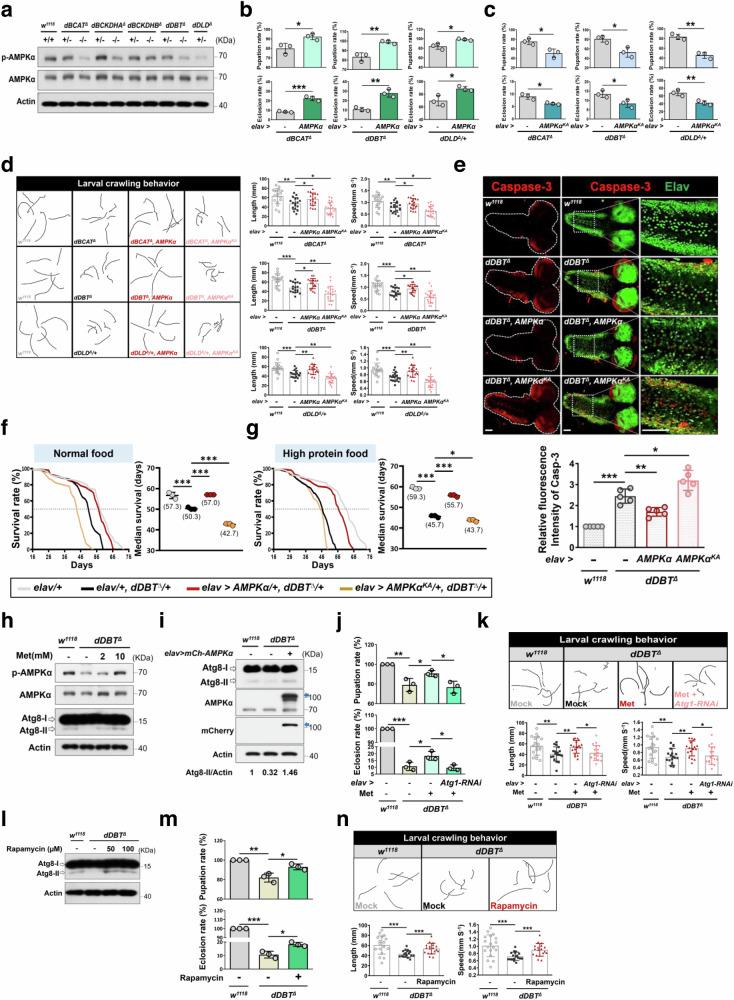
Metabolic and neurological disorders commonly display dysfunctional branched-chain amino acid (BCAA) metabolism, though it is poorly understood how this leads to neurological damage. We investigated this by generating Drosophila mutants lacking BCAA-catabolic activity, resulting in elevated BCAA levels and neurological dysfunction, mimicking disease-relevant symptoms. Our findings reveal a reduction in neuronal AMP-activated protein kinase (AMPK) activity, which disrupts autophagy in mutant brain tissues, linking BCAA imbalance to brain dysfunction. Mechanistically, we show that excess BCAA-induced mitochondrial reactive oxygen species (ROS) triggered the binding of protein phosphatase 2 A catalytic subunit (PP2Ac) to AMPK, suppressing AMPK activity. This initiated a dysregulated feedback loop of AMPK-mitochondrial interactions, exacerbating mitochondrial dysfunction and oxidative neuronal damage. Our study identifies BCAA imbalance as a critical driver of neuronal damage through AMPK suppression and autophagy dysfunction, offering insights into metabolic-neuronal interactions in neurological diseases and potential therapeutic targets for BCAA-related neurological conditions.
代谢和神经紊乱通常表现出支链氨基酸(BCAA)代谢功能失调,不过目前人们对其如何导致神经损伤了解甚少。我们通过构建缺乏BCAA分解代谢活性的果蝇突变体对此展开研究,结果导致BCAA水平升高和神经功能障碍,模拟了与疾病相关的症状。我们的研究结果显示,突变体脑组织中的神经元AMP激活的蛋白激酶(AMPK)活性降低,这破坏了自噬,将BCAA失衡与脑功能障碍联系起来。从机制上来说,我们发现过量的BCAA诱导的线粒体活性氧(ROS)触发了蛋白磷酸酶2A催化亚基(PP2Ac)与AMPK的结合,抑制了AMPK活性。这启动了一个AMPK-线粒体相互作用失调的反馈回路,加剧了线粒体功能障碍和神经元氧化损伤。我们的研究确定BCAA失衡是通过抑制AMPK和自噬功能障碍导致神经元损伤的关键驱动因素,为神经疾病中的代谢-神经元相互作用以及BCAA相关神经疾病的潜在治疗靶点提供了见解。



 Zotero 插件