
线粒体自噬的分子交响曲:泛素特异性蛋白酶30作为神经退行性疾病精准管理的指挥家。
Molecular Symphony of Mitophagy: Ubiquitin-Specific Protease-30 as a Maestro for Precision Management of Neurodegenerative Diseases.
作者信息
Siwach Ankit, Patel Harit, Khairnar Amit, Parekh Pathik
机构信息
Department of Pharmacology and Toxicology, National Institute of Pharmaceutical Education and Research (NIPER), Ahmedabad, Gujarat, India.
School of Pharmaceutical Sciences, Jaipur National University, Jaipur, Rajasthan, India.
出版信息
CNS Neurosci Ther. 2025 Jan;31(1):e70192. doi: 10.1111/cns.70192.
INTRODUCTION
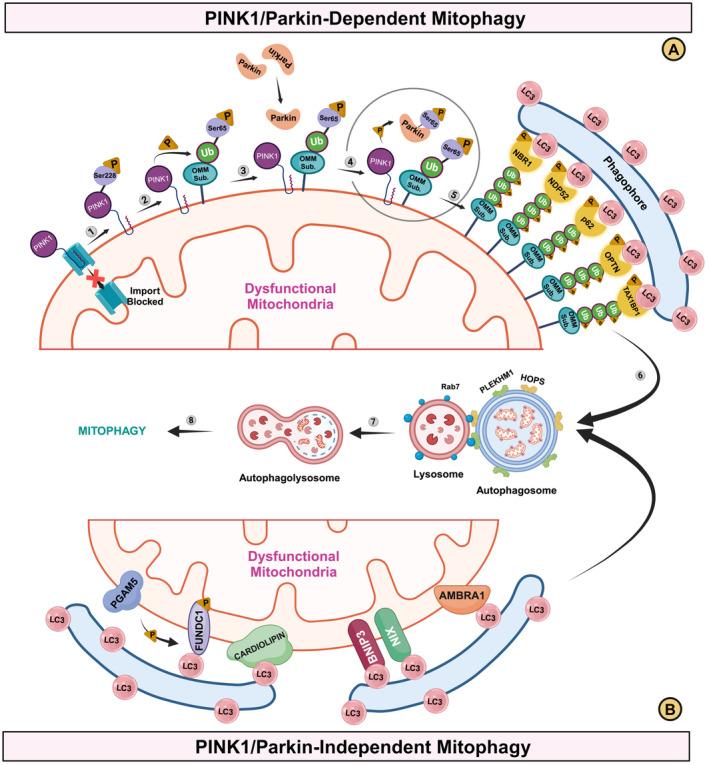
Mitochondrial dysfunction stands as a pivotal feature in neurodegenerative disorders, spurring the quest for targeted therapeutic interventions. This review examines Ubiquitin-Specific Protease 30 (USP30) as a master regulator of mitophagy with therapeutic promise in Alzheimer's disease (AD) and Parkinson's disease (PD). USP30's orchestration of mitophagy pathways, encompassing PINK1-dependent and PINK1-independent mechanisms, forms the crux of this exploration.
METHOD
A systematic literature search was conducted in PubMed, Scopus, and Web of Science, selecting studies that investigated USP's function, inhibitor design, or therapeutic efficacy in AD and PD. Inclusion criteria encompassed mechanistic and preclinical/clinical data, while irrelevant or duplicate references were excluded. Extracted findings were synthesized narratively.
RESULTS
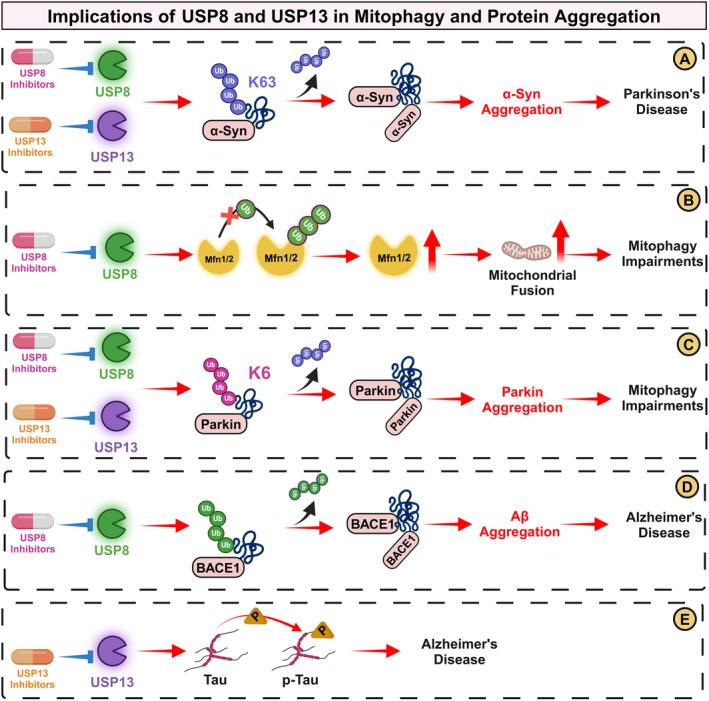
USP30 modulates interactions with translocase of outer mitochondrial membrane (TOM) 20, mitochondrial E3 ubiquitin protein ligase 1 (MUL1), and Parkin, thus harmonizing mitochondrial quality control. Emerging novel USP30 inhibitors, racemic phenylalanine derivatives, N-cyano pyrrolidine, and notably, benzosulphonamide class compounds, restore mitophagy, and reduce neurodegenerative phenotypes across diverse models with minimal off-target effects. Modulation of other USPs also influences neurodegenerative disease pathways, offering additional therapeutic avenues.
CONCLUSIONS
In highlighting the nuanced regulation of mitophagy by USP30, this work heralds a shift toward more precise and effective treatments, paving the way for a new era in the clinical management of neurodegenerative disorders.
引言
线粒体功能障碍是神经退行性疾病的一个关键特征,这促使人们寻求有针对性的治疗干预措施。本综述探讨泛素特异性蛋白酶30(USP30)作为线粒体自噬的主要调节因子在阿尔茨海默病(AD)和帕金森病(PD)中的治疗前景。USP30对线粒体自噬途径的调控,包括依赖PINK1和不依赖PINK1的机制,是本研究的核心。
方法
在PubMed、Scopus和Web of Science上进行了系统的文献检索,选择了研究USP在AD和PD中的功能、抑制剂设计或治疗效果的研究。纳入标准包括机制性和临床前/临床数据,同时排除不相关或重复的参考文献。对提取的研究结果进行叙述性综合。
结果
USP30调节与外膜转位酶(TOM)20、线粒体E3泛素蛋白连接酶1(MUL1)和Parkin的相互作用,从而协调线粒体质量控制。新出现的USP30抑制剂,外消旋苯丙氨酸衍生物、N-氰基吡咯烷,尤其是苯磺酰胺类化合物,可恢复线粒体自噬,并在多种模型中减少神经退行性表型,且脱靶效应最小。对其他USP的调节也会影响神经退行性疾病途径,提供了额外的治疗途径。
结论
通过强调USP30对线粒体自噬的细微调控,这项工作预示着向更精确、有效的治疗方法的转变,为神经退行性疾病临床管理的新时代铺平了道路。


 Zotero 插件