
体重调整腰围指数与非酒精性脂肪性肝病之间的正相关关系:一项针对美国青少年的研究。
A positive relationship between weight-adjusted waist index and non-alcoholic fatty liver disease: a study on US adolescents.
作者信息
Cui Xiaoling, Huang Yize, Kang Luyang, Han Lianxiu, Sun Weijie, Han Kexing, Gao Yufeng
机构信息
Department of Infectious Diseases, The First Affiliated Hospital of Anhui Medical University, Hefei, China.
Department of Infectious Diseases, Tongling People's Hospital, Tongling, Anhui, China.
出版信息
Front Med (Lausanne). 2025 Jan 7;11:1424667. doi: 10.3389/fmed.2024.1424667. eCollection 2024.
BACKGROUND
Non-alcoholic fatty liver disease (NAFLD) is the most prevalent chronic liver condition in children, underscoring the urgent need for non-invasive markers for early detection in this population.
METHODS
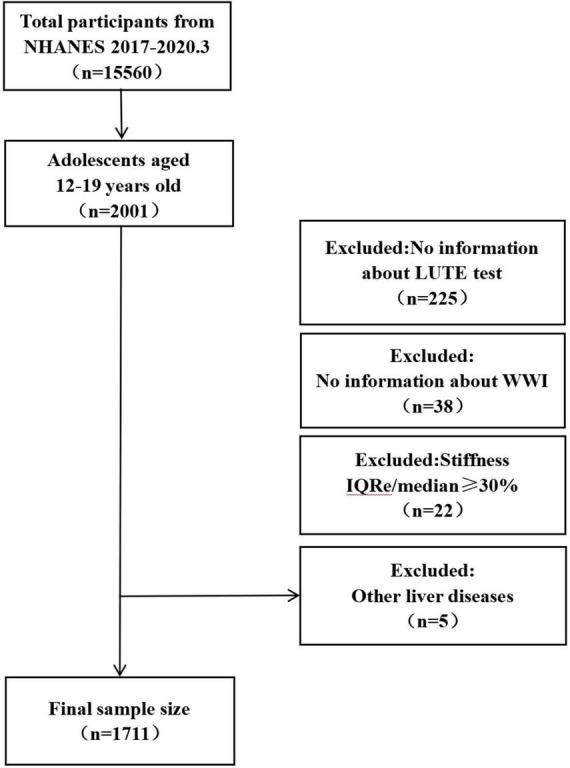
We utilized survey data from the National Health and Nutrition Examination Survey (NHANES) 2017-2020 regarding liver ultrasound transient elastography (LUTE) for the diagnosis of NAFLD (dependent variable), and used multiple logistic regression models to explore the association between weight-adjusted waist circumference index (WWI) and the prevalence of NAFLD in US adolescents. Smoothing curves and threshold effect analyses were used to assess the non-linear association between the independent variables and the dependent variable. Subgroup analysis was conducted to pinpoint particularly susceptible subgroups within our study cohort of 1,711 participants.
RESULTS
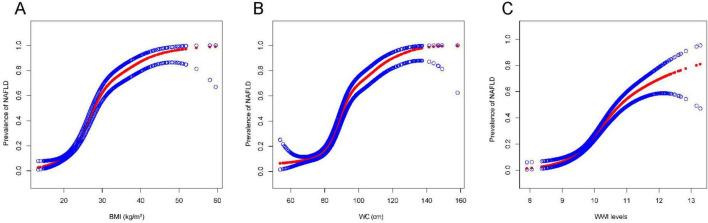
Our findings indicated a positive correlation between WWI and NAFLD scores. Adjusting for all covariates revealed a significant association between increased WWI and the presence of NAFLD, with an odds ratio of 3.37 (95% CI: 2.74, 4.15). This association proved stronger than those observed with waist circumference, body mass index, and NAFLD. Stratifying WWI into quartiles showed a clear and strong positive correlation ( for trend < 0.0001). The results of smoothing curves and threshold effect analysis showed a non-linear relationship between WWI and NAFLD (LLR < 0.001). Notably, for WWI values below 10.65, a significant correlation was observed (OR = 5.25, 95% CI: 3.77,7.31). Additionally, our subgroup analysis revealed that WWI and NAFLD were associated more positively among male participants aged 16 years and older.
CONCLUSION
WWI is positively correlated with NAFLD in American adolescents and offers a straightforward and cost-effective method for identifying hepatic steatosis. The findings highlight the importance of focusing on individuals with a WWI below 10.65, where the risk of NAFLD increases. Priority should be given to the male adolescent population aged 16 and above.
背景
非酒精性脂肪性肝病(NAFLD)是儿童中最常见的慢性肝脏疾病,这凸显了在该人群中急需用于早期检测的非侵入性标志物。
方法
我们利用了2017 - 2020年国家健康与营养检查调查(NHANES)中关于肝脏超声瞬时弹性成像(LUTE)的数据来诊断NAFLD(因变量),并使用多元逻辑回归模型来探索体重调整后的腰围指数(WWI)与美国青少年NAFLD患病率之间的关联。使用平滑曲线和阈值效应分析来评估自变量与因变量之间的非线性关联。进行亚组分析以确定我们1711名参与者的研究队列中特别易患的亚组。
结果
我们的研究结果表明WWI与NAFLD评分之间存在正相关。对所有协变量进行调整后发现,WWI升高与NAFLD的存在之间存在显著关联,优势比为3.37(95%置信区间:2.74,4.15)。这种关联比观察到的腰围、体重指数与NAFLD之间的关联更强。将WWI分为四分位数显示出明显且强烈的正相关(趋势P<0.0001)。平滑曲线和阈值效应分析结果显示WWI与NAFLD之间存在非线性关系(似然比检验<0.001)。值得注意的是,对于低于10.65的WWI值,观察到显著相关性(优势比 = 5.25,95%置信区间:3.77,7.31)。此外,我们的亚组分析显示,在16岁及以上的男性参与者中,WWI与NAFLD的关联更为积极。
结论
在美国青少年中,WWI与NAFLD呈正相关,并且为识别肝脂肪变性提供了一种简单且经济有效的方法。研究结果强调了关注WWI低于10.65的个体的重要性,在这些个体中NAFLD风险增加。应优先关注16岁及以上的男性青少年人群。
 Zotero 插件