
复合膳食抗氧化指数与血脂异常人群的心血管疾病、动脉粥样硬化性心血管疾病及心血管疾病死亡率呈负相关且为非线性关系:来自2001 - 2018年美国国家健康与营养检查调查(NHANES)的证据
Composite dietary antioxidant index is inversely and nonlinearly associated with cardiovascular disease, atherosclerotic cardiovascular disease, and cardiovascular mortality in people with dyslipidemia: evidence from NHANES 2001-2018.
作者信息
Jiang Yan, Shen Yingying
机构信息
Department of Cardiovascular Disease Treatment Center, Taihe Hospital, Hubei University of Medicine, Shiyan, China.
Department of Critical Care Medicine, Taihe Hospital, Hubei University of Medicine, Shiyan, China.
出版信息
Front Nutr. 2025 Jan 7;11:1478825. doi: 10.3389/fnut.2024.1478825. eCollection 2024.
BACKGROUND
Dyslipidemia is a major risk factor for cardiovascular disease (CVD) and atherosclerotic CVD (ASCVD). The composite dietary antioxidant index (CDAI), an emerging measure of combined dietary antioxidant exposure, may provide insights into the relationship between diet and CVD/ASCVD outcomes. We aimed to explore the association between CDAI and the prevalence of CVD/ASCVD, as well as CVD mortality in individuals with dyslipidemia.
METHODS
CDAI was assessed by integrating dietary vitamins A, C, E, zinc, selenium, and carotenoids. Dyslipidemia was diagnosed according to widely established criteria. Data on CVD/ASCVD were obtained through self-reports, while CVD mortality was obtained through prospective matching participant records with the National Death Index database. Multivariate logistic regression analysis and Cox proportional hazards regression analysis were used to explore these associations and to calculate odds ratios [OR], hazard ratios [HR], and 95% confidence intervals [CI], respectively.
RESULTS
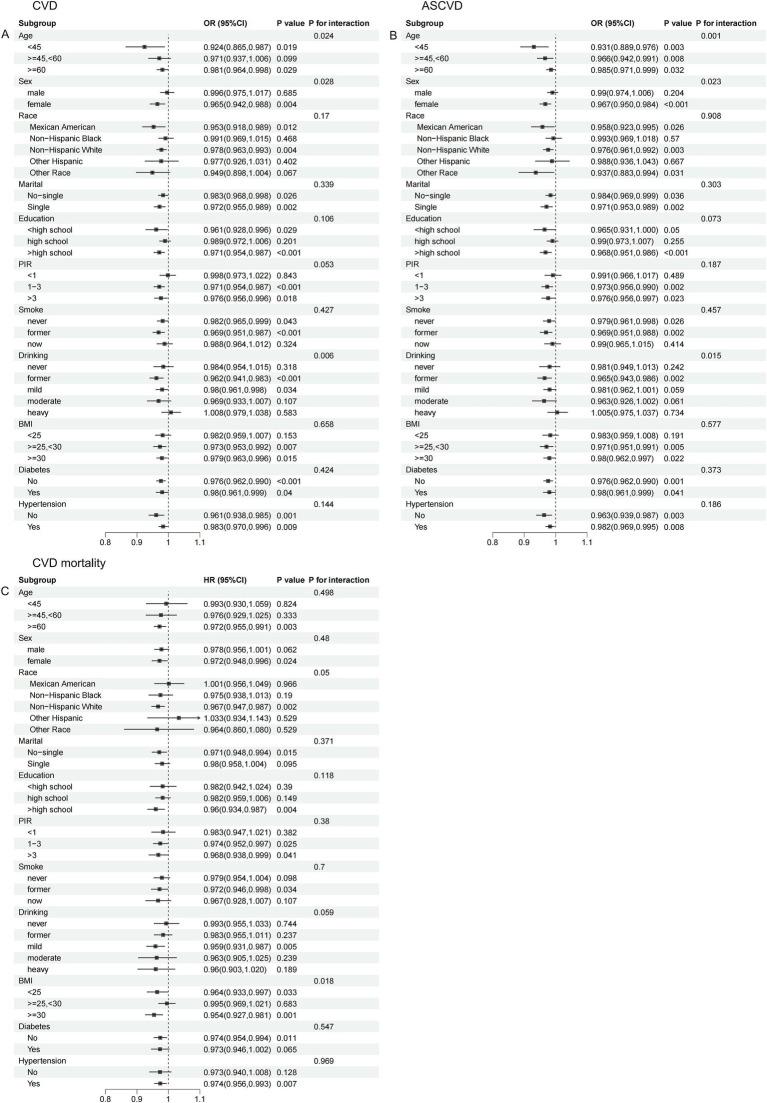
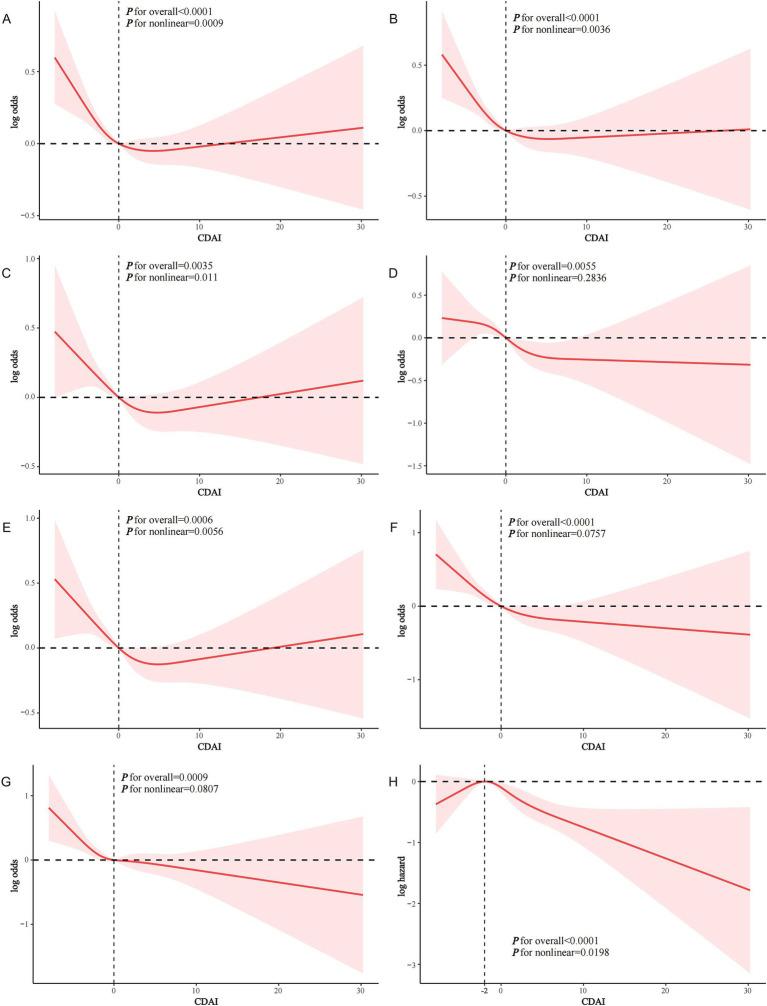
A total of 23,126 participants with dyslipidemia from NHANES 2001-2018 were included. After adjusting for potential confounders, CDAI was inversely associated with the prevalence of both CVD and ASCVD in dyslipidemia populations (OR and 95% CI 0.979 (0.964, 0.995) and 0.977 (0.961, 0.993), respectively). Similar associations were observed between CDAI and specific types of CVD. CDAI was also inversely associated with CVD mortality in dyslipidemia participants (HR = 0.957, 95% CI = 0.939-0.976, < 0.0001). Restricted cubic spline and threshold effects analyses indicated that CDAI was nonlinearly associated with CVD/ASCVD, with significant associations occurring only when CDAI≤0; however, the association of CDAI with CVD mortality was observed only when CDAI > -2. Furthermore, age, sex, and drinking were found to modify the association of CDAI with CVD/ASCVD, while body mass index influenced the relationship between CDAI and CVD mortality.
CONCLUSION
CDAI was inversely and nonlinearly associated with both CVD/ASCVD events and CVD mortality in dyslipidemic populations. These findings highlight the potential of antioxidant dietary patterns to alleviate the CVD burden in these populations and underscore the importance of personalized strategies.
背景
血脂异常是心血管疾病(CVD)和动脉粥样硬化性心血管疾病(ASCVD)的主要危险因素。复合膳食抗氧化指数(CDAI)是一种新兴的衡量膳食抗氧化剂综合摄入量的指标,可能有助于深入了解饮食与CVD/ASCVD结局之间的关系。我们旨在探讨CDAI与血脂异常个体中CVD/ASCVD患病率以及CVD死亡率之间的关联。
方法
通过整合膳食中的维生素A、C、E、锌、硒和类胡萝卜素评估CDAI。根据广泛认可的标准诊断血脂异常。通过自我报告获取CVD/ASCVD数据,而通过将参与者记录与国家死亡指数数据库进行前瞻性匹配获取CVD死亡率数据。分别使用多变量逻辑回归分析和Cox比例风险回归分析来探讨这些关联,并计算比值比[OR]、风险比[HR]和95%置信区间[CI]。
结果
纳入了2001 - 2018年美国国家健康与营养检查调查(NHANES)中23,126名血脂异常参与者。在调整潜在混杂因素后,CDAI与血脂异常人群中CVD和ASCVD的患病率呈负相关(OR和9五%置信区间分别为0.979(0.964,0.995)和0.977(0.96i,0.993))。在CDAI与特定类型的CVD之间也观察到类似的关联。CDAI与血脂异常参与者的CVD死亡率也呈负相关(HR = 0.957,95% CI = 0.939 - 0.976,P < 0.0001)。受限立方样条和阈值效应分析表明,CDAI与CVD/ASCVD呈非线性关联,仅当CDAI≤0时存在显著关联;然而,仅当CDAI > -2时才观察到CDAI与CVD死亡率的关联。此外,发现年龄、性别和饮酒会改变CDAI与CVD/ASCVD的关联,而体重指数会影响CDAI与CVD死亡率之间的关系。
结论
在血脂异常人群中,CDAI与CVD/ASCVD事件及CVD死亡率呈负向非线性关联。这些发现凸显了抗氧化剂饮食模式在减轻这些人群CVD负担方面的潜力,并强调了个性化策略的重要性。


 Zotero 插件