
寄主大小超越了母体效应,对一种次生重寄生蜂的发育产生影响。
Host size overrides maternal effects on the development of a secondary hyperparasitoid wasp.
作者信息
Shi Xianhui, Gols Rieta, de Boer Jetske G, Harvey Jeffrey A
机构信息
Department of Terrestrial Ecology, Netherlands Institute of Ecology, Wageningen, The Netherlands.
Laboratory of Nematology, Wageningen University & Research, Wageningen, The Netherlands.
出版信息
J Insect Sci. 2025 Jan 20;25(1). doi: 10.1093/jisesa/ieaf004.
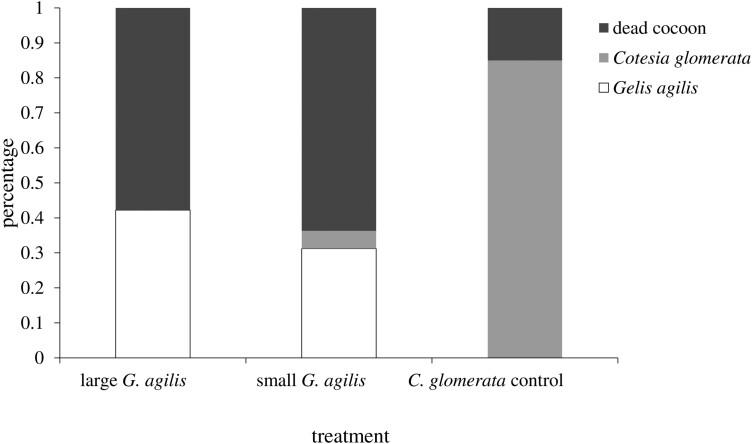
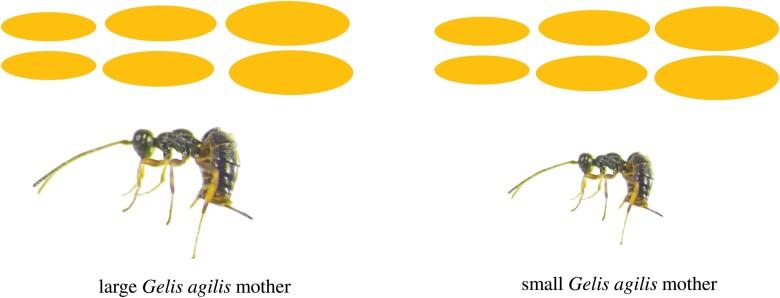
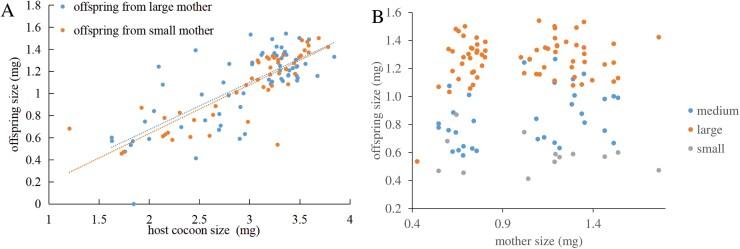
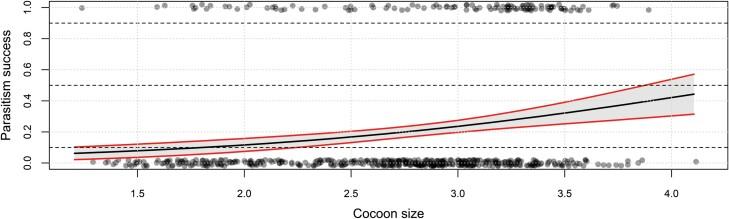
Unraveling the numerous factors that drive phenotypic variation in trait expression among animals has long presented a significant challenge. Whereas traits like growth and adult size are often heritable and are passed on from one generation to the next, these can be significantly affected by the quality and quantity of resources provided by one or both parents to their offspring. In many vertebrates, such as birds and mammals, parents raise their young until adult, providing food, shelter, and protection. On the other hand, in insects, there is often little or no parental care, and the young are left to fend for themselves. Despite that, some insects can enhance the growth of their offspring. In parasitoid wasps, for example, mothers inject biochemical factors, including venoms, teratocytes, and virus-like particles into the host that increase host quality by regulating the nutritional milieu. However, it is not known whether maternal size is positively correlated with host regulation. Here, we evaluate maternal and host size-related effects on the development of an asexually reproducing (= female only) secondary idiobiont ectoparasitoid, Gelis agilis on pre-pupae in cocoons of its host, the primary parasitoid, Cotesia glomerata. Females G. agilis from 2 adult size classes, "small" (mean 0.7 mg) or "large" (mean 1.2 mg), were allowed to parasitize cocoons of differing size along a continuum from ~1.2 mg to ~4.0 mg, and the body size and development time of their offspring were measured. In both body size classes of G. agilis mothers, there was a strong correlation between host size and offspring size. However, there was no effect of adult G. agilis size on this parameter: for a given host size, the size of G. agilis offspring did not differ between small and large mothers. Our results reveal that host quality is mostly pre-determined, irrespective of maternal size.
长期以来,揭示驱动动物性状表达中表型变异的众多因素一直是一项重大挑战。虽然生长和成年体型等性状通常是可遗传的,并代代相传,但这些性状会受到父母一方或双方为其后代提供的资源质量和数量的显著影响。在许多脊椎动物中,如鸟类和哺乳动物,父母会抚养幼崽直至成年,提供食物、住所和保护。另一方面,在昆虫中,通常很少或根本没有亲代抚育,幼崽只能自生自灭。尽管如此,一些昆虫可以促进其后代的生长。例如,在寄生蜂中,母亲会将包括毒液、畸形细胞和病毒样颗粒在内的生化因子注入宿主体内,通过调节营养环境来提高宿主质量。然而,尚不清楚母体大小是否与宿主调节呈正相关。在这里,我们评估了母体和宿主大小对一种无性繁殖(即仅雌性)的次生独栖性外寄生蜂——敏捷吉氏茧蜂在其宿主——首要寄生蜂——聚瘤姬蜂茧中的预蛹发育的影响。将来自两个成年大小类别的敏捷吉氏茧蜂雌性,“小”(平均0.7毫克)或“大”(平均1.2毫克),放入大小从约1.2毫克到约4.0毫克连续变化的茧中进行寄生,并测量其后代的体型和发育时间。在敏捷吉氏茧蜂母亲的两个体型类别中,宿主大小与后代大小之间都存在很强的相关性。然而,成年敏捷吉氏茧蜂的大小对这一参数没有影响:对于给定的宿主大小,小体型和大体型母亲所产敏捷吉氏茧蜂后代的大小没有差异。我们的结果表明,宿主质量大多是预先确定的,与母体大小无关。

 Zotero 插件