
麦角菌中尼麦角林阻断人5-HT3A受体的分子机制
Molecular Mechanisms of Nicergoline from Ergot Fungus in Blocking Human 5-HT3A Receptor.
作者信息
Pyeon Minsu, Moon Myungmi, Yun Jeongyeon, Yang Jaehui, Yeom Hye Duck, Lee Gihyun, Lee Junho H
机构信息
Department of Biotechnology and Department of Integrative Food, Bioscience and Biotechnology (BK21 FOUR), Chonnam National University, Gwangju 61186, Republic of Korea.
GoPath Laboratories, Buffalo Grove, IL 60089, USA.
出版信息
J Microbiol Biotechnol. 2024 Nov 29;35:e2411020. doi: 10.4014/jmb.2411.11020.
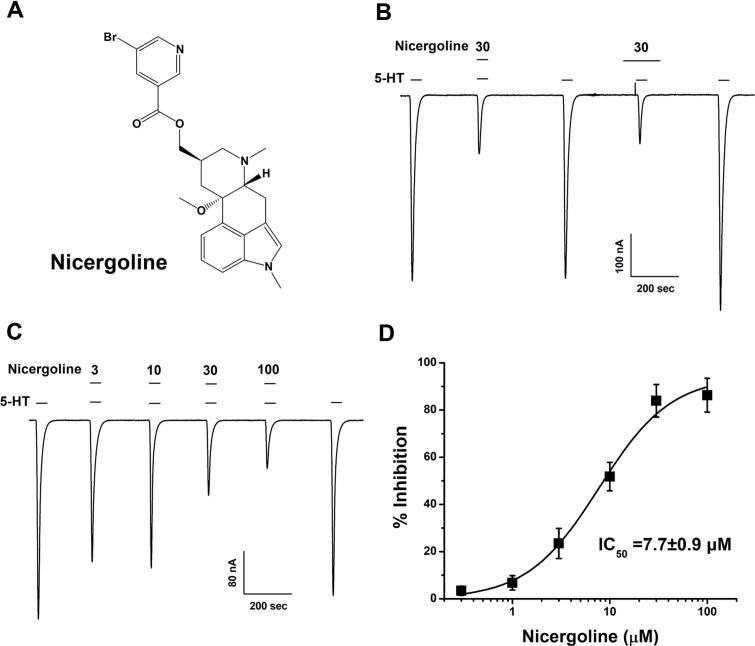
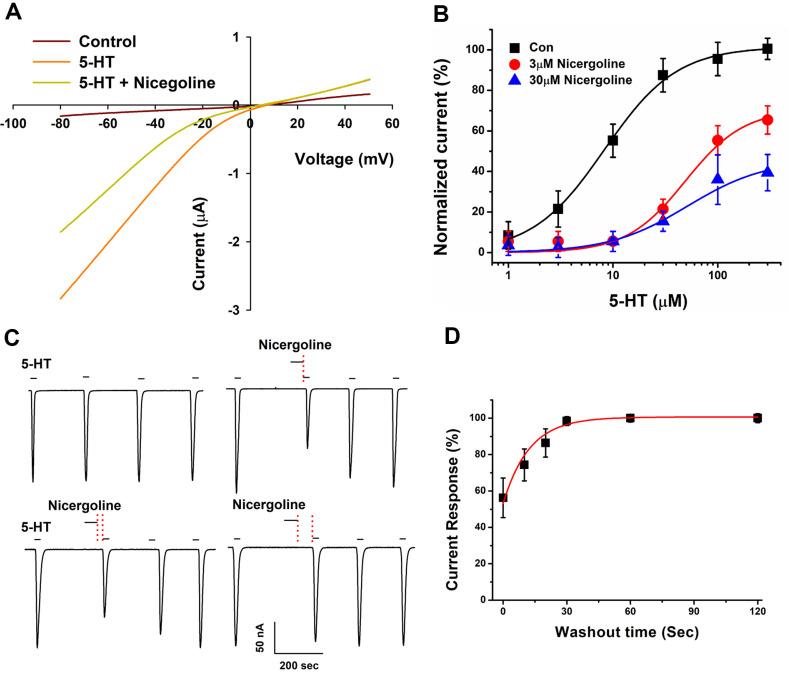
This study investigates the modulatory effects of nicergoline, a major bioactive compound derived from ergot fungus, on the 5-hydroxytryptamine 3A (5-HT3A) receptor. Utilizing a two-electrode voltage-clamp technique, we evaluated the impact of nicergoline on the 5-HT-induced inward current (I) in 5-HT3A receptors. Our findings reveal that nicergoline inhibits I in a reversible and concentration-dependent manner. Additionally, the observed voltage-dependent and use-dependent inhibition indicates that nicergoline acts as an open channel blocker of the 5-HT3A receptor. To further elucidate the interaction between nicergoline and the 5-HT3A receptor, we conducted molecular docking studies. Overactivation of the 5-HT3A receptor can enhance excitatory neurotransmission, potentially leading to heightened anxiety and stress responses. It may also interfere with hippocampal functions, adversely affecting learning and memory. Additionally, exceed activation of these receptors is a primary mechanism underlying nausea and vomiting, commonly observed during chemotherapy or in response to certain toxins. Collectively, our results suggest that nicergoline has the potential to inhibit 5-HT3A receptor activity by interacting with binding residues L260 and V264. This inhibition may enhance cognitive function by stabilizing neural circuits involved in cognitive processes and can improve cognitive symptoms in patients with dementia. Additionally, the anxiolytic effects resulting from 5-HT3A receptor inhibition could promote overall psychological well-being in affected individuals. Thus, the role of nicergoline as a 5-HT3A receptor antagonist not only highlights its therapeutic potential but also warrants further exploration into its mechanisms and broader implications for managing neurodegenerative diseases.
本研究调查了麦角灵(一种从麦角真菌中提取的主要生物活性化合物)对5-羟色胺3A(5-HT3A)受体的调节作用。利用双电极电压钳技术,我们评估了麦角灵对5-HT3A受体中5-HT诱导的内向电流(I)的影响。我们的研究结果表明,麦角灵以可逆且浓度依赖性的方式抑制I。此外,观察到的电压依赖性和使用依赖性抑制表明,麦角灵作为5-HT3A受体的开放通道阻滞剂发挥作用。为了进一步阐明麦角灵与5-HT3A受体之间的相互作用,我们进行了分子对接研究。5-HT3A受体的过度激活可增强兴奋性神经传递,可能导致焦虑和应激反应加剧。它还可能干扰海马体功能,对学习和记忆产生不利影响。此外,这些受体的过度激活是化疗期间或接触某些毒素时常见的恶心和呕吐的主要机制。总的来说,我们的结果表明,麦角灵有可能通过与结合残基L260和V264相互作用来抑制5-HT3A受体活性。这种抑制作用可能通过稳定参与认知过程的神经回路来增强认知功能,并可改善痴呆患者的认知症状。此外,5-HT3A受体抑制产生的抗焦虑作用可促进受影响个体的整体心理健康。因此,麦角灵作为5-HT3A受体拮抗剂的作用不仅突出了其治疗潜力,还值得进一步探索其机制以及对管理神经退行性疾病的更广泛意义。


 Zotero 插件