
2021年世界卫生组织分级、瘤周水肿及放疗对大体切除的颅内脑膜瘤复发的影响:一项十年随访研究
Impact of 2021 World Health Organization Grading, Peritumoral Edema, and Radiotherapy on the Recurrence of a Grossly Resected Intracranial Meningiomas: A Ten-Year Follow-Up Study.
作者信息
Alkhotani Alaa, Baeesa Saleh, Alshanqiti Maryam, Alsinani Taghreed, Najjar Ahmed, Alkhayyat Shadi, Tayyib Awab, Jastaniah Zayed, Sabbagh Abdulrahman J, Butt Nadeem S, Alamoudi Hussain A, Alharbi Mohammed, Bahakeem Basem, Kurdi Maher
机构信息
Department of Pathology, College of Medicine, Umm Al-Qura University, Makkah, Saudi Arabia.
Department of Neurosciences, King Faisal Specialist Hospital and Research Center, Jeddah, Saudi Arabia.
出版信息
World J Oncol. 2025 Feb;16(1):95-103. doi: 10.14740/wjon1999. Epub 2025 Jan 7.
BACKGROUND
The significance of histological grading and peritumoral edema (PTE) in predicting intracranial meningioma recurrence among Saudis is often neglected. This study aimed to evaluate the impact of these factors over a 10-year follow-up period.
METHODS
A retrospective cohort of 124 patients with intracranial meningioma was analyzed over the period from 2011 to 2021. All patients underwent gross total resection (GTR) of the tumor. Post-surgical radiotherapy (RT) was offered to patients with grade II-III meningiomas. The impact of histological grading, PTE, and RT on the recurrence-free interval (RFI) was investigated.
RESULTS
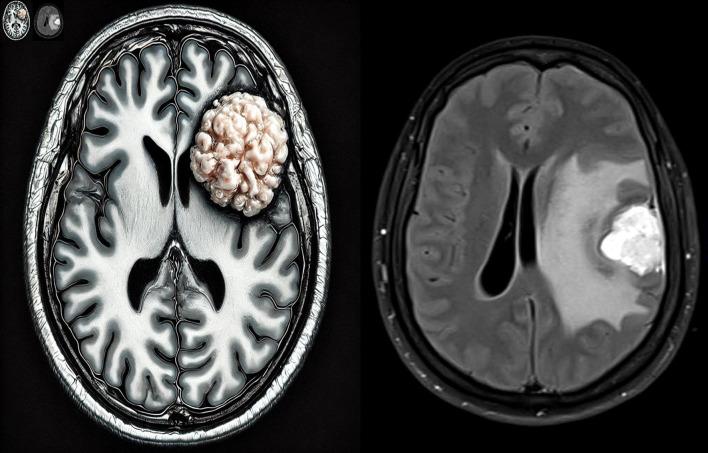
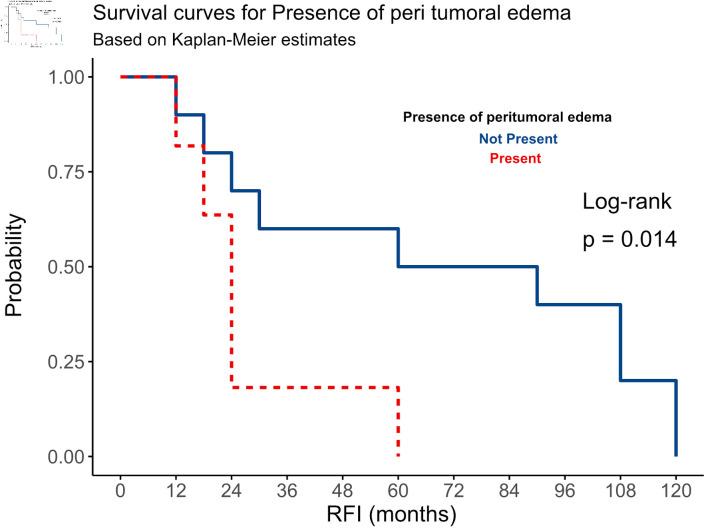
The mean age of the patients was 49 years (range: 18 - 84), with 87 females (70.2%) and 37 males (29.8%). Most tumors (88.7%, n = 110) were supratentorial, while 11.3% (n = 14) were infratentorial. The World Health Organization (WHO) grading classified 101 tumors (81.5%) as grade I, 17 (13.7%) as grade II, and six (4.8%) patients as grade III. Grading was significantly associated with RFI (P = 0.013), with grade I meningiomas having the slowest recurrence. The overall recurrence rate was 16.9%, with 38.1% (n = 8) of grade I and 61.9% (n = 13) of grade II-III meningiomas recurring within 5 years post-GTR and RT. There was no significant difference in RFI between RT-exposed and non-exposed patients (P = 0.15). PTE was present in 76 cases (61.3%) and absent in 48 (38.7%), significantly affecting RFI (P = 0.014), with shorter RFI in PTE cases. Overall, 95.2% (n = 118) of patients survived, while 4.8% (n = 6) died; five had grade II-III, and one had grade I meningioma.
CONCLUSIONS
Totally, resected intracranial meningiomas with grade II-III features and PTE were associated with earlier tumor recurrence and poorer patient survival. Post-surgical RT had an insignificant effect on the RFI.
背景
在沙特人群中,组织学分级和瘤周水肿(PTE)在预测颅内脑膜瘤复发方面的意义常常被忽视。本研究旨在评估这些因素在10年随访期内的影响。
方法
对2011年至2021年期间的124例颅内脑膜瘤患者进行回顾性队列分析。所有患者均接受了肿瘤的全切除(GTR)。对II - III级脑膜瘤患者进行术后放疗(RT)。研究组织学分级、PTE和RT对无复发生存期(RFI)的影响。
结果
患者的平均年龄为49岁(范围:18 - 84岁),其中女性87例(70.2%),男性37例(29.8%)。大多数肿瘤(88.7%,n = 110)位于幕上,而11.3%(n = 14)位于幕下。世界卫生组织(WHO)分级将101例肿瘤(81.5%)分为I级,17例(13.7%)分为II级,6例(4.8%)患者分为III级。分级与RFI显著相关(P = 0.013),I级脑膜瘤复发最慢。总体复发率为16.9%,I级脑膜瘤在GTR和RT后5年内复发率为38.1%(n = 8),II - III级脑膜瘤为61.9%(n = 13)。接受RT和未接受RT的患者在RFI方面无显著差异(P = 0.15)。76例(61.3%)存在PTE,48例(38.7%)不存在PTE,PTE对RFI有显著影响(P = 0.014),存在PTE的患者RFI较短。总体而言,95.2%(n = 118)的患者存活,4.8%(n = 6)的患者死亡;5例为II - III级,1例为I级脑膜瘤。
结论
总体而言,具有II - III级特征和PTE的全切除颅内脑膜瘤与肿瘤早期复发及患者较差的生存率相关。术后放疗对RFI的影响不显著。


 Zotero 插件