
邻苯二甲酸丁苄酯暴露对小鼠脂质代谢和肝纤维化的年龄依赖性影响
Age-Dependent Effects of Butyl Benzyl Phthalate Exposure on Lipid Metabolism and Hepatic Fibrosis in Mice.
作者信息
Park Min-Seo, Hwang Seonhwa, Kang Hyun-Bon, Ha Minjeong, Park Juyeon, Park So-Youn, Park Yong-Joo, Park Min-Hi
机构信息
College of Pharmacy, Kyungsung University, 309 Suyeong-ro, Busan 48434, Republic of Korea.
Brain Busan 21 Plus Research Project Group, Kyungsung University, Busan 48434, Republic of Korea.
出版信息
Cells. 2025 Jan 16;14(2):126. doi: 10.3390/cells14020126.
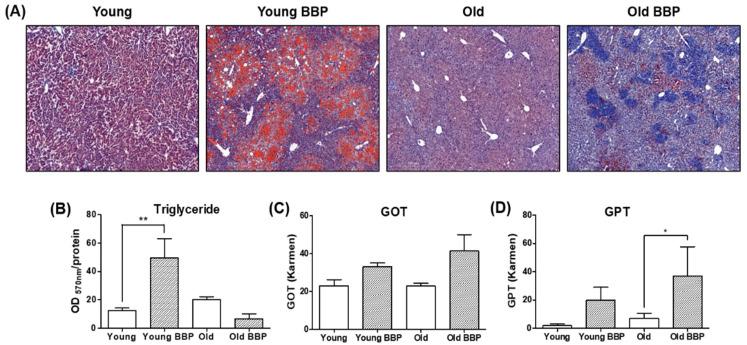
Endocrine-disrupting chemicals (EDCs), including phthalates, have been implicated in the development of non-alcoholic fatty liver disease (NAFLD) and hepatic fibrosis. This study investigates the age-dependent effects of butyl benzyl phthalate (BBP) exposure on lipid metabolism in the livers of young and aged mice. Young (2-month-old) and aged (20-month-old) male C57BL/6 mice were exposed to BBP through drinking water at a dose of 169 μg/kg/day for 6 and 4 months, respectively. Young mice exposed to BBP showed fatty liver, with downregulation of key fatty acid oxidation genes (CPT1A, CPT1B, CPT2, and Acox1) and elevated pro-inflammatory cytokines (TNF-α and IL-6). In contrast, aged mice exhibited hepatic fibrosis, with increased collagen deposition and upregulation of genes related to fibrosis (Acta2, MMP2, TGF-ß1, and Col1a2), cirrhosis (CXCR4, SOX9, DCN, and MFAP4), and cancer (Bcl2, CDKN2a, c-Myc, and Fn1). Overall, these findings emphasize the importance of age when evaluating the risks of EDC exposure, such as BBP. Future research should focus on understanding the molecular mechanisms behind these age-related differences and explore Grem1 and SOCS3 as potential therapeutic targets for treating EDC-induced and age-related liver diseases.
包括邻苯二甲酸盐在内的内分泌干扰化学物质(EDC)与非酒精性脂肪性肝病(NAFLD)和肝纤维化的发生有关。本研究调查了邻苯二甲酸丁苄酯(BBP)暴露对年轻和老年小鼠肝脏脂质代谢的年龄依赖性影响。将年轻(2个月大)和老年(20个月大)雄性C57BL/6小鼠分别通过饮用水以169μg/kg/天的剂量暴露于BBP中,持续6个月和4个月。暴露于BBP的年轻小鼠出现脂肪肝,关键脂肪酸氧化基因(CPT1A、CPT1B、CPT2和Acox1)下调,促炎细胞因子(TNF-α和IL-6)升高。相比之下,老年小鼠表现出肝纤维化,胶原沉积增加,与纤维化(Acta2、MMP2、TGF-β1和Col1a2)、肝硬化(CXCR4、SOX9、DCN和MFAP4)及癌症(Bcl2、CDKN2a、c-Myc和Fn1)相关的基因上调。总体而言,这些发现强调了在评估EDC暴露风险(如BBP)时年龄的重要性。未来的研究应专注于了解这些年龄相关差异背后的分子机制,并探索Grem1和SOCS3作为治疗EDC诱导的和与年龄相关的肝脏疾病的潜在治疗靶点。




 Zotero 插件