
单纯疱疹病毒1型UL12.5蛋白对线粒体核酸感应通路的利用以实现潜伏感染的再激活
Co-option of mitochondrial nucleic acid-sensing pathways by HSV-1 UL12.5 for reactivation from latent infection.
作者信息
Krakowiak Patryk A, Flores Matthew E, Cuddy Sean R, Whitford Abigail L, Dochnal Sara A, Babnis Aleksandra, Miyake Tsuyoshi, Tigano Marco, Engel Daniel A, Cliffe Anna R
机构信息
Department of Microbiology, Immunology and Cancer Biology, University of Virginia, Charlottesville, VA 22908.
Neuroscience Graduate Program, University of Virginia, Charlottesville, VA 22908.
出版信息
Proc Natl Acad Sci U S A. 2025 Jan 28;122(4):e2413965122. doi: 10.1073/pnas.2413965122. Epub 2025 Jan 24.
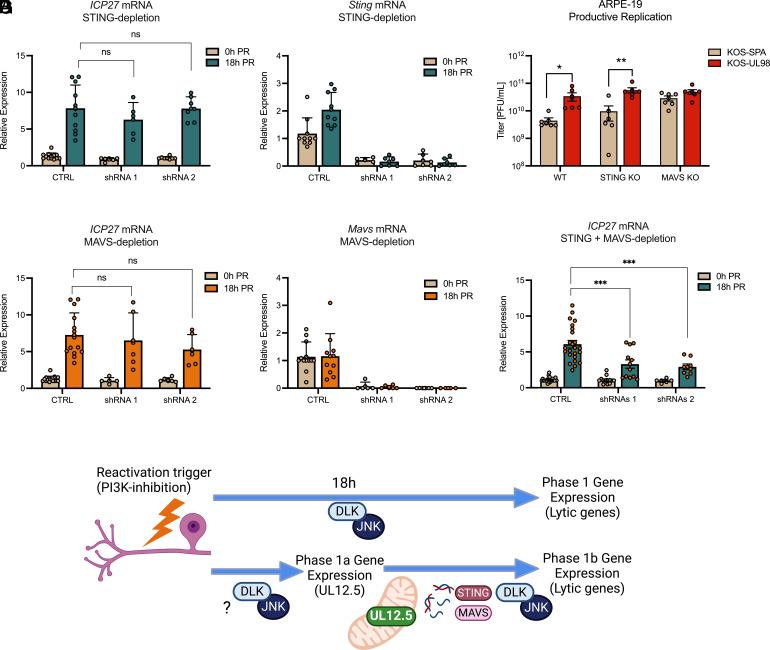
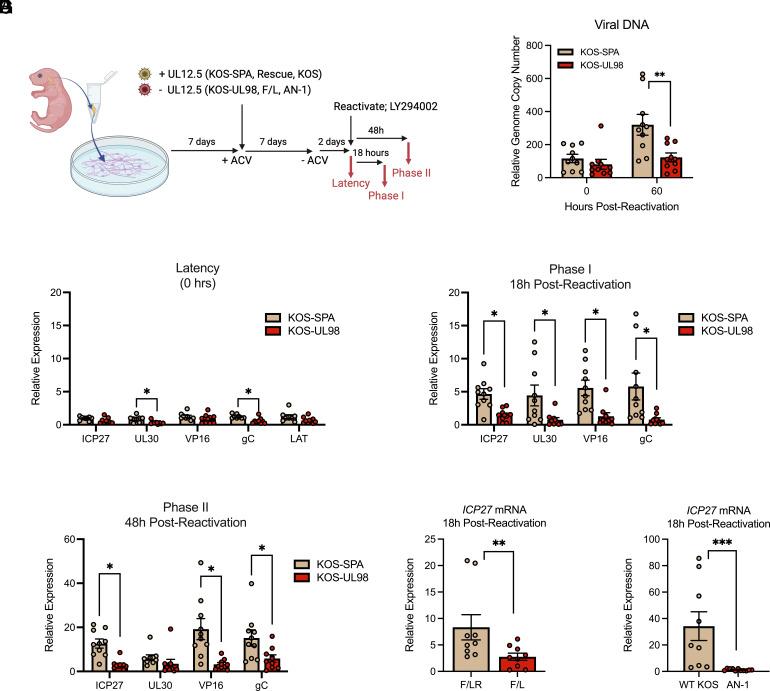
Although viruses subvert innate immune pathways for their replication, there is evidence they can also co-opt antiviral responses for their benefit. The ubiquitous human pathogen, Herpes simplex virus-1 (HSV-1), encodes a protein (UL12.5) that induces the release of mitochondrial nucleic acid into the cytosol, which activates immune-sensing pathways and reduces productive replication in nonneuronal cells. HSV-1 establishes latency in neurons and can reactivate to cause disease. We found that UL12.5 is required for HSV-1 reactivation in neurons and acts to directly promote viral lytic gene expression during initial exit from latency. Further, the direct activation of innate immune-sensing pathways triggered HSV-1 reactivation and compensated for a lack of UL12.5. Finally, we found that the induction of HSV-1 lytic genes during reactivation required intact RNA- and DNA-sensing pathways, demonstrating that HSV-1 can respond to and active antiviral nucleic acid-sensing pathways to reactivate from a latent infection.
尽管病毒会为了自身复制而破坏先天免疫途径,但有证据表明它们也会利用抗病毒反应来为自己谋利。普遍存在的人类病原体单纯疱疹病毒1型(HSV-1)编码一种蛋白质(UL12.5),该蛋白质可诱导线粒体核酸释放到细胞质中,从而激活免疫感应途径并减少非神经元细胞中的有效复制。HSV-1在神经元中建立潜伏状态,并可重新激活引发疾病。我们发现,UL12.5是HSV-1在神经元中重新激活所必需的,并且在从潜伏状态最初退出期间直接促进病毒裂解基因的表达。此外,先天免疫感应途径的直接激活触发了HSV-1的重新激活,并弥补了UL12.5的缺失。最后,我们发现重新激活期间HSV-1裂解基因的诱导需要完整的RNA和DNA感应途径,这表明HSV-1可以响应并激活抗病毒核酸感应途径,从而从潜伏感染中重新激活。



 Zotero 插件