
通过基质辅助激光解吸电离飞行时间质谱(MALDI-TOF MS)和基于树的机器学习模型快速检测阳性血培养物中的耐碳青霉烯类大肠杆菌和耐碳青霉烯类肺炎克雷伯菌
Rapid detection of carbapenem-resistant Escherichia coli and carbapenem-resistant Klebsiella pneumoniae in positive blood cultures via MALDI-TOF MS and tree-based machine learning models.
作者信息
Xu Xiaobo, Wang Zhaofeng, Lu Erjie, Lin Tao, Du Hengchao, Li Zhongfei, Ma Jiahong
机构信息
Department of Clinical Laboratory, Zhejiang Rong Jun Hospital, Jiaxing, 314000, China.
出版信息
BMC Microbiol. 2025 Jan 24;25(1):44. doi: 10.1186/s12866-025-03755-5.
BACKGROUND
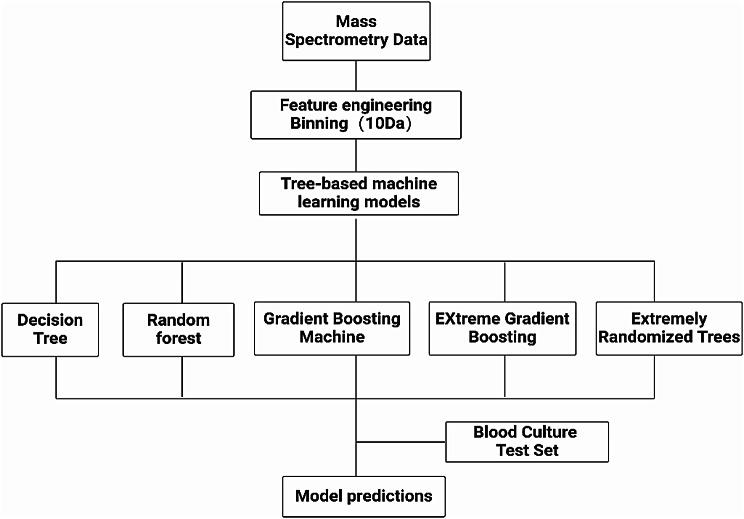
Bloodstream infection (BSI) is a systemic infection that predisposes individuals to sepsis and multiple organ dysfunction syndrome. Early identification of infectious agents and determination of drug-resistant phenotypes can help patients with BSI receive timely, effective, and targeted treatment and improve their survival. This study was based on matrix-assisted laser desorption/ionization time-of-flight mass spectrometry (MALDI-TOF MS), Decision Tree (DT), Random Forest (RF), Gradient Boosting Machine (GBM), eXtreme Gradient Boosting (XGBoost), and Extremely Randomized Trees (ERT) models were constructed to classify carbapenem-resistant Escherichia coli (CREC) and carbapenem-resistant Klebsiella pneumoniae (CRKP). Bacterial species were identified by MALDI-TOF MS in positive blood cultures isolated via the serum isolation gel method, and E. coli and K. pneumoniae in positive blood cultures were collected and placed into machine learning models to predict susceptibility to carbapenems. The aim of this study was to provide rapid detection of CREC and CRKP in blood cultures, to shorten the turnaround time for laboratory reporting, and to provide a basis for early clinical intervention and rational use of antibiotics.
RESULTS
The collected MALDI-TOF MS data of 640 E. coli and 444 K. pneumoniae were analysed by machine learning algorithms. The area under the receiver operating characteristic curve (AUROC) for the diagnosis of E. coli susceptibility to carbapenems by the DT, RF, GBM, XGBoost, and ERT models were 0.95, 1.00, 0.99, 0.99, and 1.00, respectively, and the accuracy in predicting 149 E. coli-positive blood cultures were 0.89, 0.92, 0.90, 0.92, and 0.86, respectively. The AUROC for the diagnosis of K. pneumoniae susceptibility to carbapenems by the DT, RF, GBM, XGBoost, and ERT models were 0.78, 0.95, 0.93, 0.90, and 0.95, respectively, and the accuracy in predicting 127 K. pneumoniae-positive blood cultures were 0.76, 0.86, 0.81, 0.80, and 0.76, respectively.
CONCLUSIONS
Machine learning models constructed by MALDI-TOF MS were able to directly predict the susceptibility of E. coli and K. pneumoniae in positive blood cultures to carbapenems. This rapid identification of CREC and CRKP reduces detection time and contributes to early warning and response to potential antibiotic resistance problems in the clinic.
CLINICAL TRIAL NUMBER
Not applicable.
背景
血流感染(BSI)是一种全身性感染,使个体易患败血症和多器官功能障碍综合征。早期识别感染病原体并确定耐药表型有助于血流感染患者获得及时、有效和有针对性的治疗,提高其生存率。本研究基于基质辅助激光解吸/电离飞行时间质谱(MALDI-TOF MS),构建了决策树(DT)、随机森林(RF)、梯度提升机(GBM)、极端梯度提升(XGBoost)和极度随机树(ERT)模型,用于对耐碳青霉烯类大肠杆菌(CREC)和耐碳青霉烯类肺炎克雷伯菌(CRKP)进行分类。通过血清分离凝胶法分离的阳性血培养物中的细菌种类由MALDI-TOF MS鉴定,收集阳性血培养物中的大肠杆菌和肺炎克雷伯菌并放入机器学习模型中,以预测对碳青霉烯类的敏感性。本研究的目的是在血培养物中快速检测CREC和CRKP,缩短实验室报告周转时间,并为早期临床干预和合理使用抗生素提供依据。
结果
采用机器学习算法分析收集到的640株大肠杆菌和444株肺炎克雷伯菌的MALDI-TOF MS数据。DT、RF、GBM、XGBoost和ERT模型诊断大肠杆菌对碳青霉烯类敏感性的受试者工作特征曲线下面积(AUROC)分别为0.95、1.00、0.99、0.99和1.00,预测149份大肠杆菌阳性血培养物的准确率分别为0.89、0.92、0.90、0.92和0.86。DT、RF、GBM、XGBoost和ERT模型诊断肺炎克雷伯菌对碳青霉烯类敏感性的AUROC分别为0.78、0.95、0.93、0.90和0.95,预测127份肺炎克雷伯菌阳性血培养物的准确率分别为0.76、0.86、0.81、0.80和0.76。
结论
由MALDI-TOF MS构建的机器学习模型能够直接预测阳性血培养物中大肠杆菌和肺炎克雷伯菌对碳青霉烯类的敏感性。这种对CREC和CRKP的快速鉴定减少了检测时间,有助于临床对潜在抗生素耐药性问题的预警和应对。
临床试验编号
不适用。


 Zotero 插件