
广泛期小细胞肺癌伴最多10处转移的放疗(R)联合(I)策略(RISE)——一项随机II期试验的研究方案
Radiotherapy(R) Integration(I) Strategy for Small(S)-Cell Lung Cancer in Extensive(E) Stage (RISE) with up to 10 metastases- a study protocol of a randomized phase II trial.
作者信息
Kuncman Łukasz, Fijuth Jacek, Tworek Damian, Sierko Ewa, Cisek Paweł, Masłowski Michał, Lisik-Habib Maja, Orzechowska Magdalena, Galwas-Kliber Katarzyna, Antczak Adam, Chmielewska Izabela, Ziółkowska Barbara, Kurczewska-Michalak Marta, Kuźnicki Wojciech, Jędrzejczak Nina, Ranoszek Kinga, Bilski Mateusz
机构信息
Department of Radiotherapy, Medical University of Łódź, Łódź, Poland.
Department of External Beam Radiotherapy, Copernicus Memorial Hospital in Lodz Comprehensive Cancer Center and Traumatology, Łódź, Poland.
出版信息
BMC Cancer. 2025 Jan 24;25(1):142. doi: 10.1186/s12885-025-13552-y.
BACKGROUND
The current standard of care (SoC) for patients with extensive-disease small-cell lung cancer (ED-SCLC) is chemo-immunotherapy. The efficacy of radiotherapy (RT) for chest consolidation has been established for patients with ED-SCLC who have responded to chemotherapy. There is a lack of data on incorporating RT as chest consolidation and metastasis-directed therapy for ED-SCLC. The RISE (Radiotherapy for Extensive-Stage Small-Cell Lung Cancer) study aims to evaluate the effectiveness of different RT strategies for residual lesions for patients with ED-SCLC who receive chemo-immunotherapy.
METHODS
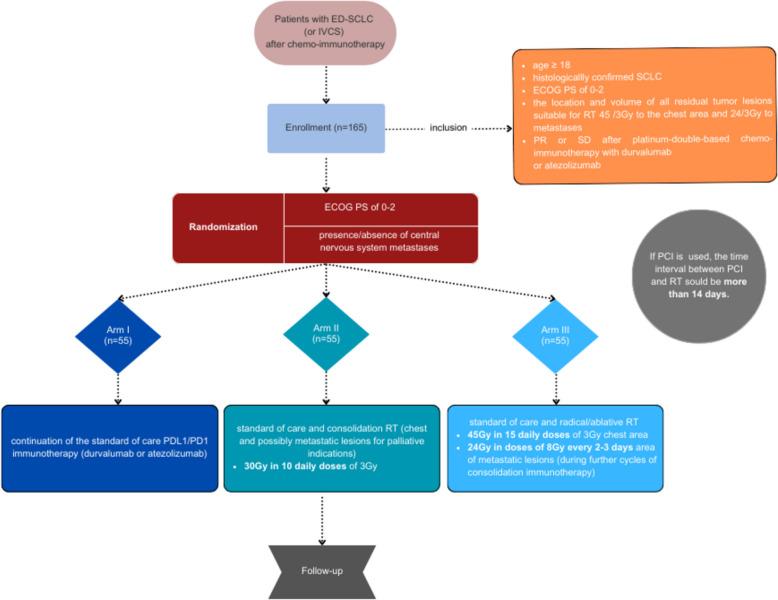
A total of 165 patients with ED-SCLC will be recruited, with 55 patients assigned to each of the three study arms. Patients with stabilization or partial regression, according to the Response Evaluation Criteria in Solid Tumors (RECIST) version 1.1, during chemo-immunotherapy will be included. • Arm I will serve as the control group, comprising patients who continue SoC of programmed death-ligand 1 (PD-L1)/programmed death-1 (PD-1) immunotherapy (durvalumab or atezolizumab) following platinum-based chemo-immunotherapy. • Arm II will receive the SoC with consolidative RT to the chest area and potentially, according to palliative indications to metastatic lesions, delivered in 30 Gy in 3-Gy fractions. • Arm III will receive SoC with RT of 45 Gy in 3-Gy fractions to the chest area and stereotactic body radiotherapy (SBRT) with 24 Gy in 8-Gy fractions to the metastatic lesions. Blood samples for circulating tumor DNA (ctDNA) will be collected before RT, during each week of treatment, and at the time of disease progression. The primary endpoint is progression-free survival (PFS) based on RECIST 1.1 or patient death. 1. Secondary endpoints are OS, treatment toxicity (frequency of G3 toxicity according to CTCAE v.5.0), area of progression (primary tumor localization/new lesions), Overall response rate (ORR), and the response rate in non-irradiated lesions.
DISCUSSION
The study population of patients with ED-SCLC has a poor prognosis. Dose-escalated chest RT and SBRT (for up to 10 metastases) administered with modern techniques offer the possibility to improve OS and PFS.
TRIAL REGISTRATION
Clinicaltrials.gov NCT06529081 (Registered 26th Jul 2024).
背景
广泛期小细胞肺癌(ED-SCLC)患者当前的标准治疗方案(SoC)是化疗免疫疗法。对于化疗有反应的ED-SCLC患者,胸部巩固放疗(RT)的疗效已得到证实。关于将RT作为ED-SCLC的胸部巩固和转移导向治疗的数据尚缺乏。RISE(广泛期小细胞肺癌放疗)研究旨在评估不同RT策略对接受化疗免疫疗法的ED-SCLC患者残留病灶的有效性。
方法
共招募165例ED-SCLC患者,三个研究组各分配55例患者。纳入化疗免疫治疗期间根据实体瘤疗效评价标准(RECIST)1.1版病情稳定或部分缓解的患者。• 第一组作为对照组,包括在铂类化疗免疫治疗后继续接受程序性死亡配体1(PD-L1)/程序性死亡1(PD-1)免疫治疗(度伐利尤单抗或阿替利珠单抗)标准治疗方案的患者。• 第二组接受胸部区域巩固放疗的标准治疗方案,并可能根据姑息治疗指征对转移病灶进行放疗,分30次给予,每次3 Gy。• 第三组接受胸部区域45 Gy分3 Gy每次的放疗标准治疗方案以及对转移病灶给予24 Gy分8 Gy每次的立体定向体部放疗(SBRT)。在放疗前、治疗的每周以及疾病进展时采集循环肿瘤DNA(ctDNA)的血样。主要终点是基于RECIST 1.1的无进展生存期(PFS)或患者死亡。1. 次要终点是总生存期(OS)、治疗毒性(根据CTCAE v.5.0的3级毒性频率)、进展区域(原发肿瘤定位/新病灶)、总缓解率(ORR)以及未照射病灶的缓解率。
讨论
ED-SCLC患者的研究人群预后较差。采用现代技术进行剂量递增的胸部放疗和SBRT(最多10个转移灶)有可能改善总生存期和无进展生存期。
试验注册
Clinicaltrials.gov NCT06529081(2024年7月26日注册)
 Zotero 插件