
探讨降钙素原、C反应蛋白、白细胞计数及中性粒细胞与淋巴细胞比值在儿童血流感染早期诊断中的临床价值。
Exploring the clinical value of procalcitonin, c-reactive protein, white blood cell count, and neutrophil-to-lymphocyte ratio in the early diagnosis of bloodstream infections in children.
作者信息
Li Yadong, Li Mingjie, Lin Chenye, Tang Wentao, Tang Qiuyu, Cheng Feng
机构信息
Department of Clinical Laboratory, Fujian Children's Hospital (Fujian Branch of Shanghai Children's Medical Center), College of Clinical Medicine for Obstetrics and Gynecology and Pediatrics, Fujian Medical University, Fuzhou, 350000, China.
Department of Laboratory Medicine, Fujian Medical University Union Hospital, Fujian Medical University, Fuzhou, 350001, China.
出版信息
BMC Pediatr. 2025 Jan 24;25(1):62. doi: 10.1186/s12887-025-05402-4.
BACKGROUD
In the diagnosis of bloodstream infections (BSI) in children, compared to the gold standard of blood culture, markers in the blood offer advantages such as rapid results and cost-effectiveness. Therefore, we investigated the clinical value of procalcitonin (PCT), C-reactive protein (CRP), white blood cell count (WBC), and neutrophil-to-lymphocyte ratio (NLR) in the early diagnosis of BSI in children.
METHODS
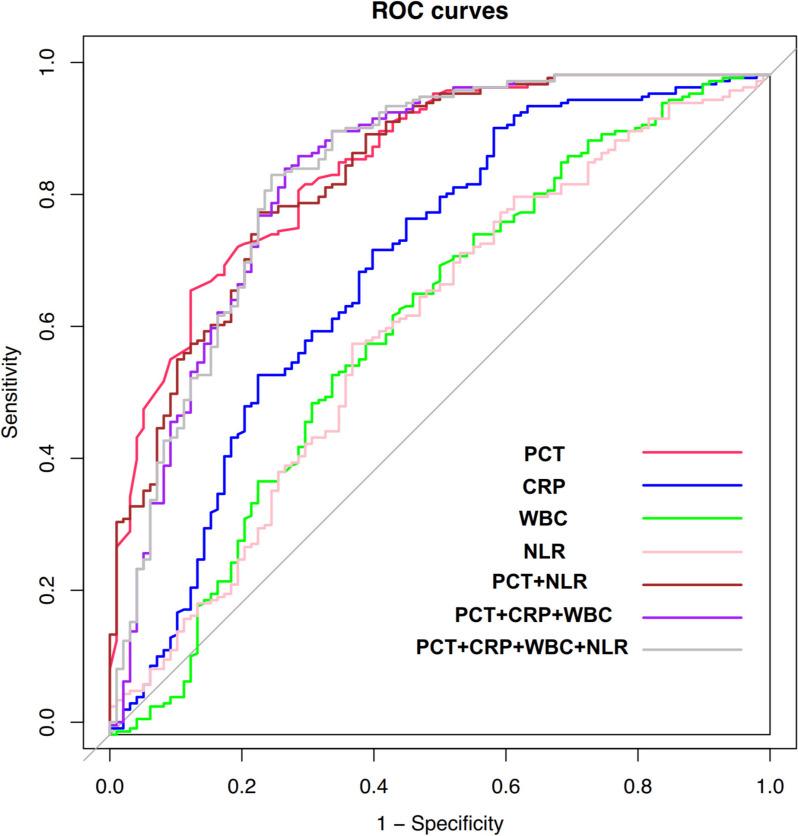
This study included a retrospective analysis of 309 suspected BSI cases and patients were categorized into 2 groups based on blood culture results: blood culture-positive group, and blood culture-negative group. The blood culture-positive group was further partitioned into 3 sub-groups based on the type of pathogen: Gram-positive (G +) bacteria, Gram-negative (G-) bacteria, and fungi. Changes in PCT, CRP, WBC, and NLR were evaluated, and pathogen infections among these aforementioned groups were further determined. Moreover, the study employed the receiver operating characteristic (ROC) curve to evaluate the diagnostic value of these indicators in identifying BSI in pediatric patients at an early stage.
RESULTS
Among the 98 strains of pathogens detected in blood culture, 58 (58.2%) strains were G- bacteria, 33 (33.7%) strains were G + bacteria, and 7 (7.1%) strains were fungi. The levels of PCT, CRP, WBC, and NLR were found to be significantly higher in the blood culture-positive group than the blood culture-negative group (p < 0.01). Upon comparing the levels of PCT and CRP in the three pathogen infections, it was found that the fungi group exhibited higher levels than the G- and G + bacteria groups (p < 0.01). The G- bacteria group exhibited higher levels of PCT, CRP, and WBC than the blood culture-negative group (p < 0.05). Similarly, the G + bacteria group exhibited higher levels of PCT, WBC, and NLR than the blood culture-negative group (p < 0.01). Besides, PCT presented the highest diagnostic efficiency among the single-item detections, with an AUC of 0.862 (95% CI: 0.819-0.906). The simultaneous detection of multiple parameters does not necessarily improve diagnostic performance but can enhance detection sensitivity.
CONCLUSIONS
PCT and CRP can provide important complementary information for the etiological diagnosis of BSI in children. Elevated levels of PCT and CRP were often associated with fungal or G- bacterial infections, with PCT showing particularly significant effects. Combined use of serum PCT, CRP, WBC, and NLR testing can improve the diagnostic sensitivity of pediatric BSI, reducing the risk of missed diagnoses, thereby enhancing the early diagnostic value of pediatric BSI.
背景
在儿童血流感染(BSI)的诊断中,与血培养的金标准相比,血液中的标志物具有结果快速和成本效益高等优点。因此,我们研究了降钙素原(PCT)、C反应蛋白(CRP)、白细胞计数(WBC)和中性粒细胞与淋巴细胞比值(NLR)在儿童BSI早期诊断中的临床价值。
方法
本研究对309例疑似BSI病例进行回顾性分析,根据血培养结果将患者分为两组:血培养阳性组和血培养阴性组。血培养阳性组根据病原体类型进一步分为3个亚组:革兰氏阳性(G+)菌、革兰氏阴性(G-)菌和真菌。评估PCT、CRP、WBC和NLR的变化,并进一步确定上述各组中的病原体感染情况。此外,本研究采用受试者工作特征(ROC)曲线评估这些指标在早期识别儿科患者BSI中的诊断价值。
结果
在血培养检测出的98株病原体中,58株(58.2%)为G-菌,33株(33.7%)为G+菌,7株(7.1%)为真菌。发现血培养阳性组的PCT、CRP、WBC和NLR水平显著高于血培养阴性组(p<0.01)。比较三种病原体感染中的PCT和CRP水平时,发现真菌组的水平高于G-菌和G+菌组(p<0.01)。G-菌组的PCT、CRP和WBC水平高于血培养阴性组(p<0.05)。同样,G+菌组的PCT、WBC和NLR水平高于血培养阴性组(p<0.01)。此外,在单项检测中,PCT的诊断效率最高,曲线下面积(AUC)为0.862(95%可信区间:0.8-19-0.906)。同时检测多个参数不一定能提高诊断性能,但可以提高检测灵敏度。
结论
PCT和CRP可为儿童BSI的病因诊断提供重要的补充信息。PCT和CRP水平升高通常与真菌或G-菌感染有关,PCT表现出尤为显著的作用。联合检测血清PCT、CRP、WBC和NLR可提高儿科BSI的诊断灵敏度,降低漏诊风险,从而提高儿科BSI的早期诊断价值。
 Zotero 插件