
接受细胞因子抑制剂治疗的银屑病患者中乙肝病毒再激活的发生率:一项单中心研究及荟萃分析的系统评价
Incidence of HBV Reactivation in Psoriasis Patients Undergoing Cytokine Inhibitor Therapy: A Single-Center Study and Systematic Review with a Meta-Analysis.
作者信息
Kuo Meng Hsuan, Ko Ping-Hung, Wang Sz-Tsan, Tseng Chih-Wei
机构信息
Department of Pharmacy, Dalin Tzu Chi Hospital, Buddhist Tzu Chi Medical Foundation, Chia-Yi 622, Taiwan.
School of Medicine, Tzuchi University, Hualien 970, Taiwan.
出版信息
Viruses. 2024 Dec 30;17(1):42. doi: 10.3390/v17010042.
BACKGROUND
Psoriasis patients who are seropositive for hepatitis B surface antigen (HBsAg) or hepatitis B core antibody (HBcAb) face an elevated risk of hepatitis B virus reactivation (HBVr) when treated with cytokine inhibitors. This study aims to elucidate the risk in this population.
METHODS
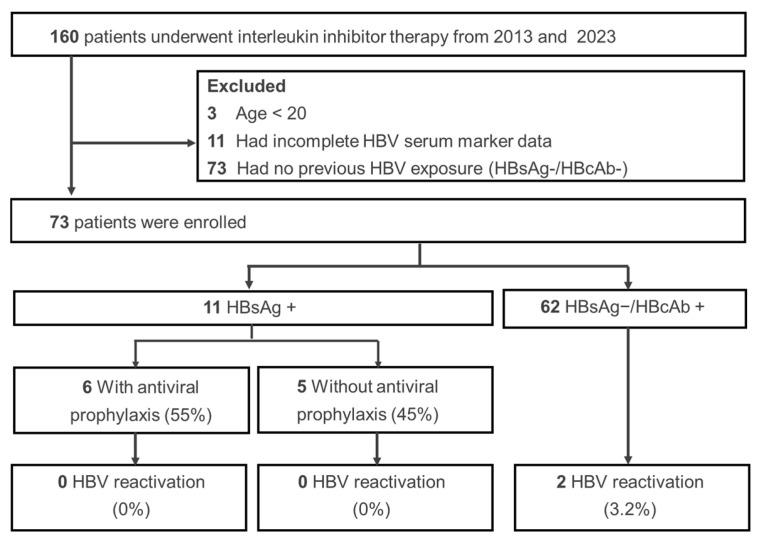
A retrospective chart review was conducted to assess the risk of HBVr in 73 psoriasis patients treated with cytokine inhibitors from 2013 to 2023. Additionally, a systematic review and meta-analysis were performed, pooling data from 10 studies (including our cohort) and adhering to PRISMA guidelines. Statistical heterogeneity was assessed using the statistic, and pooled proportions were calculated using a random effects model.
RESULTS
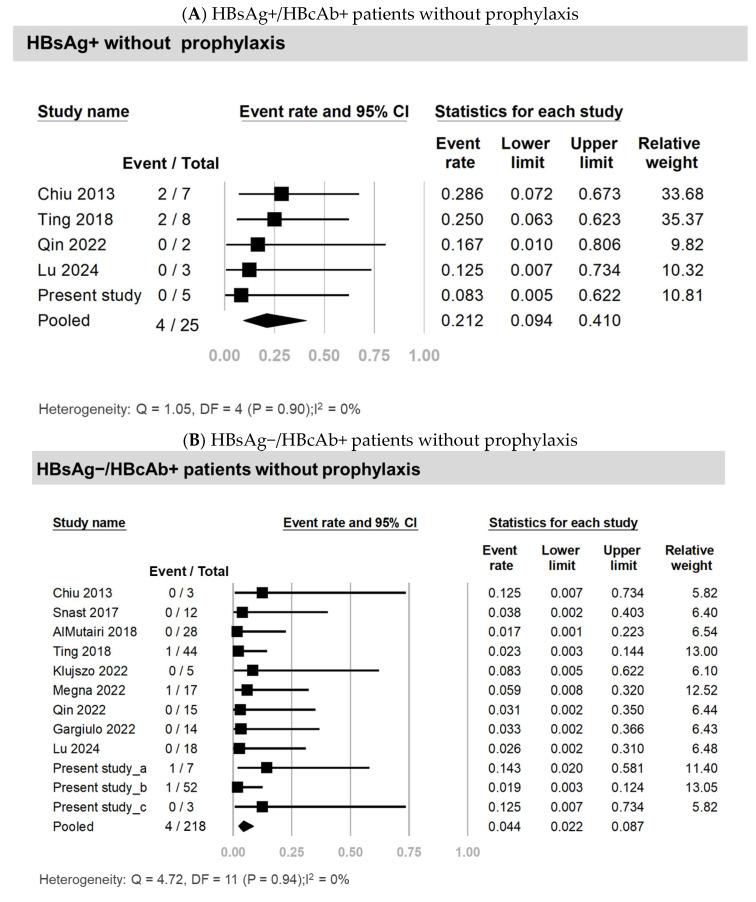
No HBVr cases were observed among the 11 HBsAg+ patients in the cohort. However, two of the sixty-two (3.2%) HBsAg-/HBcAb+ patients experienced reactivation during therapy, with outcomes ranging from spontaneous recovery in one case to death from hepatic failure despite antiviral treatment in the other. The meta-analysis, pooling data from 10 studies, revealed a reactivation rate of 21.2% (95% CI: 9.4-41.0%) in HBsAg+ patients without prophylaxis and 4.4% (95% CI: 2.2-8.7%) in HBsAg-/HBcAb+ patients.
CONCLUSION
Antiviral prophylaxis is essential for HBsAg+ patients receiving cytokine inhibitors, given the high risk of reactivation. Despite the lower risk for HBsAg-/HBcAb+ patients, the potential severity of outcomes demands careful monitoring and timely action.
背景
乙型肝炎表面抗原(HBsAg)或乙型肝炎核心抗体(HBcAb)血清学阳性的银屑病患者在接受细胞因子抑制剂治疗时面临乙型肝炎病毒再激活(HBVr)风险升高的问题。本研究旨在阐明该人群中的风险。
方法
进行了一项回顾性病历审查,以评估2013年至2023年期间接受细胞因子抑制剂治疗的73例银屑病患者的HBVr风险。此外,还进行了一项系统评价和荟萃分析,汇总了10项研究(包括我们的队列)的数据,并遵循PRISMA指南。使用统计量评估统计异质性,并使用随机效应模型计算合并比例。
结果
队列中的11例HBsAg+患者中未观察到HBVr病例。然而,62例HBsAg-/HBcAb+患者中有2例(3.2%)在治疗期间出现再激活,结果从1例自发恢复到另1例尽管接受了抗病毒治疗仍死于肝衰竭。荟萃分析汇总了10项研究的数据,显示未进行预防的HBsAg+患者的再激活率为21.2%(95%CI:9.4 - 41.0%),HBsAg-/HBcAb+患者的再激活率为4.4%(95%CI:2.2 - 8.7%)。
结论
鉴于再激活风险高,抗病毒预防对于接受细胞因子抑制剂治疗的HBsAg+患者至关重要。尽管HBsAg-/HBcAb+患者的风险较低,但结果的潜在严重性需要仔细监测并及时采取行动。
 Zotero 插件