
使用固定有肽的微珠通过紫外可见测量法开发混合溶液中铅离子检测系统。
Development of detection system for lead ions in mixture solutions using UV-Vis measurements with peptide immobilized microbeads.
作者信息
Yoshida Shuhei, Yoshida Koki, Hamada Yoshio, Tsuruoka Takaaki, Usui Kenji
机构信息
Faculty of Frontiers of Innovative Research in Science and Technology (FIRST), Konan University, Chuo-ku, Kobe, 650-0047, Hyogo, Japan.
出版信息
Sci Rep. 2025 Jan 25;15(1):3249. doi: 10.1038/s41598-025-86082-z.
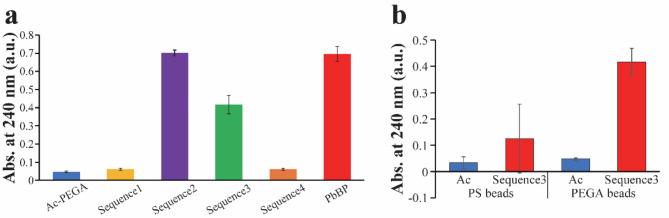
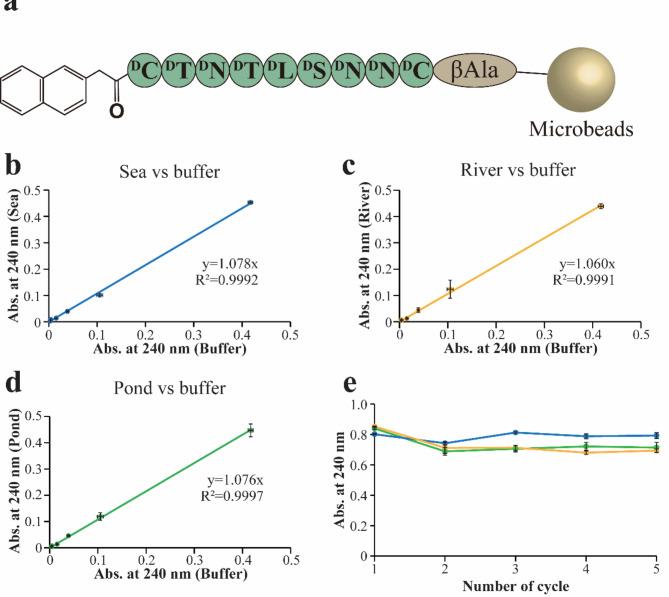
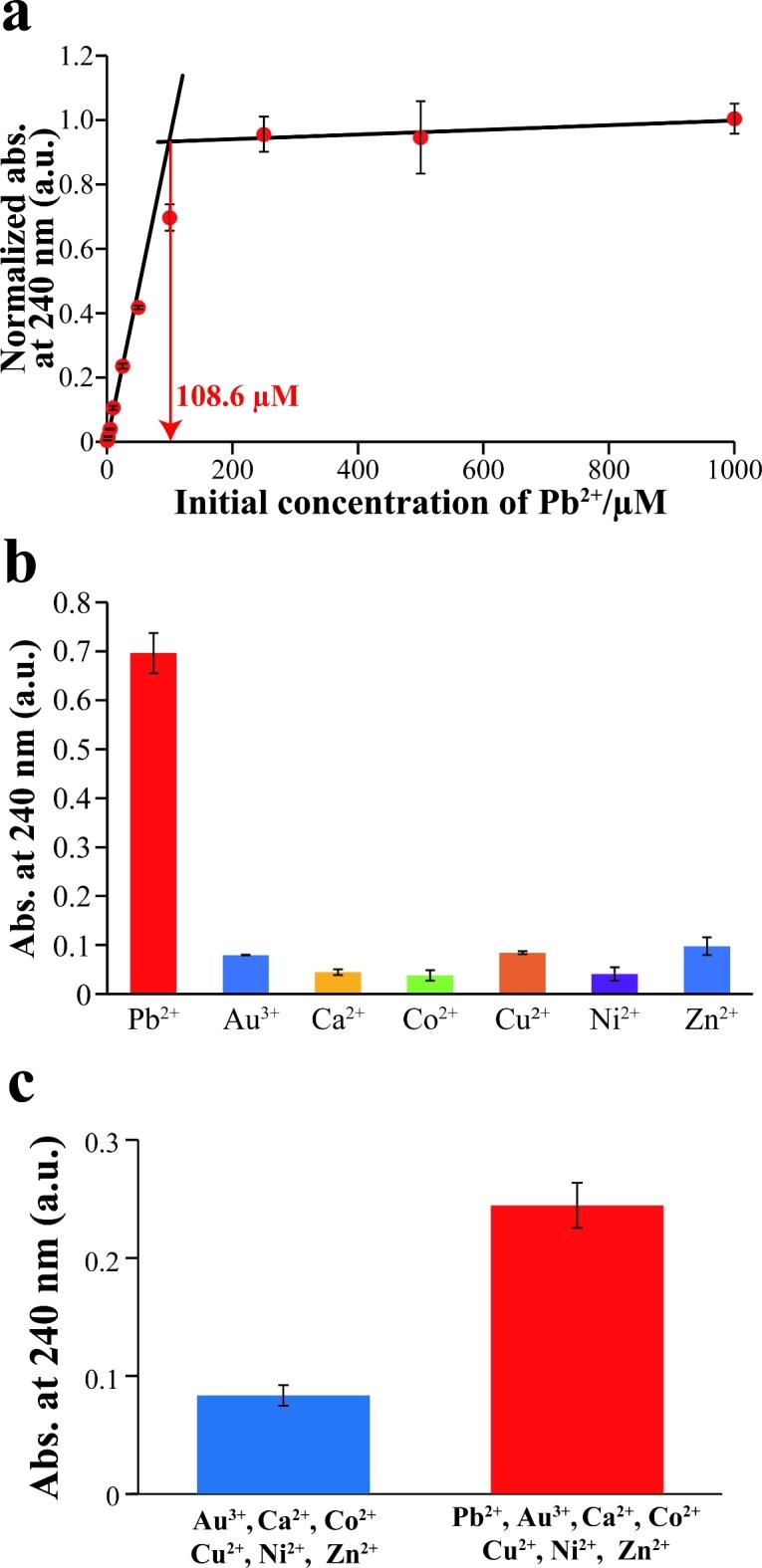
Environmental pollution caused by heavy metals are problems worldwide. In particular, pollution and poisoning by lead ions (Pb) continue to be common and serious problems. Hence, there is a need for a widely usable method to easily detect Pb from solutions containing organic materials from environmental water such as seas, ponds, etc. Here, we established a system to easily detect Pb from such mixture solutions using Pb binding peptide immobilized beads (peptidyl beads) and ultraviolet (UV) absorption measurements. This method could detect Pb at low concentrations equivalent to inductively coupled plasmon-atomic emission spectroscopy (ICP-AES). Using the detected values to create a calibration curve, it was found that there was a positive correlation between the concentration of Pb and absorbance, which also made it possible to quantify sub-µM Pb in the solutions. Furthermore, Pb was detected and quantified under mixed conditions of environmental water such as seas, rivers, and ponds. This method is expected to become a versatile and easy-to-use Pb detection method for end-users worldwide.
重金属造成的环境污染是全球性问题。特别是,铅离子(Pb)污染和中毒仍然是常见且严重的问题。因此,需要一种广泛可用的方法,以便从含有来自海洋、池塘等环境水体中有机物质的溶液中轻松检测出铅。在此,我们建立了一种系统,利用固定有铅结合肽的珠子(肽基珠子)和紫外(UV)吸收测量,从这类混合溶液中轻松检测铅。该方法能够检测出与电感耦合等离子体原子发射光谱法(ICP-AES)相当的低浓度铅。利用检测值绘制校准曲线,发现铅浓度与吸光度之间存在正相关,这也使得对溶液中亚微摩尔级的铅进行定量成为可能。此外,在海洋、河流和池塘等环境水体的混合条件下也能检测和定量铅。预计该方法将成为全球终端用户通用且易于使用的铅检测方法。

 Zotero 插件