
在明胶-羧甲基纤维素水凝胶中生成的可收获肿瘤球体,用于癌症靶向及荧光金纳米团簇成像。
Harvestable tumour spheroids initiated in a gelatin-carboxymethyl cellulose hydrogel for cancer targeting and imaging with fluorescent gold nanoclusters.
作者信息
Dashtarzheneh Ashkan Kamali, Afrashtehpour Amir, Ramesh Bala Subramaniyam, Loizidou Marilena
机构信息
Department of Surgical Biotechnology, Division of Surgery and Interventional Science, University College London, Royal Free Campus, Rowland Hill Street, London, UK.
出版信息
In Vitro Model. 2022 Oct 21;1(6):437-446. doi: 10.1007/s44164-022-00033-w. eCollection 2022 Dec.
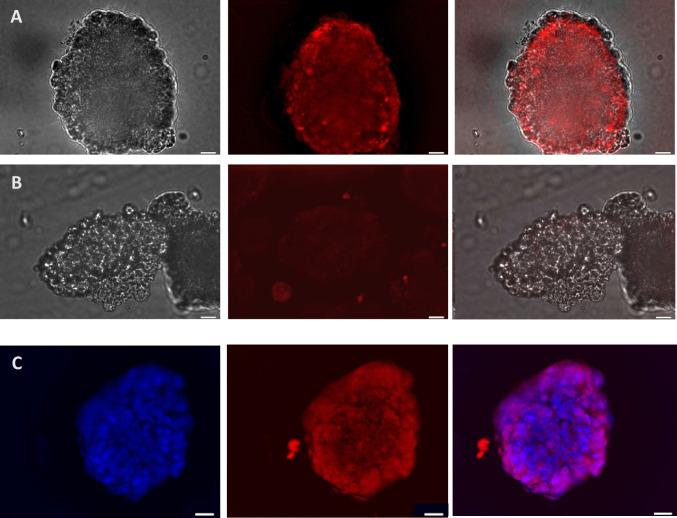
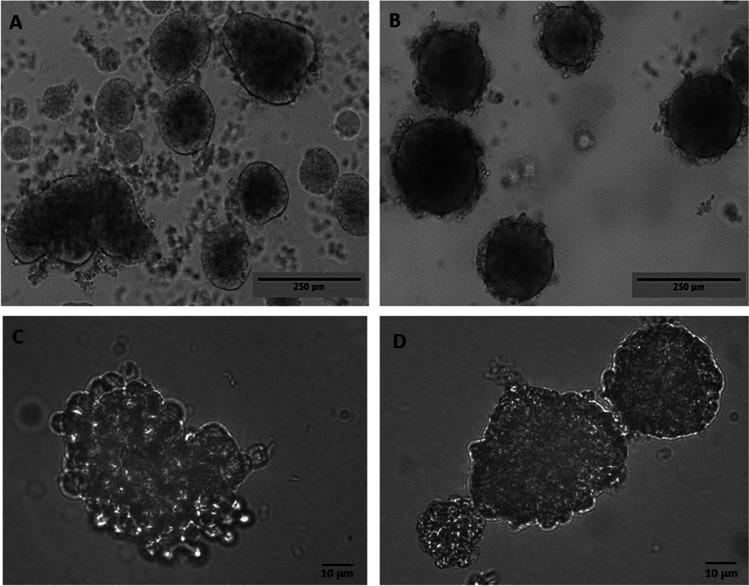
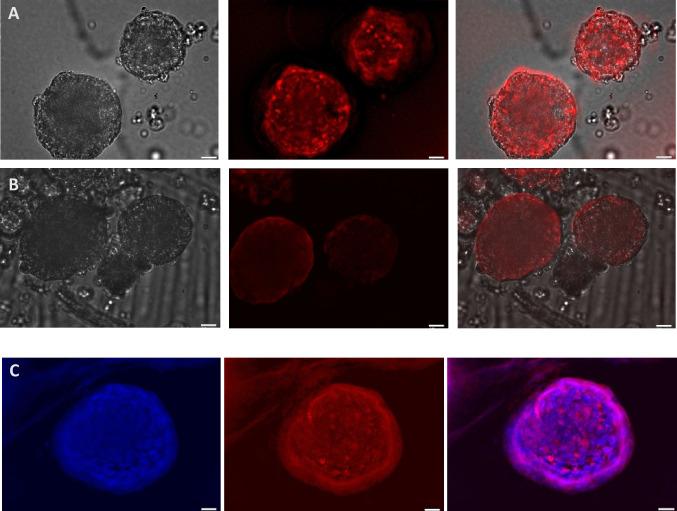
Cancer cell spheroids are the simplest 3D in vitro cancer models and have been extensively used for cancer research. More recently, models have been becoming complex, with the introduction of a matrix and non-cancer cell types to mimic specific tumour aspects. However, applying drugs or agents in matrix-embedded cancer spheroids can be problematic. Most matrices can impede and also bind drugs or visualizing agents non-specifically, in the vicinity of the embedded spheroids. This may interfere with imaging or further analysis without breaking apart the 3D model into its constituents. Here, we developed a combined gelatin-carboxymethyl cellulose (G-CMC) hydrogel for initiating cancer spheroids that enabled intact harvesting pre/post treatment for further investigation, such as targeting and imaging. We combined CMC (1.25%) and gelatin (2.5%) at 25 °C and initiated polymerisation after autoclaving (121 °C) to obtain a mechanical strength (sheer stress) of 38 Pas versus 1.28 Pas for CMC alone. These matrix conditions facilitated separation of the spheroids from the G-CMC, using low centrifugation (100 g). We described growth of colorectal and breast cancer spheroids within the G-CMC matrix (with average diameters of 220 mm and 180 μm for representative cell lines HT29 and MCF7 at 10 days, respectively). As the cancer cells express the surface biomarker calreticulin (CRT), we manufactured anti-calreticulin IgG (anti-CRT) conjugated to fluorescent gold nanoclusters (anti-CRT-AuNC) as a probe. We harvested cancer spheroids and incubated live with the nanoclusters. Imaging demonstrated strong binding of CRT-targeted AuNCs compared to control AuNCs. This novel model preserves cancer spheroid integrity upon isolation and is well suited for targeted imaging and drug delivery of cancer in 3D.
癌细胞球体是最简单的三维体外癌症模型,已被广泛用于癌症研究。最近,随着引入基质和非癌细胞类型以模拟特定肿瘤特征,模型变得越来越复杂。然而,在基质包埋的癌细胞球体中应用药物或试剂可能会出现问题。大多数基质会在包埋的球体附近非特异性地阻碍和结合药物或可视化试剂。这可能会干扰成像或进一步分析,而无需将三维模型分解成其组成部分。在这里,我们开发了一种用于启动癌细胞球体的明胶 - 羧甲基纤维素(G-CMC)复合水凝胶,它能够在处理前后完整收获球体以进行进一步研究,例如靶向和成像。我们在25℃下将CMC(1.25%)和明胶(2.5%)混合,并在高压灭菌(121℃)后引发聚合反应,以获得38 Pas的机械强度(剪切应力),而单独的CMC为1.28 Pas。这些基质条件有助于使用低离心力(100 g)将球体与G-CMC分离。我们描述了在G-CMC基质中结肠直肠癌和乳腺癌球体的生长情况(代表性细胞系HT29和MCF7在10天时的平均直径分别为220μm和180μm)。由于癌细胞表达表面生物标志物钙网蛋白(CRT),我们制备了与荧光金纳米簇偶联的抗钙网蛋白IgG(抗CRT)作为探针。我们收获癌细胞球体并与纳米簇进行活细胞孵育。成像显示与对照金纳米簇相比,CRT靶向的金纳米簇有强烈结合。这种新型模型在分离时保留了癌细胞球体的完整性,非常适合三维癌症的靶向成像和药物递送。



 Zotero 插件