
近期及终生使用大麻对脑功能的影响
Brain Function Outcomes of Recent and Lifetime Cannabis Use.
作者信息
Gowin Joshua L, Ellingson Jarrod M, Karoly Hollis C, Manza Peter, Ross J Megan, Sloan Matthew E, Tanabe Jody L, Volkow Nora D
机构信息
Department of Radiology, University of Colorado Anschutz Medical Campus, Aurora.
Department of Psychiatry, University of Colorado Anschutz Medical Campus, Aurora.
出版信息
JAMA Netw Open. 2025 Jan 2;8(1):e2457069. doi: 10.1001/jamanetworkopen.2024.57069.
IMPORTANCE
Cannabis use has increased globally, but its effects on brain function are not fully known, highlighting the need to better determine recent and long-term brain activation outcomes of cannabis use.
OBJECTIVE
To examine the association of lifetime history of heavy cannabis use and recent cannabis use with brain activation across a range of brain functions in a large sample of young adults in the US.
DESIGN, SETTING, AND PARTICIPANTS: This cross-sectional study used data (2017 release) from the Human Connectome Project (collected between August 2012 and 2015). Young adults (aged 22-36 years) with magnetic resonance imaging (MRI), urine toxicology, and cannabis use data were included in the analysis. Data were analyzed from January 31 to July 30, 2024.
EXPOSURES
History of heavy cannabis use was assessed using the Semi-Structured Assessment for the Genetics of Alcoholism, with variables for lifetime history and diagnosis of cannabis dependence. Individuals were grouped as heavy lifetime cannabis users if they had greater than 1000 uses, as moderate users if they had 10 to 999 uses, and as nonusers if they had fewer than 10 uses. Participants provided urine samples on the day of scanning to assess recent use. Diagnosis of cannabis dependence (per Diagnostic and Statistical Manual of Mental Disorders, Fourth Edition criteria) was also included.
MAIN OUTCOMES AND MEASURES
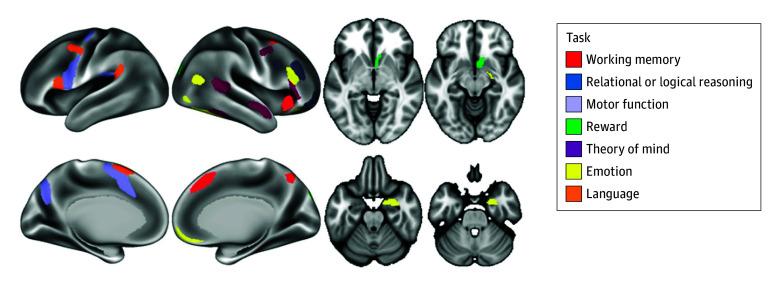
Brain activation was assessed during each of the 7 tasks administered during the functional MRI session (working memory, reward, emotion, language, motor, relational assessment, and theory of mind). Mean activation from regions associated with the primary contrast for each task was used. The primary analysis was a linear mixed-effects regression model (one model per task) examining the association of lifetime cannabis and recent cannabis use on the mean brain activation value.
RESULTS
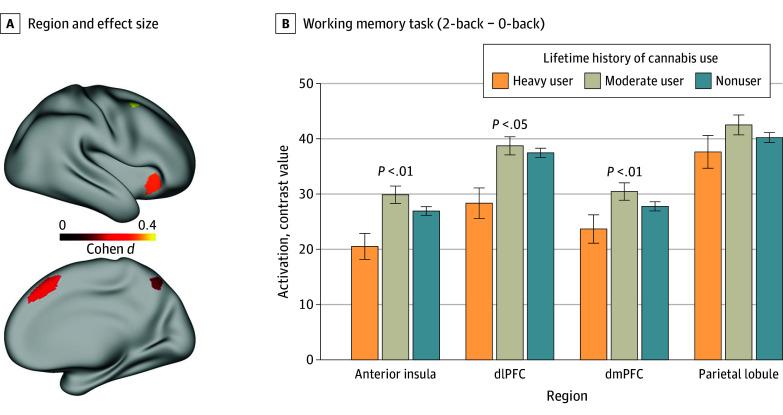
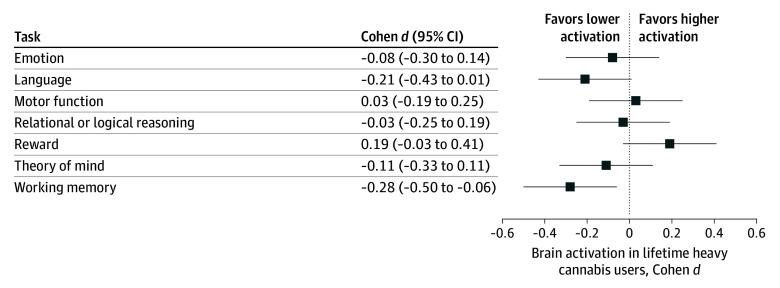
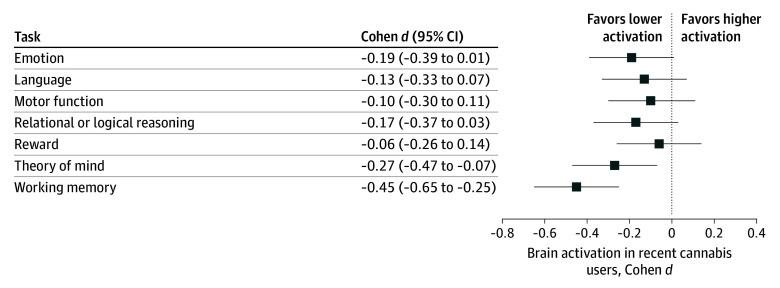
The sample comprised 1003 adults (mean [SD] age, 28.7 [3.7] years; 470 men [46.9%] and 533 women [53.1%]). A total of 63 participants were Asian (6.3%), 137 were Black (13.7%), and 762 were White (76.0%). For lifetime history criteria, 88 participants (8.8%) were classified as heavy cannabis users, 179 (17.8%) as moderate users, and 736 (73.4%) as nonusers. Heavy lifetime use (Cohen d = -0.28 [95% CI, -0.50 to -0.06]; false discovery rate corrected P = .02) was associated with lower activation on the working memory task. Regions associated with a history of heavy use included the anterior insula, medial prefrontal cortex, and dorsolateral prefrontal cortex. Recent cannabis use was associated with poorer performance and lower brain activation in the working memory and motor tasks, but the associations between recent use and brain activation did not survive false discovery rate correction. No other tasks were associated with lifetime history of heavy use, recent use, or dependence diagnosis.
CONCLUSIONS AND RELEVANCE
In this study of young adults, lifetime history of heavy cannabis use was associated with lower brain activation during a working memory task. These findings identify negative outcomes associated with heavy lifetime cannabis use and working memory in healthy young adults that may be long lasting.
重要性
大麻的使用在全球范围内有所增加,但其对脑功能的影响尚不完全清楚,这凸显了更好地确定大麻使用的近期和长期脑激活结果的必要性。
目的
在美国的大量年轻成年人样本中,研究重度大麻使用的终生史和近期大麻使用与一系列脑功能的脑激活之间的关联。
设计、背景和参与者:这项横断面研究使用了人类连接组计划(2017年发布)的数据(2012年8月至2015年收集)。纳入分析的是有磁共振成像(MRI)、尿液毒理学和大麻使用数据的年轻成年人(22 - 36岁)。数据于2024年1月31日至7月30日进行分析。
暴露因素
使用酒精中毒遗传学半结构化评估来评估重度大麻使用史,包括终生史变量和大麻依赖诊断。如果个体使用大麻超过1000次,则归类为重度终生大麻使用者;使用10至999次为中度使用者;使用少于10次为非使用者。参与者在扫描当天提供尿液样本以评估近期使用情况。还纳入了根据《精神障碍诊断与统计手册》第四版标准的大麻依赖诊断。
主要结局和测量指标
在功能磁共振成像(fMRI)会话期间进行的7项任务(工作记忆、奖励、情绪、语言、运动、关系评估和心理理论)中的每一项任务期间评估脑激活。使用与每个任务的主要对比相关区域的平均激活。主要分析是一个线性混合效应回归模型(每个任务一个模型),研究终生大麻使用和近期大麻使用与平均脑激活值之间的关联。
结果
样本包括1003名成年人(平均[标准差]年龄,28.7[3.7]岁;470名男性[46.9%]和533名女性[53.1%])。共有63名参与者为亚洲人(6.3%),137名黑人(13.7%),762名白人(76.0%)。根据终生史标准,88名参与者(8.8%)被归类为重度大麻使用者,179名(17.8%)为中度使用者,736名(73.4%)为非使用者。重度终生使用(Cohen d = -0.28[95%置信区间,-0.50至-0.06];错误发现率校正P = 0.02)与工作记忆任务中的较低激活相关。与重度使用史相关的区域包括前岛叶、内侧前额叶皮质和背外侧前额叶皮质。近期大麻使用与工作记忆和运动任务中的较差表现及较低脑激活相关,但近期使用与脑激活之间的关联在错误发现率校正后未留存。没有其他任务与重度使用的终生史、近期使用或依赖诊断相关。
结论和意义
在这项针对年轻成年人的研究中,重度大麻使用的终生史与工作记忆任务期间较低的脑激活相关。这些发现确定了健康年轻成年人中重度终生大麻使用与工作记忆相关的负面结果,这些结果可能是持久的。
 Zotero 插件